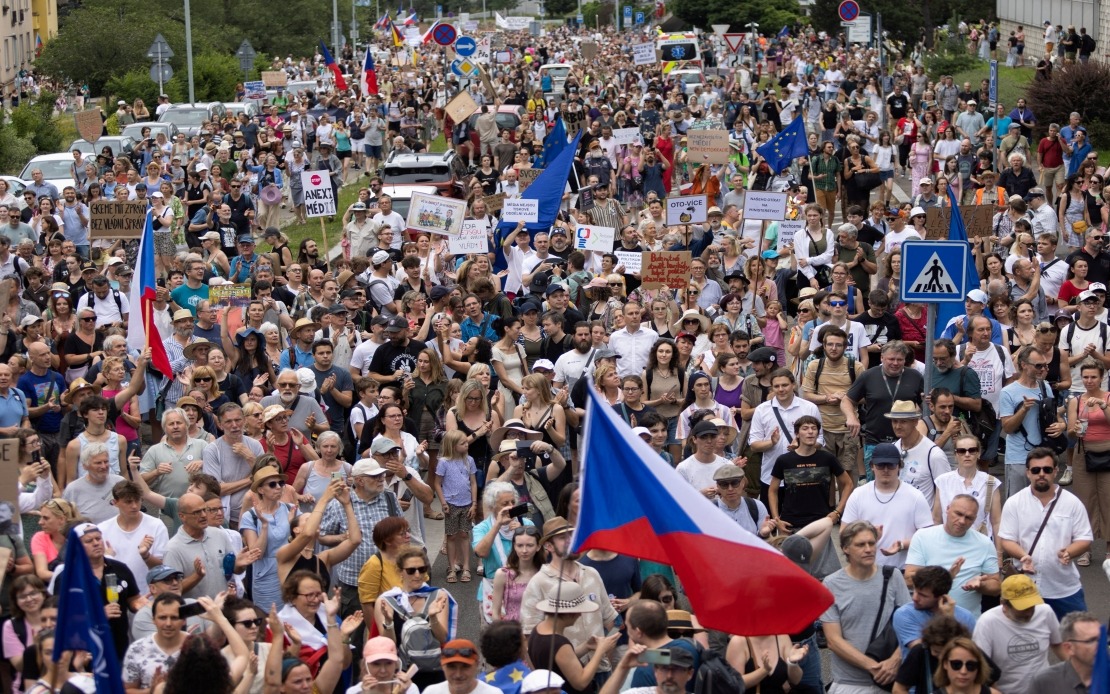
The Czech Republic witnessed a significant show of public concern on Sunday when thousands converged outside the Prague headquarters of Czech Television to voice alarm over an emerging threat to press freedom. The demonstration, organised by the civic movement "A Million Moments for Democracy", represents a crescendo of anxiety among ordinary citizens and media professionals alike about the trajectory of public broadcasting under the current government coalition led by Prime Minister Andrej Babiš.
At the heart of the controversy lies a deceptively straightforward financial restructuring proposal announced just days earlier by the government. The plan calls for the complete elimination of licence fees that currently fund both Czech Television and Czech Radio, replacing them instead with direct budget allocations from the state starting next year. While the mechanism sounds merely administrative, observers and protestors recognise it as a potential mechanism for political leverage over editorial decisions. The shift fundamentally transforms the relationship between government and broadcasters, potentially concentrating power in the hands of those controlling the purse strings.
The financial aspect compounds the concern. Government financing would arrive with substantially less money than the current fee-based system provides, creating immediate pressures on newsroom operations and editorial resources. Prime Minister Babiš has framed this as an efficiency measure, asserting that public broadcasters possess sufficient inefficiencies to absorb budget cuts without compromising quality. Yet he has also offered blanket assurances against political interference, a promise that many in civil society view with considerable scepticism given the structural incentives now embedded in the new funding model.
The composition of the current government coalition illuminates why such reassurances carry limited weight. Babiš's right-wing populist ANO party governs alongside the far-right Freedom and Direct Democracy party and the Motorists party, which has held the Culture Ministry since December. This coalition's ideological character and track record of consolidating executive power have fuelled legitimate concerns about authoritarian drift. The inclusion of both populist and far-right elements suggests a governing coalition potentially hostile to independent scrutiny of its policies and actions.
Culture Minister Oto Klempíř, representing the Motorists party, has become the focal point for opposition pressure. Rally participants and organisers explicitly demanded his resignation and the withdrawal of the entire financing restructuring plan. The targeting of Klempíř reflects broader concerns that the Culture Ministry would function as the political interface through which government influence flows into editorial decisions. In most mature democracies, such ministry involvement in day-to-day media operations would itself constitute a red flag for independence advocates.
The civic mobilisation coordinating this weekend's demonstration reveals sustained grassroots alarm. The "Million Moments for Democracy" movement had already organised comparable protests across major Czech cities during May, suggesting this represents neither a spontaneous eruption nor a one-off expression of discontent. Instead, it reflects ongoing, organised civil society pushback against what organisers perceive as creeping authoritarianism. The consistency and coordination of these protests indicate that media freedom has become a lightning rod issue for those concerned about democratic governance more broadly.
Internally, the public broadcasters themselves have signalled serious concern through concrete action. Employees of both Czech Television and Czech Radio have announced a strike for Monday, transforming the weekend's external pressure into workplace action. Moreover, staff at Czech Television created a striking visual moment by unfurling banners from the broadcaster's building thanking the protestors, a gesture that publicly aligned journalists with public concerns rather than defending management or government positions. Such employee solidarity underscores the depth of alarm within the institutions themselves about what these funding changes portend.
The messaging at the rallies crystallised the underlying principle at stake with striking simplicity: "A free society needs free media." This formulation moves beyond abstract defences of institutional independence to ground media freedom in the foundational requirements of democratic governance. Without independent media capable of holding power accountable, citizens lack the information necessary to make informed political choices, and governments face diminished constraints on abuse of authority. The protestors understand implicitly that media independence represents not a luxury for civilised societies but a structural necessity.
For Malaysian and broader Southeast Asian observers, the Czech situation carries considerable instructive weight. Several countries in the region have experienced similar dynamics, in which governments use fiscal leverage, regulatory authority, or personnel changes to engineer more compliant media environments. The Czech case demonstrates how these pressures can galvanise civil society resistance and how media professionals themselves become key constituencies in defending editorial autonomy. The structural vulnerabilities inherent in state-dependent funding models become apparent only when governments move to exploit them, yet the Czech example suggests that organised civil society and independent-minded journalists can mount effective resistance to such encroachments.
The immediate practical consequences remain uncertain. Whether the government proceeds with implementation, whether political pressure forces modification of the plan, or whether subsequent court challenges succeed all remain open questions. However, the sheer scale of public mobilisation and the coordination across civil society, media workers, and the general public have placed the government on notice that its media policies carry political costs. The strike action by broadcasters adds further pressure, as Czech citizens confronted with service disruptions must weigh the government's accountability.
The broader trajectory of Czech democracy now hinges partly on how this confrontation resolves. Should the government successfully implement these changes and exercise the political influence they enable, observers will mark this moment as a turning point toward diminished media independence in a European Union member state. Conversely, should sustained pressure force the government to abandon or substantially modify its plans, it would demonstrate that organised civil society mobilisation can successfully defend institutional independence even against determined governmental pressure. The outcome will reverberate throughout Central Europe and beyond as evidence of whether populist governments can be constrained by public pressure on fundamental democratic questions.

