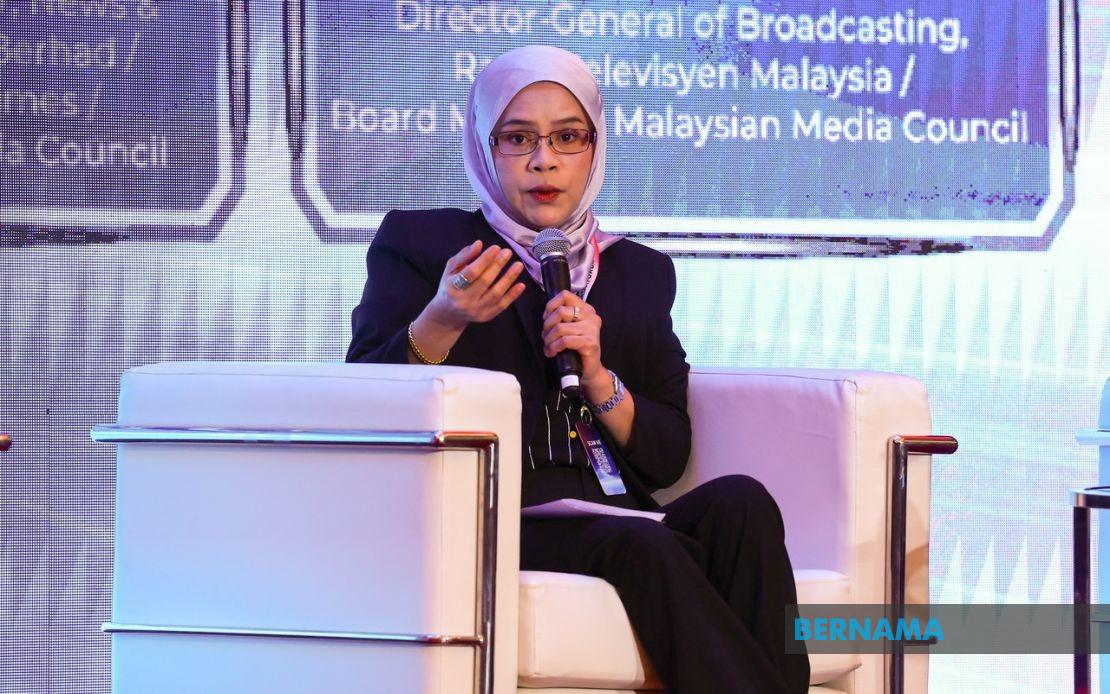
The sustainability of media organisations in the rapidly evolving digital landscape hinges on their unwavering commitment to credibility and integrity, according to Farrah Naz Abdul Karim, deputy group managing editor (News and Current Affairs) at Media Prima Bhd and group editor of New Straits Times. Speaking on Bernama Radio's Jendela Fikir programme on June 16 in conjunction with National Journalists' Day (HAWANA) 2026, she underscored that maintaining public confidence represents the most fundamental asset a news organisation can possess in contemporary times.
With over two decades of professional experience, Farrah Naz articulated a perspective grounded in practical newsroom realities. She acknowledged that media institutions today operate under intensifying commercial pressures that demand revenue generation and audience growth. However, she cautioned that compromising editorial standards to meet business objectives creates an existential threat far more serious than short-term financial shortfalls. Once credibility erodes, she emphasised, restoring public trust becomes extraordinarily difficult, often requiring years of consistent quality journalism to rebuild what was lost in far shorter timeframes.
The contemporary information ecosystem presents distinct challenges absent from earlier periods of journalism. Farrah Naz highlighted how misinformation, fabricated content, and deepfake technology have proliferated across digital platforms, fragmenting the shared factual foundation that democratic societies require. This proliferation has created an environment where audiences struggle to distinguish reliable reporting from deliberately manipulated narratives. The consequence extends beyond individual news organisations; when citizens lose confidence in institutional media broadly, alternative sources—including unreliable ones—fill the vacuum, creating feedback loops that reinforce distrust of established journalism.
Facilitating stronger media literacy among the general public emerges as a critical counterbalance to these technological threats. Farrah Naz advocated for systematic education initiatives that enable citizens to evaluate information sources critically, recognise manipulation techniques, and understand journalistic methodology. Such literacy programmes become particularly urgent in Southeast Asia, where social media penetration rates rival global leaders while regulatory frameworks governing digital content remain nascent. For Malaysian readers especially, the stakes involve not merely commercial viability of news outlets but the integrity of public discourse around elections, public health, economic policy, and social cohesion.
Regarding artificial intelligence's role in contemporary journalism, Farrah Naz outlined a nuanced position. She acknowledged AI's legitimate applications in enhancing operational efficiency—from analysing audience behaviour patterns to ensuring consistency in information packaging and distribution. However, she drew a critical distinction between algorithmic processing and authentic journalism. Artificial intelligence, by its fundamental nature, cannot physically witness events, cannot exercise editorial judgement informed by context and empathy, and cannot pursue investigative leads that require human intuition and relationship-building. The technology represents a tool augmenting human capability, not a replacement for the journalist as active participant in news-gathering processes.
Investigative journalism specifically requires renewed commitment and adequate resourcing. Farrah Naz stressed that in-depth reporting addressing systemic issues—corruption, policy failures, social injustices—necessitates sustained attention that commercial metrics often discourage. Yet such journalism fulfils journalism's constitutive democratic function: holding institutions accountable and ensuring affected communities receive attention from relevant authorities. The erosion of investigative resources across Malaysian media in recent years has created blind spots where public interest stories receive insufficient scrutiny, disadvantaging citizens who depend on professional reporting for information about matters affecting their lives.
Responsibility for maintaining information integrity extends beyond newsrooms themselves. Farrah Naz directed attention toward government officials, corporate communicators, and institutional leaders tasked with information dissemination. She observed that silence or evasion when confronted with media inquiries reflects outdated communication strategies unsuited to contemporary expectations. Modern audiences, particularly younger demographics, interpret institutional non-responsiveness as confirmation of wrongdoing. Effective communication in the digital era requires proactive engagement with journalists, transparent explanations, and timely responses—practices that paradoxically serve institutional interests even when disclosure proves uncomfortable.
The next generation of journalists faces distinctly different professional requirements than previous cohorts. Farrah Naz counselled journalism students and early-career practitioners that academic qualifications alone provide insufficient competitive advantage. Emerging professionals require practical skills spanning multiple platforms, technical proficiency in content management systems and data analysis, and adaptability to evolving audience preferences. Graduate journalists entering the profession without such supplementary competencies find themselves marginalised in hiring processes where news organisations operate leaner staffing models while demanding versatile contributors capable of producing content across print, broadcast, and digital formats simultaneously.
National Journalists' Day 2026 commemorates the profession during a pivotal period of transformation. The celebration's theme, 'Media Integrity Strengthens Credibility', encapsulates the contemporary challenge directly. The associated logo features a bridge symbol deliberately chosen to represent journalism's fundamental role: spanning the space between the general population and policymaking institutions through the dissemination of accurate, contextualised information. This conceptualisation acknowledges that journalism serves purposes extending beyond commercial news delivery; it functions as essential infrastructure for democratic governance and informed citizenship.
The primary commemoration event scheduled for June 20 at PICCA Convention Centre @ Butterworth Arena in Penang will feature Prime Minister Datuk Seri Anwar Ibrahim as the opening speaker. The gathering will convene more than 1,200 attendees encompassing media practitioners from across Malaysia and delegates from ASEAN member states. This regional dimension reflects growing recognition that media challenges transcend national boundaries—misinformation circulates across borders, technological disruption affects newsrooms throughout Southeast Asia, and audience fragmentation challenges all regional media markets similarly. The convening of ASEAN media representatives signals commitment to addressing these shared challenges through regional cooperation and knowledge exchange, acknowledging that isolated national responses prove inadequate when digital platforms operate without geographical constraints.