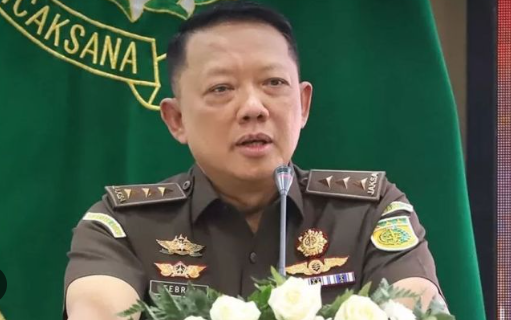
President Prabowo Subianto arrived in office with an emphatic anti-corruption message, repeatedly instructing state officials to "clean themselves up" or face law-enforcement consequences. Yet less than two years into his administration, that commitment faces an uncomfortable reality check as authorities investigate Febrie Adriansyah, until recently the deputy attorney general for special crimes and Indonesia's most influential anti-corruption prosecutor. The case has become a crucible for testing whether Prabowo's promised crackdown extends to the upper echelons of the institutions tasked with enforcing it.
The investigation itself appears substantive. Police seized approximately US$26 million in cash and gold bars from a house owned by Febrie and designated him a suspect in cases involving alleged money laundering. Yet what has drawn intense scrutiny from legal scholars and lawmakers is not primarily the allegations, but rather the procedural decisions made by investigating authorities and the glaring institutional conflict of interest they have created.
Central to the controversy is the police decision to transfer the three related cases to the Attorney General's Office—the very institution where Febrie spent much of his career and where he wielded outsized influence. While police framed this transfer as strengthening coordination between agencies, legal experts have questioned whether Indonesia's criminal procedure code even permits such a shift once active investigations have begun. Former Constitutional Court Chief Justice Mahfud MD warned that the manoeuvre could expose the entire prosecution to pretrial legal challenge, potentially rendering months of investigation work inadmissible.
The timing and sequencing of events have fuelled concerns about institutional posturing rather than genuine accountability. Police did not detain Febrie despite naming him a suspect, even as other individuals connected to the case were arrested. Meanwhile, another suspect in the investigation was apprehended on July 10, creating an apparent two-tier system where a former senior prosecutor receives differential treatment. Immigration authorities imposed a 20-day travel ban, yet this administrative measure hardly substitutes for the detention procedures normally applied to white-collar suspects in high-profile cases.
Zaenur Rohman, an anti-corruption scholar at Gadjah Mada University, captured the structural dilemma succinctly, describing the case transfer as "a political settlement aimed at easing tensions" between police and prosecutors rather than a solution grounded in law. The inherent conflict of interest in allowing prosecutors to investigate their former leader proved impossible to dismiss. Several lawmakers responded by forming a working group specifically to monitor the investigation, while others pressed the Attorney General's Office to establish an independent investigative team insulated from institutional loyalties.
Coordinating Minister Yusril Ihza Mahendra defended the transfer on efficiency grounds, though he candidly acknowledged the perception that it amounted to "oranges eating oranges"—an Indonesian expression denoting institutional self-protection. More telling, Yusril revealed that Prabowo himself had met with both the police chief and attorney general to provide directives on handling the case transfer. This presidential involvement, rather than reassuring observers, highlighted the case's political sensitivity and raised questions about whether investigative decisions reflected legal merit or executive convenience.
Febrie's institutional prominence intensifies the stakes considerably. As head of the Attorney General's Office's Special Crimes Division, he oversaw some of Indonesia's largest corruption investigations, including probes into major state-owned enterprises like Pertamina and Garuda Indonesia, as well as inquiries into Prabowo's signature free-meals programme and former Education Minister Nadiem Makarim. Few prosecutors wielded comparable influence over the nation's anti-corruption architecture. The reputational damage to the institution is therefore substantial, but so too is the institutional interest in containing the investigation.
The case must be understood within the broader context of jurisdictional competition among Indonesia's overlapping law-enforcement bodies. The police, the Attorney General's Office, and the Corruption Eradication Commission all maintain investigative authority over corruption cases, creating periodic friction over which institution claims high-profile matters. These rivalries are not merely bureaucratic; they centre on political influence, public visibility, and access to seized assets. Jacqui Baker, a senior lecturer in South-East Asian politics at Murdoch University, noted that corruption investigation powers are "jealously fought over by law-enforcement agencies because they lie at the core of their political and economic power."
Prabowo's administration has altered the institutional landscape through recent legal amendments. A 2025 revision to Indonesia's military law now permits active-duty military officers to serve in the Attorney General's Office without first retiring, a change that reflects broader shifts in civil-military relations. Separately, amendments that year expanded the Attorney General's Office's authority to seek military protection for prosecutors, a function previously monopolised by police. These modifications reveal an administration actively reshaping institutional power balances, though whether such changes strengthen accountability or merely redistribute political influence remains contested.
The free-meals programme investigation adds another layer of complexity. After police named an active police brigadier general as a suspect in a probe of the initiative—Prabowo's signature antipoverty policy—the Attorney General's Office abruptly ordered regional prosecutors to cease collecting data related to the US$15 billion programme. Officials cited the completion of the initial collection period, yet the timing suggested a desire to insulate a presidential flagship programme from further scrutiny. The sequence of events, while not explicitly proving institutional conflict, narrated a pattern that invited scepticism.
Public displays of tension have subsided since the initial raids on Febrie's residence in South Jakarta, when armed soldiers were visibly deployed. Prabowo subsequently called for "introspection" from all institutions, while the National Police chief appeared jointly with the attorney general to deny any organisational rift. Yet such public reconciliation glossed over substantive procedural and institutional questions that remain unresolved. The case illustrates a persistent challenge for Southeast Asian democracies: how to maintain genuine institutional independence while preserving inter-agency coordination, particularly when investigating powerful insiders.
For Malaysian observers, the Indonesian experience offers instructive lessons. Institutional independence in corruption investigations requires not merely formal legal frameworks but genuine insulation from the investigating agency's internal interests and political pressures. The Febrie case demonstrates how procedural irregularities and institutional self-interest can compound initial credibility problems. As Malaysia continues navigating its own accountability architecture, the Indonesian precedent suggests that genuine anti-corruption commitment demands willingness to investigate powerful insiders according to uniform standards, even—or especially—when those individuals formerly led the investigating institutions themselves.

