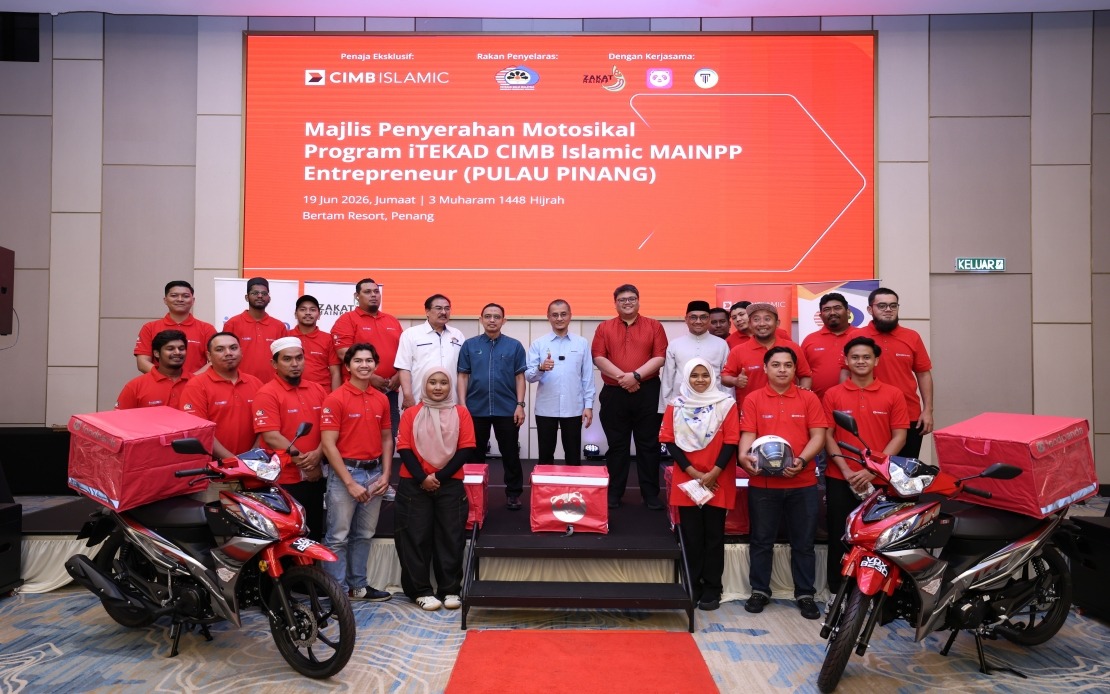
Twenty carefully selected participants have been handed motorcycles and delivery equipment through the iTEKAD CIMB Islamic-MAINPP Entrepreneur programme, a significant step in efforts to lift the asnaf community out of poverty through structured employment pathways. The distribution ceremony, held in Kepala Batas on June 19, represents the culmination of a competitive selection process and underscores a broader pivot towards collaborative social investment in Malaysia's Islamic finance sector.
The initiative springs from a strategic alliance between CIMB Islamic Bank Berhad and the Penang Islamic Religious Council (MAINPP) via Zakat MAINPP, with implementation support from the Malaysian Youth Foundation (YBM), Taylor's Community and foodpanda Malaysia. This multi-stakeholder approach reflects a recognition that poverty alleviation requires more than direct cash transfers—it demands a coordinated ecosystem of financing, training, mentorship and marketplace access. Penang Deputy Chief Minister I Datuk Dr Mohamad Abdul Hamid, who also chairs MAINPP, emphasised that sustainable asnaf development cannot succeed in isolation but demands genuine synergy and shared commitment from both public and private actors.
The financial architecture underlying the programme illustrates how zakat funds can be leveraged for productive investment. The initiative draws on a RM400,000 seed fund structured as a matching grant: RM200,000 originates from CIMB Islamic Bank Berhad's Wakalah Zakat fund, while Bank Negara Malaysia contributes an equivalent RM200,000. This co-investment model signals confidence in the programme's viability and creates accountability across multiple parties, each with reputational stakes in the participants' success.
The selection process itself was rigorous and merit-based, reflecting quality over quantity. Zakat MAINPP initially fielded 151 applications—a strong indicator of demand for such opportunities among the asnaf population. The 20 selected participants were winnowed through interviews and a residential Entrepreneurship Camp (BootCamp) conducted from May 31 to June 3, 2026. This intensive training component equips recipients with more than just assets; they gain grounding in financial management fundamentals, work discipline and entrepreneurial mindset, essential for translating a motorcycle into sustained income generation.
Participants will leverage their motorcycles primarily for delivery work, partnering with foodpanda Malaysia. This partnership offers immediate income-earning potential whilst the participants develop their entrepreneurial capabilities. The delivery sector, particularly in urban and semi-urban Penang, provides flexible opportunities well-suited to workers entering formal economic structures for the first time. Beyond the immediate earnings, the arrangement offers structured work experience and exposure to modern operational standards—assets that extend far beyond the immediate transaction.
The programme aligns strategically with Penang's broader Islamic economic agenda. The state government has embedded the iTEKAD initiative within the Penang Islamic Religious Development Agenda 2030 (APAI2030), which encompasses education, economic participation, family welfare, and youth development. This integration ensures that motorcycles and delivery jobs are not standalone interventions but components of a comprehensive vision for ummah prosperity. Such alignment lends legitimacy and sustainability, as the programme draws institutional commitment beyond individual corporate goodwill.
For Malaysian readers and regional observers, this model offers instructive lessons on how Islamic banking institutions can transition from profit-centric operations towards social impact without sacrificing financial discipline. The use of zakat—one of Islam's five pillars—as venture capital for entrepreneurship exemplifies how religious obligations can fund productive economic activity. The matching grant structure ensures that tax-derived public resources complement religious alms, creating a hybrid funding mechanism increasingly relevant across Southeast Asia's diverse religious and economic contexts.
The broader context matters significantly. Malaysia's asnaf population—comprising the poor, destitute, debt-burdened, new Muslims and others eligible for zakat assistance—often faces structural barriers to formal employment. Limited asset ownership, weak access to credit and networks, and gaps in business acumen constrain their economic participation. By bundling motorcycles with training, mentorship from foodpanda's operational expertise, and Taylor's Community's social support, the iTEKAD programme attacks multiple constraints simultaneously. This comprehensive approach increases the likelihood of genuine, sustained income improvements rather than temporary relief.
The programme's emphasis on asset ownership deserves closer attention. Motorcycles represent both productive capital and a form of collateral-like security that can unlock additional opportunities. A participant earning through foodpanda delivery gains income history, transaction records and demonstrated reliability—credentials increasingly valuable in accessing microfinance, upgrading to larger vehicles, or pivoting into related entrepreneurial ventures. In this sense, the motorcycles function as bridges into broader financial inclusion.
For Bank Negara Malaysia's involvement, the programme signals official recognition that zakat-based social enterprise financing warrants central bank engagement. BNM's RM200,000 contribution, matched by CIMB Islamic's Wakalah fund, suggests that leveraging Islamic finance for poverty reduction is becoming embedded in monetary policy considerations. This legitimates similar initiatives across Malaysia's wider banking system and creates precedent for other institutions to follow.
The 151 initial applications underscore unmet demand. With only 20 motorcycles distributed, a substantial cohort of aspiring entrepreneurs remains unserved. This scarcity creates accountability pressure on the current participants but also highlights opportunity for programme scaling. Should the current batch demonstrate strong success metrics—sustained income generation, business retention, and qualitative life improvements—stakeholders may justify expanded funding rounds. For Penang and potentially other states, replicating this model with larger capital injections could systematically expand entrepreneurial pathways within the asnaf community.
Risk mitigation embedded in the programme design also warrants recognition. The BootCamp and interview screening reduce selection error, identifying participants with genuine motivation and foundational capability. Ongoing support from Taylor's Community and mentorship from foodpanda's operations team provide safety nets and guidance when participants encounter inevitable challenges. This reduces default risk whilst improving genuine success likelihood—a combination that benefits all stakeholders, including future participants who depend on programme credibility and sustainability.
Moving forward, monitoring and impact evaluation will prove critical. Success metrics might include income stability, employment duration, savings accumulation, and subjective life satisfaction. Transparent reporting on these outcomes will determine whether the iTEKAD model becomes a template for replication across Malaysia's Islamic banking sector and beyond. For regional economies with comparable asnaf populations and Islamic finance infrastructure, the Penang experience offers a tested blueprint for translating religious obligation into measurable economic empowerment.

