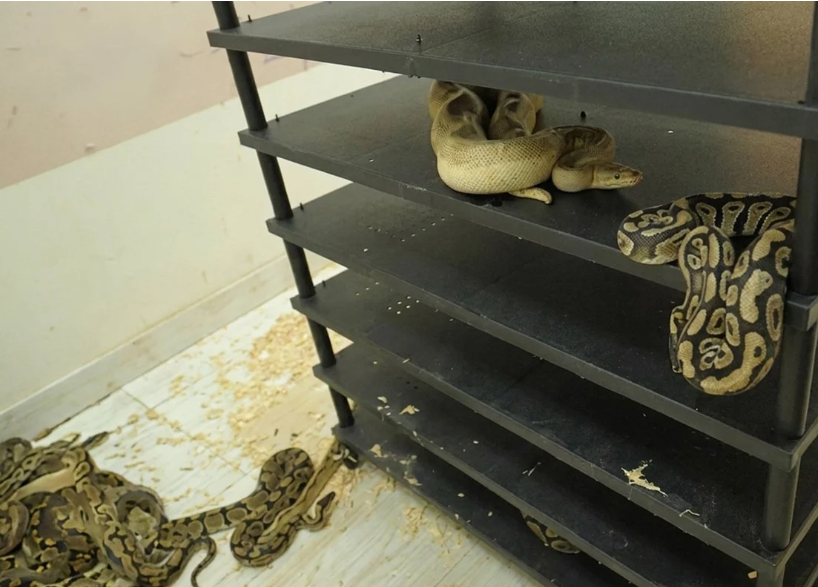
A court in Taizhou, Zhejiang province in eastern China has sentenced a man identified as Guo to prison for operating an illegal python breeding operation from his residential flat, in what state media described as a case involving serious harm to rare and protected wildlife. The case came to light in late June when state broadcaster CCTV highlighted the arrest and conviction, which centred on the discovery of over 300 pythons hidden within Guo's apartment alongside accomplices Di and Deng, a pet shop owner. The entire operation involved approximately 436 pythons with a combined value exceeding 30 million yuan, equivalent to roughly 4.4 million US dollars.
In China's wildlife protection framework, pythons occupy a sensitive legal position as Grade Two protected animals, a classification that renders their purchase, sale, breeding, and transportation illegal without explicit government authorisation. The violation carries serious legal consequences under the country's Criminal Law, with offenders facing maximum prison sentences of up to five years for breaching protections afforded to animals at this classification level. Guo's operation therefore represented a substantial breach of national environmental and wildlife legislation, compounded by the commercial nature of his breeding scheme and the significant financial gains derived from unauthorised sales.
The breakthrough in the investigation originated unexpectedly in March 2024 when an elderly resident of Taizhou discovered a large python near the base of a local mountain. The resident, unfamiliar with seeing such a reptile in the region and struck by its considerable girth comparable to an adult's arm, reported the finding to local authorities. Police officers immediately recognised the significance of the discovery, reasoning that an indigenous species would be unlikely to roam the area, and the early spring timing contradicted typical snake behaviour patterns when reptiles remain dormant during colder months. This prompted investigators to conclude the animal had escaped from a captive breeding environment somewhere nearby.
The investigative approach that ultimately cracked the case demonstrated considerable sophistication. Consulting with a professional snake handler, police learned a critical environmental detail: pythons thrive only in consistently warm and humid conditions, typically maintained between 20 and 30 degrees Celsius. Maintaining such temperatures artificially would require sustained electricity consumption at levels substantially above normal residential usage patterns. Law enforcement then systematically reviewed electricity consumption records of households throughout Taizhou, using abnormally high power usage as a screening criterion. This forensic approach successfully narrowed suspects to a manageable pool, eventually identifying Guo as the prime candidate based on his usage patterns.
Once Guo emerged as the primary suspect, investigators deepened their scrutiny through multiple investigative channels. They observed that Guo lived alone, was unmarried, and unemployed, raising questions about income sources supporting his lifestyle. A pattern emerged showing that a frequent visitor named Di regularly collected parcels from courier collection points, with shipments consistently containing small white mice purchased through online retailers. Police traced these online transactions and confirmed that sellers regularly supplied rodents specifically for feeding to reptile owners. Furthermore, Guo had posted photographs of snakes on social media accounts with occasional oblique references to selling his python stock, inadvertently creating digital evidence of his breeding enterprise.
Financial records provided additional corroboration of the breeding operation's commercial dimensions. Police identified a transaction wherein Di had sold two pythons to an unrelated purchaser for 1,000 yuan, approximately 150 US dollars per animal, demonstrating the profitability of even small-scale transactions. These transaction details, combined with the patterns of mouse purchases and online snake communications, provided sufficient evidence to warrant arrests. Officers moved to apprehend both Guo and Di on charges related to illegal breeding and commercial sale of protected species.
When police officers executed a search warrant at Guo's residence, they encountered an operation far more extensive than initial intelligence had suggested. The flat presented an extraordinary sight: numerous plastic containers stacked in towering arrangements throughout the living quarters, each housing an individual python. Guo had consolidated all his personal furniture into a single bedroom, dedicating the remaining two bedrooms and the entire living room exclusively to python housing and care. Altogether, authorities catalogued 309 pythons seized from the residence, subsequently transferred to a local zoo for proper care and eventual placement.
Guo's personal account of his involvement revealed the deep-seated nature of his obsession with reptile breeding. He acknowledged maintaining a long-standing interest in snakes dating back a decade, claiming complete absence of fear toward the species. His breeding journey commenced in 2014 when he initially acquired four pythons, after which he devoted himself to researching and perfecting breeding techniques. In statements to authorities, Guo expressed pride in his technical proficiency, stating "I am capable of cultivating snakes of various colours" and describing himself as feeling "like a creature creator." This psychological dimension suggests the operation transcended purely financial motivation, incorporating elements of scientific interest and personal accomplishment.
The investigation's scope expanded further when police identified a third participant in the scheme. Deng, identified as a pet shop owner who had sold the original four pythons to Guo in 2014, faced arrest following discovery of 47 additional pythons at his residence. This connection indicated that Guo's operation had developed sophisticated supply chains integrating with legitimate pet retail businesses, suggesting possible coordination between legal and illegal breeding activities. The authorities' dismantling of this network prevented continued sales and breeding that would have perpetuated violations of China's wildlife protection regime.
The convictions of Guo, Di, and Deng mark a significant enforcement action within China's broader campaign to protect endangered species and maintain control over the illegal wildlife trade. The case illustrates both the sophisticated methods wildlife enforcement agencies deploy, such as electricity consumption analysis, and the vulnerability of illegal operations to detection through routine reporting and pattern recognition. For regional observers, the case underscores the serious penalties China imposes for wildlife protection violations and demonstrates that breeding protected species in residential settings, regardless of scale, carries substantial criminal liability extending to prison sentences. The operation's exposure and prosecution reinforces that enforcement authorities prioritise such violations despite operating within densely populated urban environments.

