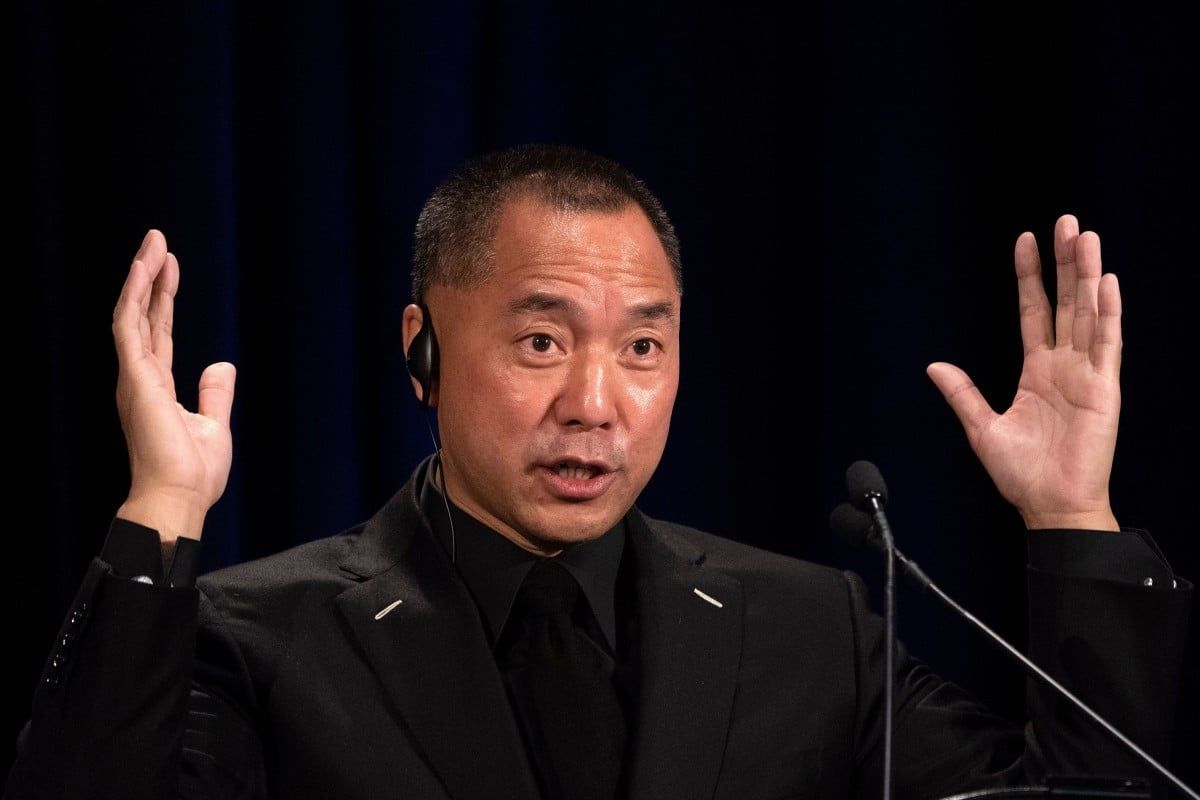
A once-prominent Chinese billionaire who reinvented himself as a dissident critic of Beijing's Communist Party was handed a 30-year prison sentence on Monday in Manhattan for orchestrating one of the largest financial frauds in recent US history. Guo Wengui, who fled China a decade ago to pursue what he claimed was a campaign to destabilize the Chinese government, was convicted of systematically defrauding investors who believed they were funding democratic initiatives against Beijing. Federal Judge Analisa Torres determined that his scheme cost more than 1,000 victims across the globe hundreds of millions of dollars, describing a calculated betrayal of those who entrusted him with their life savings based on his professed political mission.
The Manhattan courtroom erupted with applause from Guo's supporters as he was led away following the sentencing, a dramatic moment that underscored the polarized public perception surrounding the case. Throughout the proceedings, Guo maintained his defiance, appearing in court despite claims of illness and refusing to acknowledge responsibility for the financial devastation he caused. He briefly addressed the charges by reiterating his stated objective of undermining the Chinese Communist Party, suggesting that his primary motivation had always been political rather than criminal. However, Judge Torres dismissed this narrative entirely, noting that Guo had repeatedly denied causing any harm whatsoever and had actively encouraged his followers to intimidate and harass those willing to testify against him.
The judge ordered Guo to forfeit USD 889 million in restitution to his victims, though prosecutors emphasize that recovering these funds will prove extraordinarily challenging given the complexity of his financial networks. Among those who testified was Wei Chen, a victim whose personal account painted a stark portrait of financial and emotional devastation. Chen described how the fraud had systematically destroyed not only her own life but also that of her entire family, a testimony that Judge Torres specifically highlighted when explaining the reasoning behind the lengthy sentence. The court received numerous letters from victims describing the loss of retirement savings, the breakdown of family relationships, and the psychological toll of discovering they had been deliberately deceived by someone they believed represented their political values.
Guo's meteoric rise in American society prior to his arrest three years ago illustrated how effectively he had cultivated connections with influential figures across the political spectrum. He grew sufficiently close to prominent conservative strategist Steve Bannon that the two publicly announced a joint initiative in 2020 to overthrow the Chinese government, lending apparent credibility to Guo's claims of being a genuine dissident rather than a fraudster. He secured membership at Mar-a-Lago, President Donald Trump's exclusive Florida golf club, and maintained residence in a luxury Manhattan apartment overlooking Central Park, a lifestyle that prosecutors argued was entirely funded through the systematic theft of investor money.
The fraud operated from 2018 to 2023 through multiple fraudulent entities bearing innocuous names designed to appeal to pro-democracy sentiment. Guo established GTV Media Group Inc., which he promoted as a platform for dissenting voices, along with the Himalaya Farm Alliance and the Himalaya Exchange, all presented as components of a broader movement to undermine Beijing's authority. Prosecutors demonstrated that Guo convinced hundreds of thousands of investors to collectively deposit more than USD 1 billion into these controlled entities, a massive accumulation of capital that he then diverted to support an extravagant personal lifestyle marked by mansions, yachts, high-performance vehicles, and designer goods. During a seven-week trial, the prosecution methodically dismantled Guo's carefully constructed persona by presenting evidence of systematic deception, leading to his conviction on nine of twelve criminal charges.
Guo's defense attorneys pursued an alternative narrative, arguing that their client had become a victim of coordinated persecution by the Chinese Communist Party, which they claimed had recruited influential figures across American business, entertainment, and political circles to conspire against him. They presented evidence of physical trauma Guo allegedly endured in China, including scars and disfigurements resulting from torture between 1993 and 2022, to paint a picture of a man desperately fleeing persecution. According to the defense, Guo's escalating wealth stemmed from his family's position as the largest shareholder in China's largest publicly traded securities company, a position that supposedly triggered retaliation from corrupt Chinese officials whose misconduct he had exposed. The defense argued for leniency, noting that comparable defendants in similar fraud cases typically received sentences of only two to four years and contending that an extended prison term would validate what they characterized as China's broader smear campaign against all Chinese dissidents.
Chinese authorities have maintained that Guo remains wanted for multiple serious crimes, including rape, kidnapping, and bribery, allegations that Guo has consistently denied as fabrications designed to silence his political activism. The Chinese government has secured an Interpol Red Notice for Guo, a formal request to law enforcement agencies worldwide to apprehend him pending potential extradition. This international dimension adds complexity to the case, as it raises questions about whether Guo's extensive involvement with American political figures and his cultivation of a dissident persona may have obscured the underlying criminal conduct for longer than would have been possible otherwise. The simultaneous existence of both legitimate political persecution concerns and genuine criminal fraud creates a narrative too complicated for simple categorization.
For Malaysian and Southeast Asian observers, Guo's case presents a cautionary example of how charismatic figures operating across international borders can exploit sympathies for anti-authoritarian causes while conducting elaborate financial schemes. The case demonstrates the vulnerability of diaspora communities and pro-democracy supporters to manipulation by individuals who present themselves as champions of freedom while actually seeking personal enrichment. Furthermore, the case illustrates how individuals fleeing authoritarian regimes can leverage American legal systems and political networks to establish themselves while simultaneously conducting predatory financial operations. The sentencing also raises broader questions about the adequacy of regulatory frameworks designed to protect investors from sophisticated fraud schemes presented under the veneer of political legitimacy.
The implications for regional governance and financial regulation deserve serious consideration. Southeast Asian countries, which host significant overseas Chinese communities and pro-democracy movements, must grapple with how to protect vulnerable investor populations from schemes that exploit political and cultural sympathies. The case highlights the necessity for financial regulators to scrutinize investment opportunities presented by internationally prominent figures, particularly those claiming to represent political causes, with the same rigor applied to conventional business propositions. Guo's ability to maintain his fraudulent operations for approximately five years while maintaining high-profile connections to American political figures suggests that even sophisticated regulatory environments can be circumvented when fraudsters successfully cultivate appropriate political and social credentials.
Prosecutors had argued that Guo's refusal to acknowledge any wrongdoing, combined with his sustained influence over thousands of remaining supporters, posed an ongoing danger to potential victims. The federal government characterized the fraud as not merely a financial crime but as a profound betrayal of individuals motivated by genuine political conscience. By explicitly demonstrating that his supporters' political idealism had been weaponized to extract their savings, prosecutors constructed a narrative emphasizing Guo's manipulation of fundamental values held by his victims. Judge Torres's sentencing statement reinforced this characterization, emphasizing that Guo had specifically targeted those seeking to advance democratic governance and had exploited their political convictions to facilitate their own financial destruction.
As Guo enters the federal prison system to begin his 30-year sentence, questions remain about the broader network of individuals and entities he cultivated during his years operating in America. The case has prompted renewed scrutiny of due diligence procedures among exclusive clubs and social venues catering to wealthy individuals with international connections. The USD 889 million restitution order, while symbolically significant, will likely prove difficult to enforce given the complexity of Guo's financial arrangements and the likelihood that substantial portions of his fraudulently obtained wealth have been transferred beyond easy recovery. For victims, the sentence provides legal closure but offers minimal financial compensation for the devastating losses many endured.

