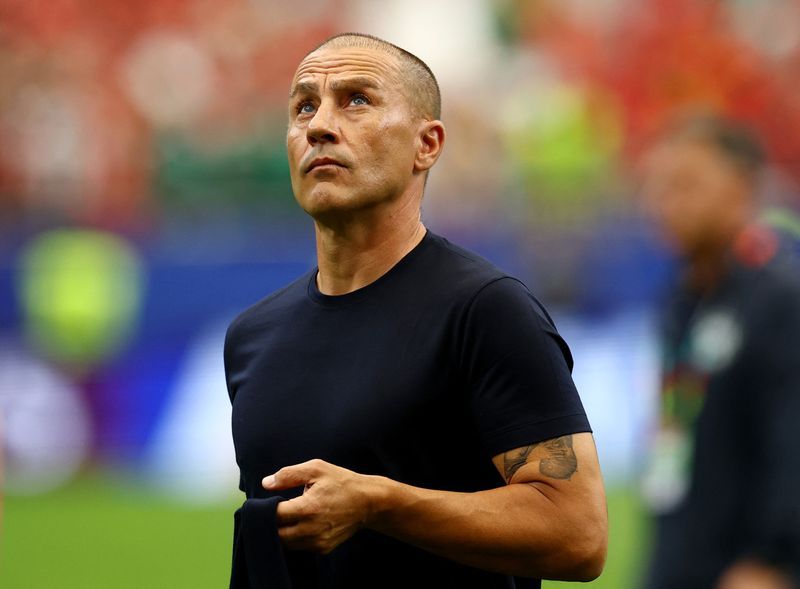
Uzbekistan's World Cup dream suffered a devastating blow on Tuesday when they capitulated to Portugal with a 5-0 loss in Houston, leaving coach Fabio Cannavaro to confront the harsh realities of international football's highest stage. Yet rather than deflect or offer excuses, the Italian tactician immediately assumed full accountability for the debacle, setting a measured tone in his post-match assessment despite the magnitude of the defeat.
Cannavaro's willingness to shoulder responsibility reflected his philosophy throughout the campaign. The 2006 World Cup winner with Italy acknowledged that as the orchestrator of tactical decisions and team preparation, the onus rested squarely on his shoulders. In his candid remarks to reporters, he absolved his players of blame, framing the loss instead as a consequence of his own miscalculations rather than their execution or commitment. This stance revealed the mentality he has cultivated within a squad making its inaugural World Cup appearance—one that prioritizes learning and resilience over assigning individual culpability.
Uzbekistan now teeters on the precipice of group-stage elimination following a sequence of defeats that has left their advancement prospects grim. After their opening 3-1 reversal against Colombia, the Portuguese thrashing compounded their Group K predicament. With only a fixture against the Democratic Republic of Congo remaining on Saturday, Uzbekistan requires victory to harbour any mathematical possibility of progressing to the round-of-32. The mathematical scenario, while theoretically possible, demands not only an emphatic win but also a specific result elsewhere in their group to salvage their tournament.
Yet Cannavaro resisted any atmosphere of despair emanating from his camp. He emphasized that his players had demonstrated genuine effort and commitment throughout the match, qualities he respected despite the scoreline. His refusal to abandon hope, even when circumstances appeared to dictate otherwise, provided an important psychological anchor for a squad navigating uncharted territory at football's grandest event. The coach's message to the dressing room centred on the value of experience and the importance of maintaining confidence in their developing project.
A pivotal moment emerged when Azizjon Ganiev appeared to have scored a crucial goal for Uzbekistan while the deficit stood at 2-0. The disallowance for a foul deemed to have occurred during the build-up proved more consequential than merely a single goal, according to Cannavaro's analysis. He identified this decision as inflicting psychological damage upon a team already operating within severe margin-for-error constraints. The moment represented a threshold—had the goal stood, it would have altered momentum and restored belief at a critical juncture. Instead, its rejection appeared to accelerate the collapse that followed.
Cannavaro's comments regarding the disallowed goal illuminated how fine the margins operate in elite competition, particularly for nations lacking World Cup experience. The impact transcended the numerical scoreline; it represented lost momentum and fractured confidence at a time when psychological fortitude proved essential. He reflected that his team had begun the match with the same tactical boldness they had attempted against Colombia, indicating they possessed a coherent gameplan despite their comparative inexperience.
The coach's philosophy throughout the tournament stressed courage and attacking ambition rather than defensive conservatism. He had explicitly encouraged his players to embrace boldness, to take risks in possession, and to view errors not as career-defining moments but as inevitable components of development. This instructional approach aimed at cultivating a learning environment where individuals felt empowered to make incisive passes and construct attacking movements, even when attempting unfamiliar international competition.
Cannavaro's framing of the tournament as an experience-gathering mission provided important perspective for a nation featuring at the World Cup for the first time. Rather than viewing defeat as purely damaging, he positioned adversity as valuable instruction for a squad destined for future tournaments. This mentality acknowledged that immediate qualification, while desirable, held less strategic importance than establishing a sustainable project. Uzbekistan's football development benefited from exposure to elite opposition and the lessons derived from such encounters, regardless of immediate results.
The veteran coach's personal history lent credibility to his measured response. Having captained Italy to World Cup triumph in 2006, he possessed intimate understanding of tournament football's demands and the psychological resilience required across multiple matches. His own path to success included defeats and setbacks, informing his patient approach to Uzbekistan's nascent World Cup campaign. This historical context positioned his accountability-accepting statements as authentic rather than performative.
Looking forward, Uzbekistan must now focus entirely upon their Democratic Republic of Congo encounter, recognizing that only an assured victory preserves any possibility of advancing. Whether they succeed or experience elimination, Cannavaro's conduct throughout the campaign—accepting responsibility while building confidence and emphasizing development—establishes a foundation upon which the national programme might construct future competitive strength. The immediate tournament outcome may prove secondary to the institutional message being conveyed about how professional football organisations respond to adversity at the international stage.

