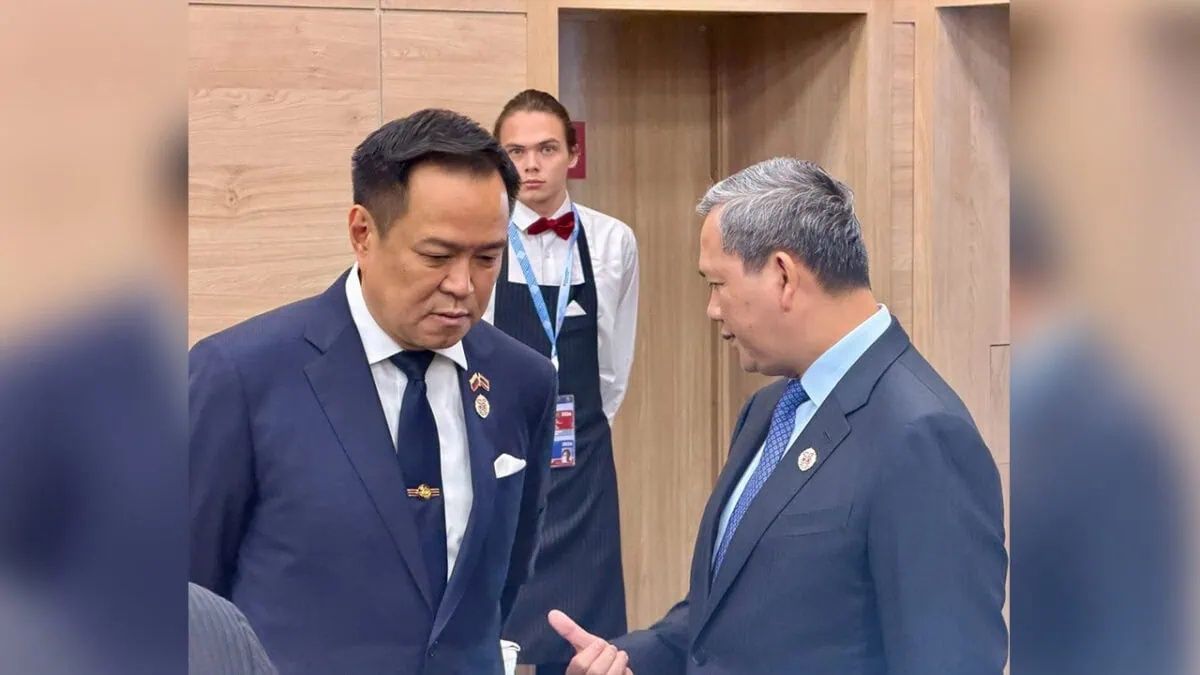
Cambodian Prime Minister Hun Manet has called on Thailand to fill a vacant position at the Joint Boundary Commission and commence border survey and demarcation activities, signalling Cambodia's determination to advance stalled boundary work through established diplomatic channels. The appeal came during an informal encounter between Manet and Thai Prime Minister Anutin Charnvirakul at an Asean-Russia engagement gathering in Kazan, Russia, underscoring the ongoing efforts by both Southeast Asian neighbours to manage their complex and contentious border relationship.
In remarks posted to social media on Friday, Manet outlined Cambodia's position that it continues to favour bilateral cooperation within existing frameworks despite the protracted nature of border negotiations between the two nations. He specifically referenced Point Three of a Joint Statement signed on December 27, 2025, as the basis for his appeal to Bangkok to appoint its JBC chief and commence joint survey operations without further delay. The reference to this recent agreement suggests that both capitals have established fresh parameters for advancing discussions that have languished for years without substantial progress.
Cambodia's dual-track approach to resolving boundary disagreements reflects the complexities of the dispute, which encompasses both maritime and terrestrial components. On maritime matters, Phnom Penh is pursuing compulsory conciliation procedures available under the UN Convention on the Law of the Sea, a mechanism both nations have already activated. For land border issues, however, Cambodia maintains its preference for direct bilateral engagement conducted through the JBC structure, a position that differs markedly from other potential international avenues that could be pursued.
Matters of border security and sovereignty carry enormous political weight in both Cambodia and Thailand, with public opinion in each country sensitive to perceptions of national interest being compromised. This reality shaped the respective leaders' public characterisations of their Kazan meeting. While Manet emphasised substantive discussions about border mechanisms and Cambodia's commitment to peaceful resolution, Anutin downplayed the encounter as merely a brief aside between formal meetings, describing it colloquially as the two leaders "pulling each other aside by the elbow" due to scheduling constraints.
Anutin's response to questions about reopening border crossings provided insight into the political constraints both governments navigate. He laughed off the suggestion that the topic had been discussed, remarking candidly that Thai citizens would be upset if such negotiations proceeded without careful management. This candid acknowledgement reveals the domestic sensitivities surrounding border reopenings and the need for governments to proceed methodically to maintain public confidence.
Both leaders nevertheless presented remarkably aligned public positions regarding their fundamental approach to border management. Thailand's Prime Minister confirmed that Bangkok remains committed to international and bilateral frameworks, explicitly mentioning UNCLOS, the JBC, and the General Border Committee as the vehicles through which disputes should be addressed. This convergence of stated principles suggests that despite rhetorical differences, both governments share a commitment to managing tensions through established mechanisms rather than escalation.
The emphasis on peaceful dialogue reflects a broader regional imperative within Asean, where member states have long prioritised stability and non-confrontation even when facing difficult bilateral issues. Cambodia and Thailand's commitment to existing dispute resolution mechanisms, despite their slow progress, demonstrates this institutional preference for working through established channels. The compulsory conciliation process under UNCLOS, while not guaranteeing rapid outcomes, provides an alternative pathway for maritime issues that neither country appears ready to abandon.
However, Cambodia's specific urging of Thailand to appoint its JBC chief suggests that Bangkok may be dragging its feet on appointments or resource allocation that would accelerate the demarcation process. This asymmetry in urgency could indicate that Phnom Penh views progress as increasingly necessary, whether for domestic political reasons or because of developments on the ground that make resolution more pressing. The reference to the December 2025 Joint Statement indicates that both nations have attempted to inject fresh momentum into negotiations through recent diplomatic initiatives.
For Malaysia and other Southeast Asian observers, the Cambodia-Thailand border situation carries implications beyond bilateral relations. Protracted boundary disputes in the region, if mishandled, risk triggering broader tensions that could affect Asean cohesion and subregional stability. The commitment by both nations to peaceful mechanisms represents a reassuring signal that neither government seeks to convert border disagreements into open conflict, even as underlying issues remain unresolved.
The timing of this exchange in Kazan, at a multilateral gathering, also reflects how regional powers increasingly address bilateral disputes in multilateral settings where third-party presence and international norms constrain escalatory rhetoric. Such venues provide opportunities for leaders to communicate positions and take measured steps toward resolution without the domestic political heat that can accompany major bilateral announcements.
Cambodia's specific reference to Point Three of the recent Joint Statement and its call for Thailand to accelerate appointments and commence surveys suggests a desire to move beyond the pattern of stalled negotiations that have characterised this relationship. Whether Thailand will prioritise appointing its JBC chief and commencing fieldwork remains uncertain, as bureaucratic and political factors in Bangkok may constrain rapid implementation despite the apparent diplomatic alignment.
The broader picture reveals two governments attempting to balance genuine commitments to peaceful resolution with domestic political constraints and the complexity of boundary disputes that touch on fundamental sovereignty concerns. As Cambodia and Thailand continue pursuing their disputes through established channels, their ability to generate tangible progress will serve as a test of whether existing Asean mechanisms and bilateral arrangements can deliver meaningful outcomes on long-festering regional challenges.

