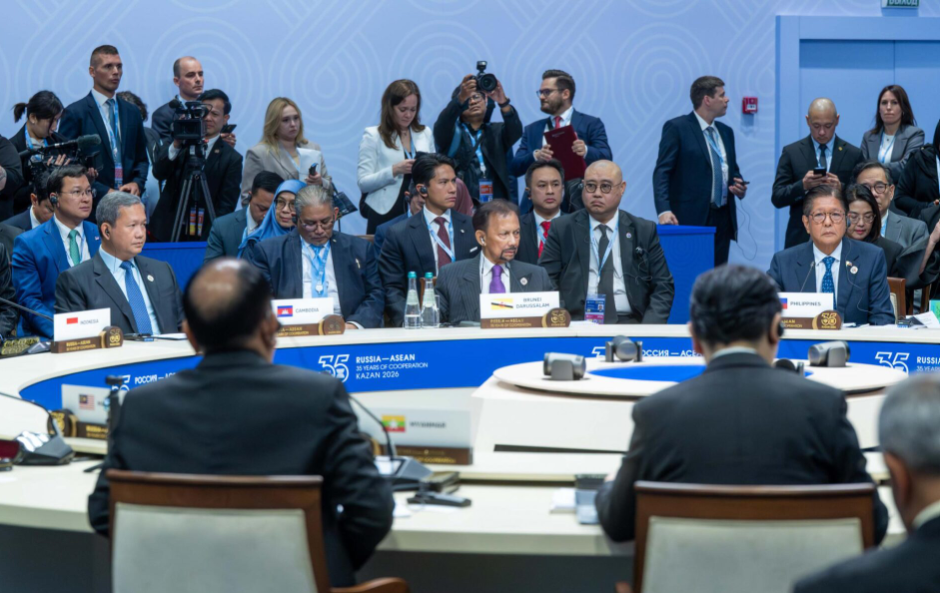
Sultan Hassanal Bolkiah travelled to Kazan, Russia on Thursday, June 18, to participate in the Asean-Russia Commemorative Summit held at the Kazan Expo International Exhibition Centre. During the gathering, the Brunei monarch delivered remarks acknowledging Russian President Vladimir Putin's hospitality and expressing gratitude to the government of the Republic of Tatarstan and residents of Kazan for welcoming the regional delegation. He also extended formal condolences to Thailand's Prime Minister Anutin Charnvirakul following the recent death of Princess Bajrakitiyabha of Thailand. Prince 'Abdul Mateen, Brunei's Minister of Foreign Affairs, accompanied the Sultan throughout the diplomatic visit.
The summit marked a significant moment for bilateral relations, coming three-and-a-half decades after Asean and Russia first established their formal dialogue partnership. In reflecting on this lengthy engagement, Sultan Hassanal Bolkiah characterised the relationship as fundamentally resilient, noting how it has grown in relevance despite sweeping transformations in the international system. He observed that collaborative initiatives spanning the political, economic and socio-cultural dimensions of the Asean Community framework have yielded concrete outcomes whilst simultaneously strengthening interpersonal and institutional linkages between the two sides.
Central to the Sultan's address was an assessment of tangible achievements flowing from three-and-a-half decades of engagement. Beyond diplomatic formalities, he underscored how the partnership has delivered measurable benefits to both regions and contributed toward shared aspirations of lasting peace, economic stability and broad-based prosperity. The emphasis on practical outcomes rather than rhetorical commitments reflects growing demands from Asean capitals and Moscow to demonstrate the value of continued cooperation in an era of competing geopolitical priorities.
Looking ahead, Sultan Hassanal Bolkiah connected Asean-Russia cooperation directly to the bloc's Vision 2045 strategic roadmap, a comprehensive framework charting the region's development trajectory through 2045. He argued that Russia's partnership remains integral as Asean navigates interconnected global pressures, specifically mentioning geopolitical tensions between major powers, fragmentation in the global economic system, the accelerating climate crisis and disruptive technological change. Each of these domains presents distinct challenges that require coordinated responses spanning multiple nations and sectors.
The Sultan placed particular emphasis on non-traditional security concerns, areas where conventional military defence proves inadequate and demand cross-border cooperation. Energy security emerged as a priority, reflecting regional vulnerability to supply disruptions and price volatility in global oil and gas markets, issues directly affecting Malaysia and its neighbours. Food security likewise featured prominently, a concern with heightened relevance across Southeast Asia where population growth and climate variability create dietary pressures. Climate action and disaster management, perennial challenges in a region prone to typhoons, flooding and environmental degradation, were similarly highlighted as domains requiring sustained Russian engagement.
Recognising that institutional frameworks ultimately depend on people, Sultan Hassanal Bolkiah stressed the critical importance of human capital development in anchoring long-term cooperation. He advocated for expanded educational initiatives, official exchange programmes and technical training frameworks capable of equipping younger generations with the expertise, knowledge base and professional networks necessary to sustain and deepen the bilateral relationship. This focus on generational renewal suggests recognition that maintaining partnership momentum requires continuous investment in individuals who will navigate future collaboration.
The Kazan Declaration 2026, formally adopted following the summit's first plenary session, represented the culmination of diplomatic negotiations and policy coordination between Asean and Russia. Sultan Hassanal Bolkiah expressed confidence in this outcome document, viewing it as a foundation for navigating emerging challenges. Three additional instruments emerged from the plenary: a comprehensive implementation plan detailing specific cooperative initiatives through 2030, a statement on energy sector collaboration and a cultural cooperation agreement. These varied documents signal commitment across multiple government sectors and demonstrate institutional depth beyond bilateral political relations.
Participants subsequently moved to a working lunch structured as the summit's second plenary session, centred on integration processes unfolding across Eurasia. This session facilitated dialogue between Asean leaders and senior officials from the Shanghai Cooperation Organisation and the Eurasian Economic Commission, expanding the discussion beyond bilateral Asean-Russia dynamics to encompass broader regional integration dynamics. Such engagement reflects growing recognition in Southeast Asia that developments in Central Asia and Eastern Europe have increasingly direct consequences for regional security and economic stability.
The commemorative summit programme also encompassed an Asean-Russia Business Forum convened on June 17 as an ancillary event. This gathering brought together corporate leaders, investors and trade officials from both sides, demonstrating commitment to deepening commercial ties beyond governmental channels. The forum's positioning as a formal summit component indicates that diplomatic engagement increasingly demands private sector participation, reflecting how international relations operate within complex networks encompassing states, enterprises and civil society actors.
For Malaysian readers, the summit's outcomes carry particular significance given Malaysia's status as the region's largest economy and Asean's current chair or recent leadership roles. Russia represents a crucial partner for diversifying Malaysian energy supplies, with both nations sharing interests in stable hydrocarbons pricing and supply chains. Climate cooperation frameworks discussed at Kazan directly affect Malaysia's transition agenda and regional disaster preparedness. The emphasis on people-to-people exchanges and educational cooperation creates opportunities for Malaysian institutions and citizens to deepen engagement with Russian counterparts across academia, technical training and professional networking.

