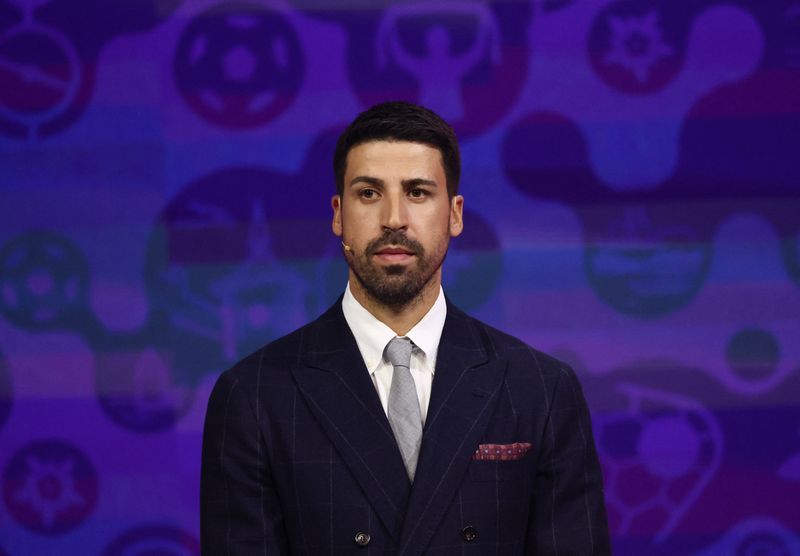
Sami Khedira has lived the reality of divided loyalties. The German midfielder, who helped his country win the 2014 World Cup, carries two nations in his heart—Germany, where he was born and raised, and Tunisia, his father's homeland. So when the subject turns to brothers representing different countries at international tournaments, Khedira dismisses concerns about identity conflicts entirely. Rather than viewing such situations as problematic, he sees them as a natural and even beautiful expression of contemporary football and the complex identities that define modern families across Europe and beyond.
Speaking at the Home of Football museum in New York, Khedira articulated a vision of international sport that embraces rather than penalizes the reality of global migration and cultural inheritance. For him, the phenomenon of siblings wearing different national jerseys is not evidence of fragmentation but rather a window into how identity functions in an interconnected world. His perspective carries particular weight given that his own brother Rani currently represents Tunisia at World Cup qualifiers—the nation of their father—creating a tangible example of his stated philosophy that multiple allegiances need not constitute a crisis.
The 2026 World Cup will feature eight sets of brothers, with four pairs playing together for the same country and four representing different nations. Among the most notable are Iñaki and Nico Williams, who play together for Athletic Bilbao but have chosen divergent international paths, with Iñaki committing to Ghana while Nico represents Spain. Similarly, brothers Guéla and Désiré Doudou split between Ivory Coast and France, whilst Derrick Luckassen and Brian Brobbey, connected through their mother but carrying their fathers' surnames, play for Ghana and the Netherlands respectively. Harry and John Souttar represent Australia and Scotland, demonstrating how fraternal bonds can span separate football nations across the globe.
Khedira's own journey illuminates why he holds such an egalitarian view. Born to a German mother and Tunisian father, he navigated questions about his identity throughout his career. He acknowledged experiencing moments when his Germanness was questioned due to his name and appearance, whilst simultaneously being perceived as German when in Tunisia. Rather than viewing this ambiguity as an obstacle, he frames it as an enriching duality. Having internalized both German and Tunisian cultures, he argues that individuals from such backgrounds possess something distinctive—a lived understanding of multiple worldviews that cannot be reduced to singular national allegiance.
The emotional resonance of this multicultural reality crystallized for Khedira when he witnessed the Doudou brothers singing both national anthems before a recent friendly match between France and Ivory Coast. That image encapsulated for him something profound about football's capacity to transcend sporting competition and communicate deeper truths about human belonging. The moment demonstrated that international football can celebrate rather than suppress the complex inheritance that many players carry, especially those from immigrant or mixed-heritage backgrounds increasingly common throughout European societies.
Khedira contextualizes the rise of such cases within broader structural changes in world football. The expansion of the World Cup to 48 teams has enlarged the stage for nations previously marginalized on the international scene. Countries like Cape Verde, Curaçao, and Haiti now possess pathways to compete at football's highest level, whilst African and Asian footballing nations have demonstrably narrowed the quality gap separating them from traditional powerhouses in Europe and South America. This democratization of opportunity has consequences for player development and recruitment, creating genuine choices for young athletes with multiple national eligibilities.
Yet Khedira recognizes that structural opportunity does not automatically translate into equitable outcomes. He contends that European nations retain a responsibility to contribute to football development in less resourced regions rather than simply harvesting talent through dual-nationality recruitment. Improved coaching infrastructure, educational systems, and technical foundations across Africa and Asia will ultimately prove more valuable than short-term talent acquisition strategies. The health of global football depends on sustainable development rather than extraction of prepared players from emerging markets.
The most challenging dimension of this multifaceted landscape, Khedira emphasizes, involves young athletes navigating federation interest and national eligibility decisions before reaching psychological maturity. Federations actively court teenagers, applying pressure—whether explicit or implicit—to commit to particular flags. Yet Khedira insists that such fundamentally personal decisions cannot be imposed through political considerations, family heritage, or institutional leverage alone. The choice demands something more intuitive: an internal compass that pulls a player toward one community over another.
Reflecting on his own decision at eighteen years old, Khedira acknowledged the profound difficulty of such choices when confronted at a formative age. The weight of potentially disappointing family, federation, or community expectations creates genuine psychological strain on adolescents still developing their sense of self. Nonetheless, he values that young people possess agency in determining their international futures rather than having these decisions made by others. He has counseled various national federations, including Tunisia, approaching such conversations with mutual respect for the autonomy required in matters so deeply personal and consequential.
Khedira's philosophy ultimately challenges conventional thinking about national sporting identity. Rather than treating dual allegiances as problematic disloyalty requiring resolution, he invites football—and society more broadly—to recognize that modern identity operates across borders and that individuals can authentically belong to multiple communities simultaneously. The presence of brothers representing different nations at world tournaments is not a flaw to be remedied but rather a reflection of contemporary reality that football can either resist or embrace. By embracing this diversity, international football positions itself as genuinely representative of the multicultural societies it serves whilst celebrating the rich textures of human identity that defy reduction to single national categorization.

