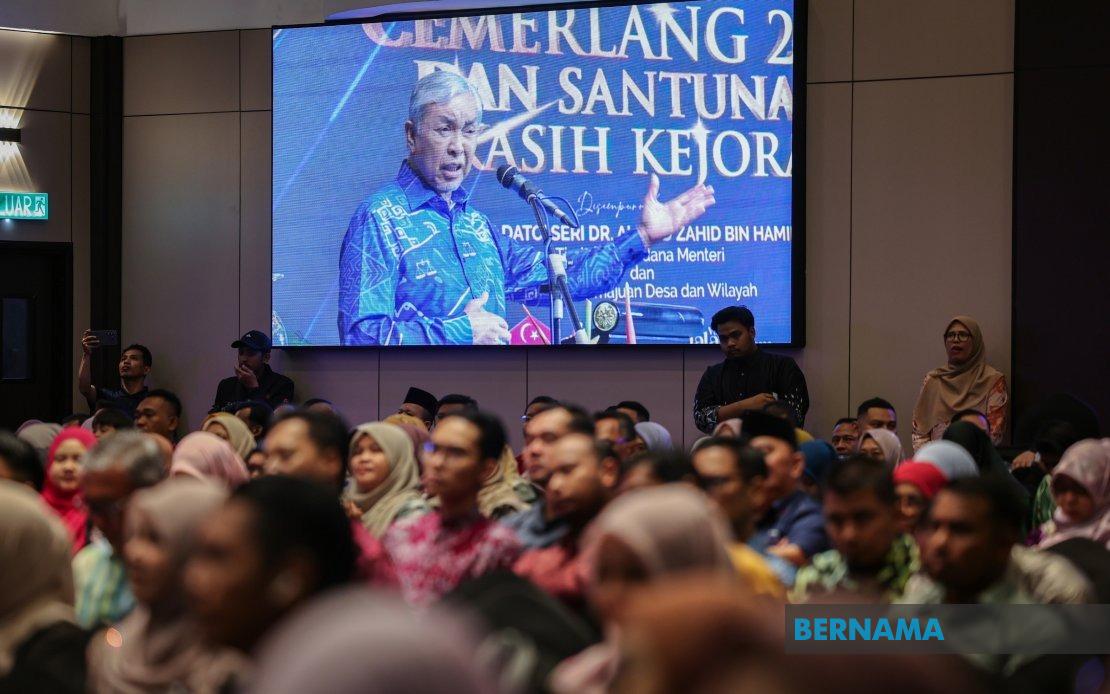
Barisan Nasional's campaign machinery in Johor is operating at full capacity despite external claims to the contrary, according to coalition chairman Datuk Seri Dr Ahmad Zahid Hamidi. Speaking in Kota Tinggi on July 2, the Deputy Prime Minister rejected characterisations of the campaign as lacklustre, framing such assessments as subjective political commentary rather than reflections of actual ground activity. Zahid's remarks come as the coalition prepares for the Johor state election scheduled for July 11, with early voting taking place on July 7.
Zahid acknowledged that rival political coalitions hold different perspectives on BN's campaign intensity, but stressed this did not diminish the reality of the coalition's on-ground efforts. He emphasised that BN welcomes observations and critiques from all quarters, whether supportive or otherwise, viewing such engagement as a natural element of democratic electoral competition. The coalition chairman's comments suggest a strategy of projecting confidence while deflecting negative narratives about campaign momentum ahead of polling day.
A significant aspect of BN's electoral strategy in Johor involves demonstrating administrative competence at the state level. Zahid highlighted that the Johor government under Menteri Besar Datuk Onn Hafiz Ghazi achieved record revenue of RM2.26 billion in the previous financial year, the highest recorded among Peninsular Malaysian states. This fiscal performance forms a cornerstone of BN's campaign narrative, positioning the coalition as a capable steward of state finances and development. The emphasis on revenue generation and financial management reflects a calculation that voters will reward proven governance over campaign rhetoric.
BN's contested all 56 state seats in the Johor election, signalling ambitions beyond merely retaining power. Zahid articulated the coalition's objective as securing a strengthened mandate that would facilitate implementation of its five-year development agenda. This approach reflects confidence in the Onn Hafiz administration's popularity and suggests BN strategists believe conditions favour an improved electoral outcome compared to previous contests. The drive for expansion reflects both organisational momentum and a reading of voter sentiment that appears favourable to the incumbent administration.
The relationship between BN's state-level operations and its participation in the federal-level Unity Government with Pakatan Harapan presents a potential complication for the coalition's electoral prospects. Opposition voices have suggested this cooperation might confuse traditional BN voters in Johor who have historically viewed PH as adversarial. However, Zahid dismissed such concerns, arguing that Johor's state government was constituted before the Unity Government was established at federal level. This chronological distinction, he maintained, provided clear separation between state and federal arrangements, making the coexistence of BN state governance and federal partnership unremarkable.
Zahid's approach to the BN-PH dynamic reflects a broader calculation about how Malaysian voters perceive coalition governments and inter-party cooperation. The Deputy Prime Minister noted that officials within the Unity Government work together professionally and cooperatively, suggesting this pragmatism should assuage any voter anxiety about divided loyalties or inconsistent governance. The framing positions BN as sufficiently confident in its state record that federal-level political arrangements need not undermine electoral support for state-level candidates. Whether this narrative persuades voters in Johor remains an open question, particularly among constituencies with deep historical allegiance to BN's founding principles of Malay-Muslim dominance.
Comments from Perikatan Nasional's spiritual leader Tan Sri Abdul Hadi Awang, calling for voters to categorically reject PH candidates including in contests where BN faces PH directly, prompted Zahid to differentiate BN's approach. While acknowledging PAS's political strategy, Zahid characterised BN's posture as more measured and professional, focused narrowly on promoting its own candidates rather than attacking rivals. This distinction reveals different electoral philosophies: PAS appears willing to adopt combative positioning and explicitly encourage split voting scenarios favourable to Perikatan, whilst BN prefers to emphasise administrative achievements and avoid direct antagonism toward federal coalition partners. The contrast illustrates tensions within the broader Malaysian political landscape regarding how coalitions navigate simultaneous state and federal competitions.
The electoral field in Johor remains fragmented across multiple coalitions and independent candidates. Beyond BN and PH's identical slate of 56 candidates each, Perikatan Nasional fields 33 nominees, whilst newer entrants Bersama contest 15 seats, MUDA four, and smaller parties Asli and PSM one seat each. Six independent candidates complete the roster. This fragmentation suggests Johor's electorate faces genuine choice beyond the traditional BN-PH binary, though structural advantages favour the two major coalitions. The presence of multiple viable alternatives may influence voter calculations, particularly if segments feel alienated from established players.
Zahid's comments reflect BN's broader strategic positioning in contemporary Malaysian politics, where the coalition seeks to reconcile its historical dominance with its current role within a federal power-sharing arrangement. The emphasis on administrative performance, state-level autonomy, and professional engagement with federal partners indicates a modernised electoral pitch less reliant on identity politics and more focused on governance metrics. Whether this approach suffices to maintain BN's traditional dominance in Johor, a state historically considered a coalition stronghold, will become apparent when voters cast ballots on July 11. The election serves as a significant test of whether BN's rebranding as a technocratic administrator rather than identity-based hegemon resonates with Johor's electorate.
The stakes in Johor extend beyond state-level outcomes, carrying implications for the federal Unity Government's stability and legitimacy. A decisive BN victory would strengthen the coalition's hand in asserting influence over federal policy and resource allocation, whilst confirming that voters accept the PH-BN arrangement at national level. Conversely, diminished BN performance would complicate the federal coalition's governance narrative and potentially embolden Perikatan to present itself as the authentic custodian of traditional Malaysian political values. For Southeast Asian observers and Malaysian stakeholders monitoring democratic resilience and coalition politics, the Johor election provides a revealing case study in how major parties navigate electoral competition whilst managing complex multiparty coalitions at different governmental levels.

