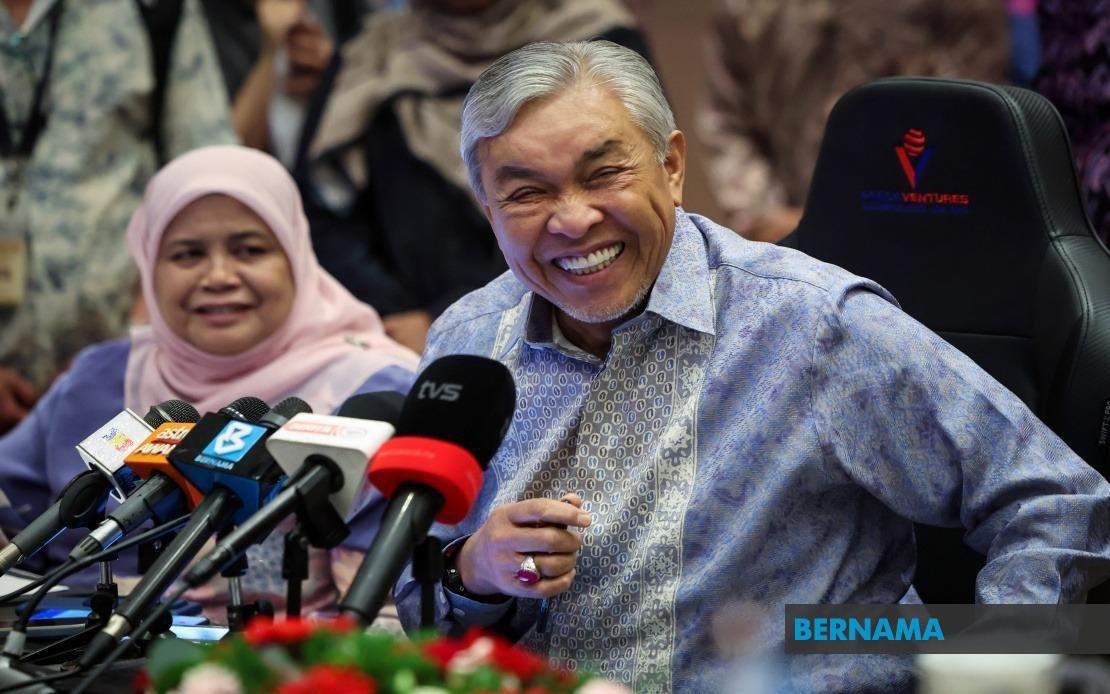
Barisan Nasional leadership has moved to quell persistent rumours of political instability by explicitly reaffirming its commitment to the Unity Government framework under Prime Minister Datuk Seri Anwar Ibrahim. Speaking in George Town on July 23, Deputy Prime Minister and BN chairman Datuk Seri Dr Ahmad Zahid Hamidi provided categorical reassurance that the 96-member coalition remains bound by its initial undertaking to sustain the administration through the entire 15th Parliament term, dismissing suggestions of any departure from this position.
Ahmad Zahid's intervention carries particular weight given the persistent speculation about BN's durability within the broader political alliance. He explicitly rejected references to controversial political manoeuvres, stating with unambiguous clarity that there would be no "Bangkok Move" or "Dubai Move"—colloquial references to rumoured efforts to destabilise governments through clandestine international negotiations. This forthright denial addresses a recurring concern among observers and market participants who have questioned whether BN's partnership with Pakatan Harapan and other coalition members would withstand internal pressures. The Deputy Prime Minister's statement underscores that BN's alignment with the Unity Government framework originated from the Yang di-Pertuan Agong's directive following the 2022 General Election, lending it constitutional legitimacy beyond mere political convenience.
The timing of Ahmad Zahid's remarks is significant, emerging amidst the Negeri Sembilan state election campaign where competing pressures are testing coalition unity. The state contest presents a microcosm of broader alignment challenges, with BN and Pakatan Harapan effectively campaigning independently despite their national-level partnership. This separation between state and federal cooperation mechanisms reflects the practical complexities of managing multi-party coalitions in Malaysia's federal structure, where state-level electoral dynamics frequently diverge from national arrangements. Such friction is inevitable in any coalition system but risks being misinterpreted as fundamental disagreement over the continuation of federal cooperation.
The BN chairman's comments arrived shortly after addressing an internal organisational challenge within the coalition. A polling district centre (PDM) in Klawang had ceased operations in apparent protest after BN declined to field a candidate for the contested state seat, instead leaving the position to Perikatan Nasional and Bersatu candidates. This decision, while strategic at the national level where maintaining coalition discipline matters, created tension at the grassroots level among BN activists. Ahmad Zahid characterised the situation as a resolvable administrative matter, noting that discussions with Negeri Sembilan UMNO leadership were underway and expected resolution within the campaign timeline. Such local-level complications, though manageable, illustrate the friction points that accumulate when coalition partners must navigate competing interests across multiple election levels simultaneously.
Additionally, Ahmad Zahid addressed speculation about potential formalisation of a Perikatan Barisan Nasional alliance structure. He clarified that references to "PBN" had appeared only in campaign rhetoric and had not progressed to official inter-party discussions. This distinction is crucial for understanding the current political landscape, where opposition figures occasionally invoke structural alternatives that lack substantive negotiation or formal consideration. The Deputy Prime Minister's statement effectively positioned such speculation as premature commentary rather than genuine political development, though his acknowledgment that any such arrangement would require careful deliberation leaves theoretical space for future discussions. This carefully calibrated response neither closes doors entirely nor suggests active exploratory talks, maintaining diplomatic flexibility while affirming present commitments.
The relationship between Ahmad Zahid and Prime Minister Anwar, despite their opposing campaign positions in the Negeri Sembilan contest, remains collegial and functional. This personal dynamic matters significantly in Malaysian politics where relationships between senior leaders frequently influence broader coalition stability. Ahmad Zahid's good-natured response to Anwar's earlier pantun verse—a traditional Malay poetic form emphasising unity and friendship—demonstrated that disagreement over electoral tactics does not corrode the underlying operational relationship necessary for government continuity. Such symbolic exchanges, while seemingly minor, communicate to party cadres and the broader public that coalition tensions remain manageable and that ideological differences do not translate into fundamental administrative breakdown.
From a Malaysian governance perspective, the emphatic reaffirmation of BN's commitment to the Unity Government addresses concerns about political sustainability that have periodically unsettled investors and international observers. Malaysia's economic performance partly depends on policy consistency and executive stability, both of which require predictable political arrangements. The uncertainty surrounding coalition durability creates unnecessary friction in policy implementation and investor confidence. By decisively rejecting speculation about political coups or coalition dissolution, Ahmad Zahid provides reassurance that the current framework, however imperfect, will persist through the electoral cycle. This stability enables government agencies to progress medium-term initiatives without perpetual concern about administrative continuity.
The broader Southeast Asian context reinforces the importance of Malaysia maintaining effective governance structures. Regional economies face interconnected challenges including supply chain disruptions, currency volatility, and climate-related pressures. Political instability in a major regional economy reverberates across the entire Association of Southeast Asian Nations (ASEAN) through trade networks and investment flows. Malaysia's position as a developed upper-middle-income nation and ASEAN's third-largest economy means that uncertainty here carries disproportionate weight. The Unity Government, despite its inherent tensions and compromises, provides a functioning framework for addressing these challenges. Continuity in this arrangement, therefore, serves not merely domestic interests but regional stability.
The coalition structure itself, while unconventional by historical Malaysian standards, has demonstrated unexpected durability. The partnership combines erstwhile adversaries—UMNO and Pakatan Harapan—in arrangements that require constant negotiation and compromise. Such coalitions are notoriously unstable globally, yet Malaysia's has survived two years of operation including multiple electoral tests at state and federal levels. This persistence suggests that the pain of opposition and the benefits of ministerial position create sufficient incentive alignment to sustain the partnership, at least through the current Parliamentary term. Ahmad Zahid's categorical statements today reinforce these underlying structural factors by providing unambiguous political cover for BN figures who might otherwise be tempted toward alternative arrangements.
Looking forward, the Unity Government's continuation through the 15th Parliament—expected to conclude around 2027—provides Malaysia with a defined horizon for political planning. This timeframe allows ministries to design and implement policy initiatives with confidence that supporting coalitions will remain in place. The Negeri Sembilan state election, despite its local dynamics, ultimately reinforces rather than undermines federal coalition stability by allowing each partner to maintain distinct identities at state level while preserving national-level cooperation. Ahmad Zahid's measured, direct intervention today serves to clarify these arrangements for internal party members, investors, and international observers, each of whom requires confidence in Malaysia's political trajectory.

