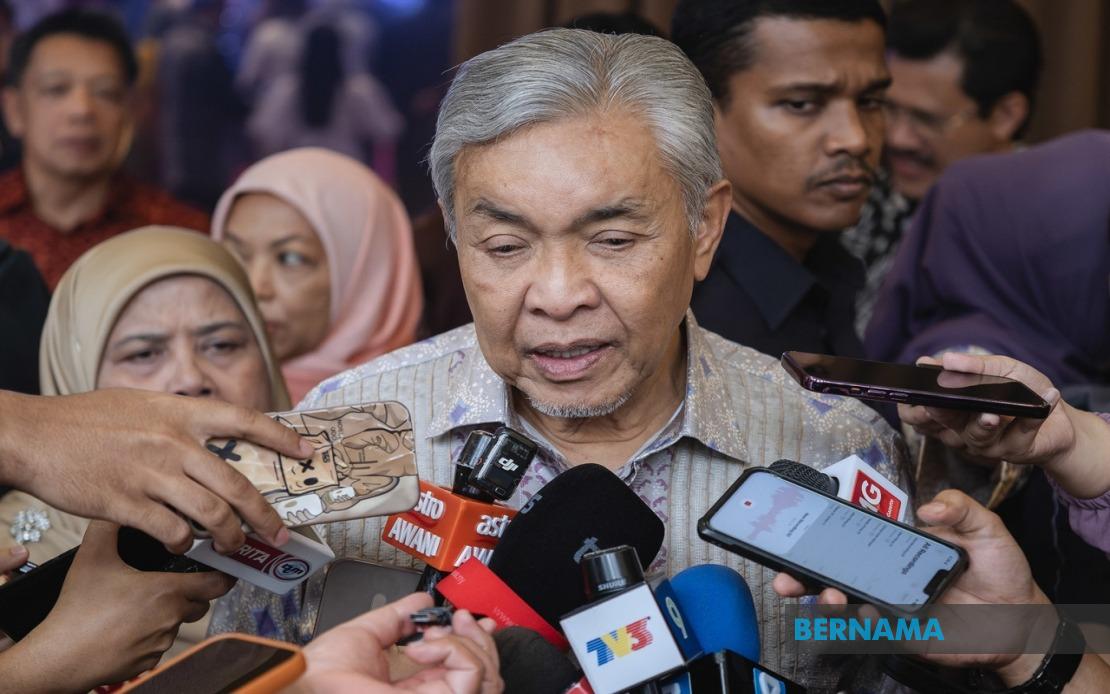
Barisan Nasional has committed to remaining entirely separate from decisions involving Negeri Sembilan's royal establishment and the state's Council of Justice and Laws (DKU) as the coalition gears up for the upcoming state election. Deputy Prime Minister Datuk Seri Dr Ahmad Zahid Hamidi, who also leads UMNO, made this declaration following strategic meetings with the party's leadership in the state, signalling that the coalition recognizes the importance of maintaining institutional boundaries during an election campaign.
The pledge reflects an attempt to manage perceptions during what has become an increasingly sensitive period for Malaysian politics. Ahmad Zahid's explicit commitment to avoid involvement in legal and royal matters suggests that BN leadership is acutely aware of how interference—or even the appearance of interference—in such spheres could damage the coalition's electoral prospects. By drawing clear lines around the jurisdiction and autonomy of the palace and the DKU, BN appears to be positioning itself as a respectful guardian of constitutional institutions rather than a force seeking to dominate all aspects of state governance.
This stance represents a notable shift in approach compared to Negeri Sembilan's previous election cycle. During the 15th state assembly polls, BN operated under a different alliance structure, cooperating with component parties from Pakatan Harapan as part of broader political arrangements. That collaborative model proved unsustainable or politically inconvenient, and BN is now charting an independent course for the August 1 election, which will determine control of 36 state seats. The change underscores how dramatically Malaysia's political landscape has shifted, with coalitions fragmenting and reforming based on local and national circumstances.
Ahmad Zahid's emphasis on internal party unity rather than external alliances reflects BN's current strategic priority. Rather than seeking to expand its appeal through partnerships with other political organizations, the coalition is focusing on consolidating support among its own ranks. This inward-looking approach suggests that BN believes its electoral prospects depend more on mobilizing existing members and supporters than on negotiating new political deals. For a coalition that once dominated Malaysian politics, this represents a more defensive posture, concentrating resources and messaging on core constituencies.
The timing of these remarks carries significance for Negeri Sembilan specifically and for Malaysian politics more broadly. The state has a unique constitutional arrangement with its elective monarchy, where the Yang di-Pertuan Besar is chosen by and from among the nine chiefs of the state's royal households. This system makes Negeri Sembilan particularly sensitive to perceptions of political interference in royal and institutional matters. Any suggestion that an election campaign is attempting to influence or pressure royal decision-making could provoke significant backlash and undermine democratic legitimacy.
The DKU, or Dewan Ketua-Ketua Negeri Sembilan, functions as both a guardian of Islamic law and a custodian of constitutional propriety within the state. Its involvement in legal and governance matters places it in a sensitive position during election periods. By assuring that BN will not intervene in DKU proceedings, Ahmad Zahid is essentially guaranteeing that the coalition will not attempt to weaponize judicial or religious processes for electoral advantage—a concern that voters across Malaysia have grown increasingly attentive to in recent years.
The coalition's approach also reflects lessons learned from recent political turmoil elsewhere in the country. Malaysia has witnessed multiple instances where political actors have been accused of manipulating institutions, prosecuting rivals through the courts, or leveraging royal prerogatives for partisan gain. These episodes have corroded public confidence in institutions and deepened polarization. By publicly disavowing such tactics before the Negeri Sembilan election, BN appears to be attempting to differentiate itself and appeal to voters fatigued by institutional politicization.
For opposition parties contesting the August 1 election, BN's pledge creates both opportunities and constraints. On one hand, they can hold the coalition to its word, pointing out any deviation as evidence of hypocrisy. On the other hand, if BN successfully maintains this boundary, it removes one avenue through which opposition parties might have hoped to demonstrate that the coalition was engaged in institutional manipulation. The election will therefore be decided more squarely on policy platforms, governance records, and traditional campaigning rather than on institutional drama.
The regional context cannot be ignored either. Negeri Sembilan, positioned between Kuala Lumpur and the Klang Valley, serves as a bellwether for broader trends in peninsular Malaysian politics. How BN performs here will send signals about the coalition's capacity to recover ground and whether its strategy of emphasizing institutional respect and internal unity can translate into electoral success. The result will likely influence how other coalitions approach similar challenges in future state and national elections.
Ahmad Zahid's emphasis on maintaining institutional distance also addresses implicit concerns about democratic backsliding. By voluntarily constraining BN's own potential reach into sensitive spheres, the Deputy Prime Minister is signalling that democratic norms and constitutional limits matter to the coalition. Whether this reflects genuine commitment or tactical calculation remains open to interpretation, but the public commitment itself has value in reassuring institutions and voters that political actors still recognize boundaries they should not cross.

