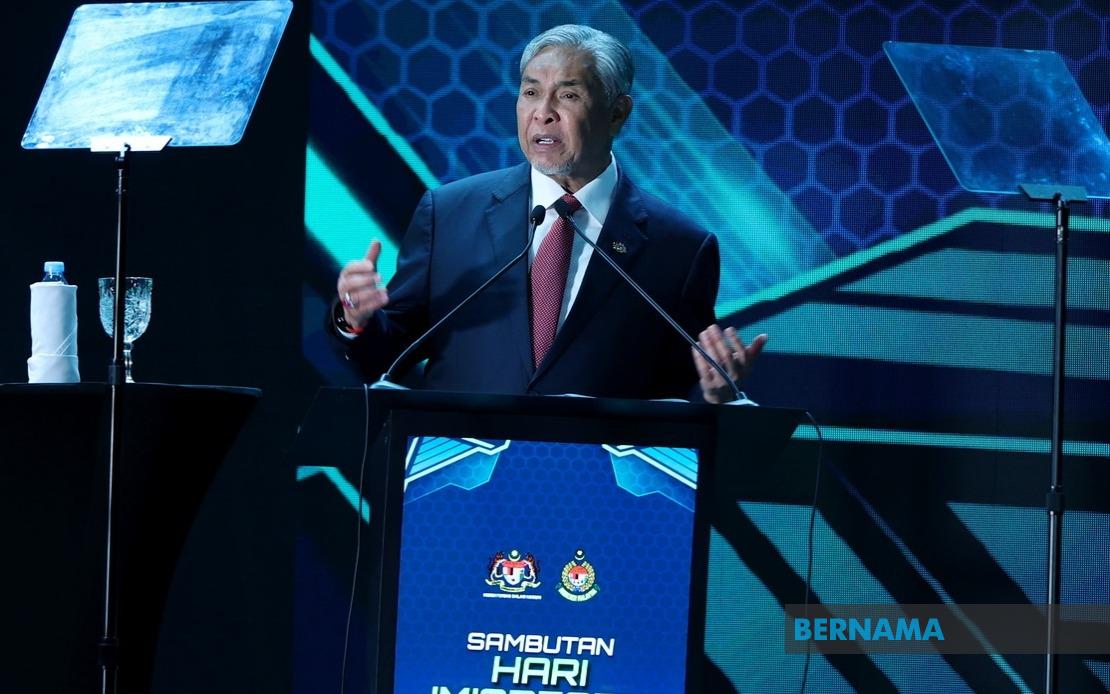
Barisan Nasional leadership has reaffirmed the coalition's unwavering commitment to the Unity Government, with party chairman Datuk Seri Dr Ahmad Zahid Hamidi making the declaration at the 2026 Immigration Day celebration in Cyberjaya. The assurance comes as a direct response to speculation about the coalition's future role in Malaysia's current political arrangement, with Ahmad Zahid stressing that the decision aligns with resolutions formally endorsed during UMNO's recent General Assembly.
The UMNO president and Deputy Prime Minister emphasized that no institution carries greater weight than the party's General Assembly when matters of strategic importance are deliberated and decided. This framing carries significant implications for understanding how Malaysia's largest Malay-Muslim political party makes its most consequential decisions, particularly regarding federal-level governance and coalition participation. By invoking the assembly's authority, Ahmad Zahid was essentially signaling that the commitment to the Unity Government represents a binding consensus among UMNO's broader membership, not merely a leadership preference that could shift.
Ahmad Zahid's remarks suggest an attempt to quell ongoing concerns about BN's stability within the coalition arrangement. The emphasis on respecting assembly-level decisions appears designed to project internal unity and constrain speculation about potential defections or shifting allegiances. In Malaysian political context, such public affirmations often serve as reassurances to coalition partners, particularly to the other ethnic-based parties in the Unity Government, that their non-Malay support base can depend on sustained BN participation in federal governance.
The timing of this reaffirmation coincides with ongoing political navigation in various state elections, where coalition discipline faces practical tests. Ahmad Zahid's statement fundamentally addresses the governance question of whether BN ministers and representatives will prioritize coalition loyalty over parochial state-level interests when campaigning and implementing policy. This tension between national coalition commitments and regional political ambitions has historically been a source of friction in Malaysian coalition arrangements.
On the matter of ministerial appointments and removals, Ahmad Zahid clarified the constitutional and practical reality that Prime Minister Datuk Seri Anwar Ibrahim retains exclusive authority over such decisions. This pronouncement becomes relevant in light of recent media reports indicating that Anwar had cautioned ministers and deputy ministers against leveraging their governmental positions to criticize coalition partners during state election campaigns. The framework Ahmad Zahid described essentially empowers the Prime Minister to enforce coalition discipline through the threat of ministerial dismissal, establishing a clear hierarchical mechanism for maintaining political order.
The Prime Minister's warning to governmental office-holders carries particular weight given Malaysia's tradition of ministerial accountability and coalition protocols. Anwar's reported stance that any minister or deputy minister contravening the stipulated guidelines would face removal sets explicit boundaries around acceptable political behavior. This represents an attempt to prevent the fragmentation that can occur when individual politicians prioritize electoral advantage in subnational contests over broader coalition coherence. For Malaysian readers monitoring coalition stability, such disciplinary mechanisms offer some concrete evidence of institutional mechanisms designed to prevent dissolution.
The Unity Government itself remains a relatively young political arrangement in Malaysian terms, having consolidated around the aftermath of the 2022 general election. Its composition includes BN, the Pakatan Harapan coalition, and various independent MPs and smaller parties. This diverse configuration inherently requires constant negotiation and discipline to function effectively. The tensions that occasionally surface—particularly when different coalition components compete in state-level contests—reflect the fundamental challenge of maintaining unity across ideologically and ethnically distinct parties with different strategic interests.
For BN specifically, the commitment to the Unity Government represents a significant strategic choice that shapes the party's political trajectory. Rather than pursuing purely oppositional strategies, the coalition's decision to work within government frameworks places greater emphasis on demonstrating competent administration and securing ministerial positions than on mounting aggressive electoral campaigns that might destabilize the broader arrangement. This approach trades potential short-term electoral gains for longer-term institutional security and access to state resources.
The implications for Malaysian political stability should not be underestimated. Coalition stability at the federal level determines not merely which parties hold ministerial portfolios, but substantively affects how policy is formulated, implemented, and adjudicated across bureaucratic structures. Continuity in coalition arrangements permits clearer long-term policy planning in areas ranging from economic development to infrastructure investment. Conversely, persistent instability creates uncertainty that can constrain investment decisions and administrative effectiveness across government agencies.
Regional observers and Malaysia's international partners also monitor coalition stability closely, as it affects the country's capacity to pursue coherent foreign policy and economic strategies. A fragmented federal government often produces inconsistent positioning on regional issues and economic initiatives. Ahmad Zahid's affirmation of BN's commitment thus carries implications extending beyond domestic political competition into broader questions about Malaysia's regional role and engagement with neighboring Southeast Asian states.
Looking forward, the sustainability of this commitment will be tested repeatedly as state elections proceed and political circumstances evolve. The explicit invocation of assembly-level authority provides Ahmad Zahid and other BN leaders with rhetorical resources to enforce party discipline, yet such declarations carry weight only if followed by consistent action. Future tests will likely emerge around resource allocation, ministerial appointments affecting state-level BN interests, and particularly in scenarios where state and federal political interests diverge sharply.
The broader context reveals Malaysian politics navigating toward more structured coalition governance rather than the dominant-party systems of previous decades. This evolution requires explicit commitments like Ahmad Zahid's and mechanisms like those Anwar articulated for enforcing discipline. Whether these institutional innovations prove durable will significantly influence how Malaysian coalition politics functions in coming years.

