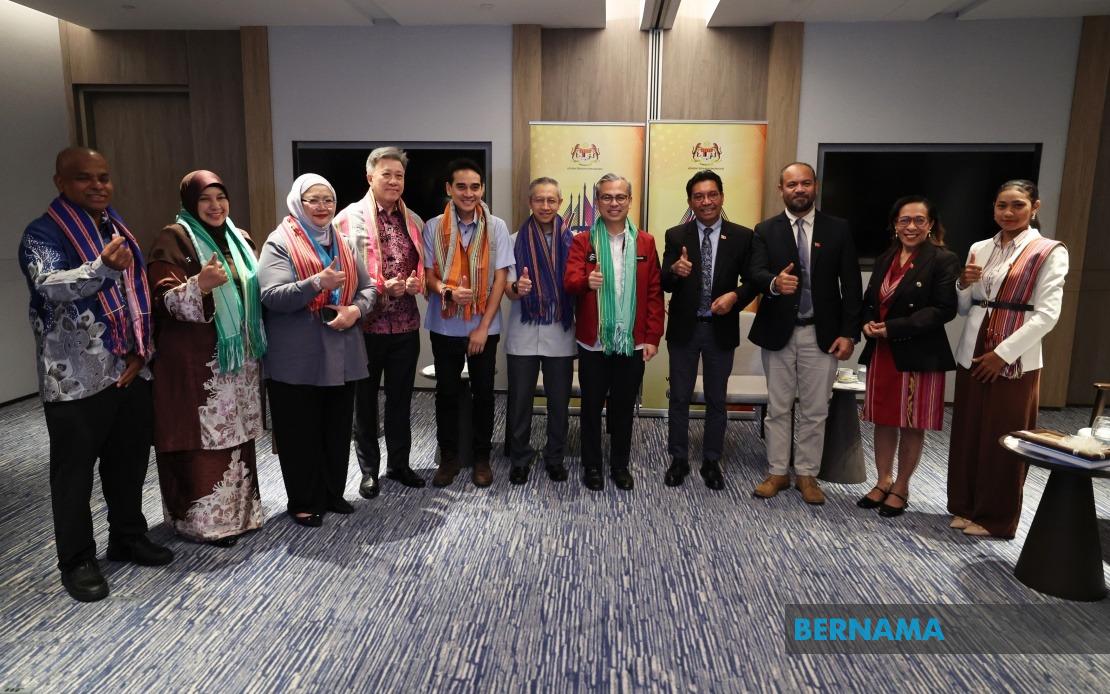
The Malaysian National News Agency (Bernama) and Timor-Leste's official news agency, Agência Noticiosa de Timor-Leste (TATOLI), have formalized a strategic partnership aimed at deepening regional media cooperation. The memorandum of understanding, exchanged during celebrations of the National Journalists' Day (HAWANA) 2026 in Butterworth, represents a significant step in building stronger institutional ties between the two ASEAN member states and reflects Malaysia's broader commitment to supporting the region's information ecosystem.
The agreement encompasses multiple dimensions of collaboration, with particular emphasis on the exchange of news, photographic material, and multimedia content across platforms. Beyond content sharing, the partnership establishes a framework for professional development, with Bernama committing to provide comprehensive journalism training and specialized courses to TATOLI personnel. This dual approach—combining content cooperation with capacity building—addresses both immediate information-sharing needs and longer-term institutional strengthening in Timor-Leste's media sector.
Bernama's Chief Executive Officer Datin Paduka Nur-ul Afida Kamaludin emphasized that this collaboration transcends bilateral advantage, instead serving a broader regional purpose. By channeling ASEAN-originated news through local agencies rather than relying on external international wire services, the partnership aims to ensure that the region's voice and narrative are shaped by regional actors themselves. This principle carries particular significance in an era when media narratives are increasingly contested and geopolitically sensitive, allowing Southeast Asian nations to exercise greater editorial autonomy over their information environment.
A practical dimension of the arrangement involves language accessibility and reach. Bernama's content will be disseminated through TATOLI's platform in four languages—Tetum, Portuguese, Bahasa Indonesia, and English—making Malaysian news accessible to Timor-Leste's diverse populations. In response, Bernama indicated its intention to add Portuguese to its existing six-language portfolio, which currently includes Bahasa Melayu, English, Tamil, Mandarin, Arabic, and Spanish. This linguistic expansion reflects the growing recognition that news agencies must operate within genuinely multilingual environments to maximize their influence and utility.
The timing of this agreement carries particular significance, as it was formalized following Timor-Leste's accession as ASEAN's eleventh member state in October 2025. According to Nur-ul Afida, TATOLI had initiated collaboration discussions even before official ASEAN membership materialized, demonstrating sustained institutional interest in deepening ties with Malaysia's news infrastructure. Bernama's deliberative approach to evaluating the proposal ensured that the final agreement would generate mutual benefits for both organizations and their personnel, rather than imposing asymmetrical obligations.
The training dimension addresses a critical infrastructure gap in Timor-Leste's media development. A contingent of TATOLI reporters is scheduled to undertake training at Bernama facilities before the year's conclusion, exposing them to operational practices across multiple news platforms. Bernama's institutional expertise is substantial—the agency maintains specialized editorial and instructional personnel covering online news, television, digital media, radio, and photography disciplines. Additionally, Bernama operates a formal training institution, the Bernama School of Journalism, and has accumulated over two decades of experience in professional development programming. This depth of institutional capacity positions Bernama as a credible and experienced partner for Timor-Leste's media professionalization efforts.
TATOLI's leadership reciprocated this commitment to the partnership while articulating a broader vision for regional media development. TATOLI President Noémio Mateus Soares Falcão emphasized that cooperation between news agencies could strengthen journalists' professional competencies, catalyze sectoral innovation, and contribute to creating an information environment characterized by freedom, responsibility, and social utility. His remarks underscored a shared understanding that professional journalism standards and ethical practices are foundational to functional democracies and informed citizenries.
Falcão's address also highlighted the contemporary challenge of information verification and credibility in digital environments. He noted that the rapid dissemination of content across diverse digital platforms creates both opportunity and responsibility for professional journalists to ensure that publicly circulated information is factual, verified, and grounded in established professional principles. This concern reflects anxieties about misinformation, disinformation, and the erosion of trust in institutional media that affect Southeast Asian societies broadly. The partnership thus implicitly addresses these systemic vulnerabilities by strengthening professional standards and institutional capacity in the region.
The agreement was formally executed by both agencies' leaders and ceremonially witnessed by high-level political figures, including Malaysia's Communication Minister Datuk Fahmi Fadzil, Timor-Leste's Secretary of State for Social Communication Expedito Loro Dias Ximenes, Prime Minister Datuk Seri Anwar Ibrahim, Penang Chief Minister Chow Kon Yeow, and Bernama Chairman Datuk Seri Wong Chun Wai. This configuration of attendees underscored the political significance attached to the collaboration, positioning it as part of Malaysia's broader foreign policy agenda and regional leadership role.
Bernama itself represents an established institutional actor in the global news ecosystem, having been established under parliamentary statute in April 1967 and officially inaugurated in August of that year, coinciding with Malaysia's independence anniversary. The agency operates as the official national news service, enjoying institutional standing and resources that reflect its role in disseminating government and national information. By contrast, TATOLI, established in 2016, remains a relatively young institution tasked with disseminating official information from Timor-Leste's government. The asymmetry in institutional maturity creates a clear capacity-transfer dynamic favoring the Malaysian partner.
The HAWANA 2026 event that hosted the agreement's ceremonial formalization itself demonstrated the regional dimensions of institutional media cooperation. Beyond Malaysian and Timor-Leste participants, the gathering included representatives from Cambodia and Laos, indicating that Bernama's outreach and media cooperation initiatives extend across the broader ASEAN membership. These parallel engagements suggest a coordinated strategy to strengthen institutional media capacity across the region while positioning Malaysia as a central node in regional information infrastructure.
For Malaysian stakeholders, the partnership represents both soft power projection and genuine institutional interest in regional development. By positioning Bernama as a provider of training and expertise to neighboring news agencies, Malaysia reinforces its image as a regional leader committed to strengthening ASEAN institutional capacity. Simultaneously, the agreement expands Bernama's reach and influence, creating pathways for Malaysian news and perspectives to circulate across additional linguistic and geographic territories. This mutually reinforcing dynamic of regional influence and institutional capacity has become increasingly characteristic of Malaysian foreign policy in Southeast Asia.

