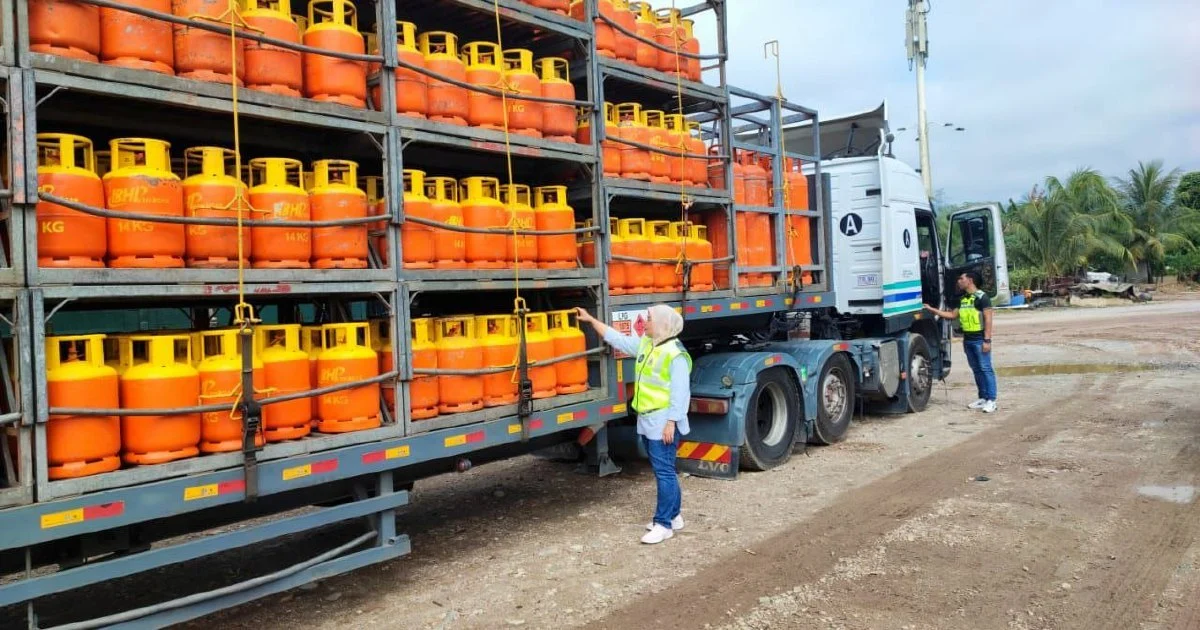
A surprise enforcement operation in Bentong has led to the seizure of a substantial cache of liquefied petroleum gas cylinders, with total value placed at RM405,000. The discovery was made at a concealed storage facility surrounded by fencing, where authorities located the pressurised gas containers stacked on a commercial trailer within the compound.
The raid highlights the ongoing challenge faced by Malaysian authorities in combating the unauthorised distribution and hoarding of essential household utilities. LPG cylinders remain a critical resource for Malaysian households and small businesses, particularly in areas where piped gas infrastructure remains underdeveloped. The sheer quantity discovered suggests an operation designed to circumvent official supply channels and potentially feed black market distribution networks across the Pahang region.
Enforcement teams conducted the operation based on intelligence gathered regarding suspicious activity at the location. The fenced nature of the storage area, which appeared designed to obscure the contents from public view, raised immediate red flags with authorities tasked with monitoring fuel and gas commodity integrity. Such concealment methods are commonly employed by operators engaged in illicit trading activities, where goods are diverted from legitimate supply chains to avoid proper taxation and regulatory oversight.
The Bentong district, situated strategically in western Pahang along the Perak border, has previously been identified as a transit point for goods moving between major population centres. This geographical positioning makes it an attractive location for individuals seeking to warehouse controlled commodities away from high-surveillance urban areas. The accessible nature of the district, combined with its network of industrial and agricultural properties, creates opportunities for unauthorised storage operations that might escape casual detection.
Liquefied petroleum gas cylinder operations fall under stringent regulatory frameworks enforced by multiple government agencies in Malaysia. Legitimate distributors must adhere to safety protocols, maintain proper licensing, and operate through authorised supply networks. Unauthorised hoarding represents not only an economic crime depriving the government of tax revenue, but also creates genuine public safety concerns. Improperly stored or handled LPG cylinders pose significant explosion and fire hazards, particularly when accumulated in residential or mixed-use areas without proper ventilation and safety systems.
The discovery underscores the economic incentives driving informal gas trading. With controlled pricing on LPG cylinders to maintain affordability for the general population, profit margins for legitimate retailers remain modest. This regulatory environment inadvertently creates opportunities for operators willing to circumvent official channels, who can achieve substantially higher returns by selling into unregulated markets or exporting across borders. The RM405,000 valuation suggests a sophisticated operation handling hundreds of cylinders.
The operation also reflects broader enforcement priorities within Pahang's regulatory framework. State and federal authorities have increased surveillance of commodity storage facilities following previous discoveries of similar illicit caches. These enforcement actions serve dual purposes: disrupting criminal operations and gathering intelligence about distribution networks that feed black market activities. Each successful raid generates leads regarding upstream suppliers and downstream customers involved in the unauthorised trade.
For Malaysian consumers and legitimate businesses reliant on LPG cylinders, such enforcement actions theoretically support market stability by removing unauthorised supply that could distort pricing. However, these operations must be balanced against concerns that disrupting supply chains could temporarily create cylinder shortages in affected regions. Authorities typically coordinate with legitimate distributors to ensure that seizures do not create artificial scarcity that drives consumers toward underground suppliers offering inventory at inflated prices.
The incident raises important questions about enforcement capacity given Malaysia's vast network of storage facilities, warehouses, and industrial properties. Detecting illicit operations requires sustained intelligence gathering, tip-offs from the public, and coordinated action by multiple agencies. The success at Bentong demonstrates that effective enforcement remains possible, but resource constraints mean that systematic, nationwide coverage remains challenging. Authorities must prioritise high-risk locations and remain responsive to community reports of suspicious activity.
Investigations following the seizure typically focus on identifying the operation's management structure, funding sources, and customer networks. This intelligence gathering phase often proves more valuable than the physical seizure itself, as it enables authorities to disrupt broader criminal enterprises rather than simply removing inventory from circulation. Successful prosecutions require building comprehensive cases that link individuals to the contraband and demonstrate their knowledge and intent in hoarding controlled commodities.
The Bentong seizure also carries implications for the broader Southeast Asian context, where cross-border smuggling of fuel and gas products remains a persistent challenge. Malaysia's regulated LPG pricing creates price differential incentives with neighbouring countries, potentially encouraging transnational trade. Intelligence sharing between Malaysian authorities and counterparts in Thailand and Singapore helps identify patterns suggesting large-scale diversion toward export markets rather than purely domestic black market distribution.
Moving forward, this operation underscores the necessity for continued investment in enforcement capacity, public awareness campaigns encouraging reporting of suspicious activity, and technological solutions for tracking authorised cylinder distribution. Digital tagging systems and improved supply chain monitoring can make it progressively more difficult for operators to successfully divert large quantities without detection. Community engagement remains essential, as tip-offs from observant citizens often provide the crucial intelligence that triggers successful enforcement operations like the Bentong raid.

