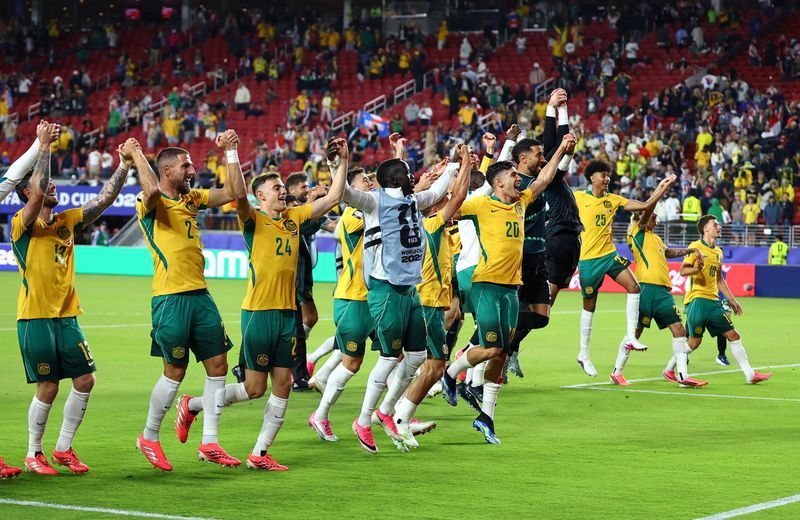
Australia have secured their passage to the World Cup's round of 32 after a tense 0-0 stalemate with Paraguay on Thursday, marking the Socceroos' third appearance in the tournament's knockout phase. The match, played at San Francisco Bay Area Stadium in California's Santa Clara region, saw Tony Popovic's squad seal second place in Group D and set up a meeting with the runner-up from Group G, which will be determined once Egypt face Iran and Belgium take on New Zealand in Friday's remaining fixtures.
The contest proved to be a grinding affair, with neither side able to find the breakthrough despite Australia dominating large portions of play. Paraguay, meanwhile, finished with four points and must now await the outcome of other third-place matches to confirm whether their tally will be sufficient to sneak into the last 16 as one of the tournament's eight best third-placed teams. The 2010 quarter-finalists, having peaked on the world stage over a decade ago, face an anxious wait as the final group matches play out across the competition.
Popovic engineered a significant tactical reshuffle ahead of the encounter, making six alterations to his starting lineup in a deliberate attempt to inject attacking momentum. The inclusion of Nestory Irankunda, known for his energetic play and direct approach, alongside Cristian Volpato in the forward ranks signalled clear attacking ambitions despite the pressure to simply secure qualification. Jordan Bos switched from his usual left-back position to the right side to compensate for the absence of injured defender Jacob Italiano, a positional flexibility that would prove central to Australia's attacking play.
The Socceroos made several promising advances down the right flank in the opening exchanges, with Volpato and Bos creating chances that went begging. Early in the encounter, Volpato laid the ball for Jackson Irvine, who found himself in space on the right side of the penalty area but produced a wayward finish, driving his shot directly at Paraguay goalkeeper Orlando Gill when greater precision might have changed the match's complexion entirely. Further attempts from both Bos and Volpato in the latter stages of the first half drew saves from Gill, though neither striker penetrated deeply enough to create genuine alarm.
Paraguay's attacking output in the opening 45 minutes was limited to a single shot, reflecting their cautious approach and Australia's territorial dominance. However, coach Gustavo Alfaro made an attacking change at the interval, introducing Brazilian-born forward Mauricio to inject impetus into the South American side's play. Within five minutes of the restart, Mauricio tested the Australian goalkeeper with an ambitious long-range effort, indicating Paraguay's shift toward a more aggressive posture.
The momentum gradually tilted in Paraguay's favour as the second half progressed, with the dynamic Julio Enciso becoming increasingly influential in breaking down Australia's defensive lines. Enciso created problems on multiple occasions through his direct running and positioning, and came closest to breaking the deadlock eight minutes from full-time when he connected with a low shot that flashed wide of the left post. The intensity of the encounter visibly increased as the final whistle approached, with both teams sensing an opportunity to settle the matter.
In an enthralling concluding period, Australia came desperately close to snatching victory when Bos made a determined run down the right flank in the 89th minute. The fullback drove forward with pace, split two defenders in the process, charged into the penalty area and unleashed a shot that fizzed across the face of goal just beyond the far post. Had the ball found the target by even a matter of inches, it would have delivered a dramatic late winner for the Australians and confirmed their progression with a victory rather than qualification by design.
Paraguay pressed for a winner in the closing moments, with Mauricio finding space on the edge of the technical area and testing Australian goalkeeper Thomas Beach with a low effort. However, the shot lacked the power or accuracy to trouble Beach seriously, and the keeper collected the effort with relative ease. As the final moments ebbed away, Australia held firm to secure their passage into the knockout rounds, though their performance—marked more by defensive solidity and missed opportunities than flowing attacking football—reflected the pragmatism required to advance at the World Cup's latter stages.
The draw leaves Paraguay in a precarious position depending on how other results unfold, while Australia now prepares to face a Group G runner-up in their first knockout match. For Malaysian and Southeast Asian readers, this result underscores the tightest margins operating at elite international football tournaments, where securing progression often matters more than the manner of doing so. Australia's qualification also means the Socceroos continue their presence as one of Asia's strongest performing nations on the world's biggest football stage.

