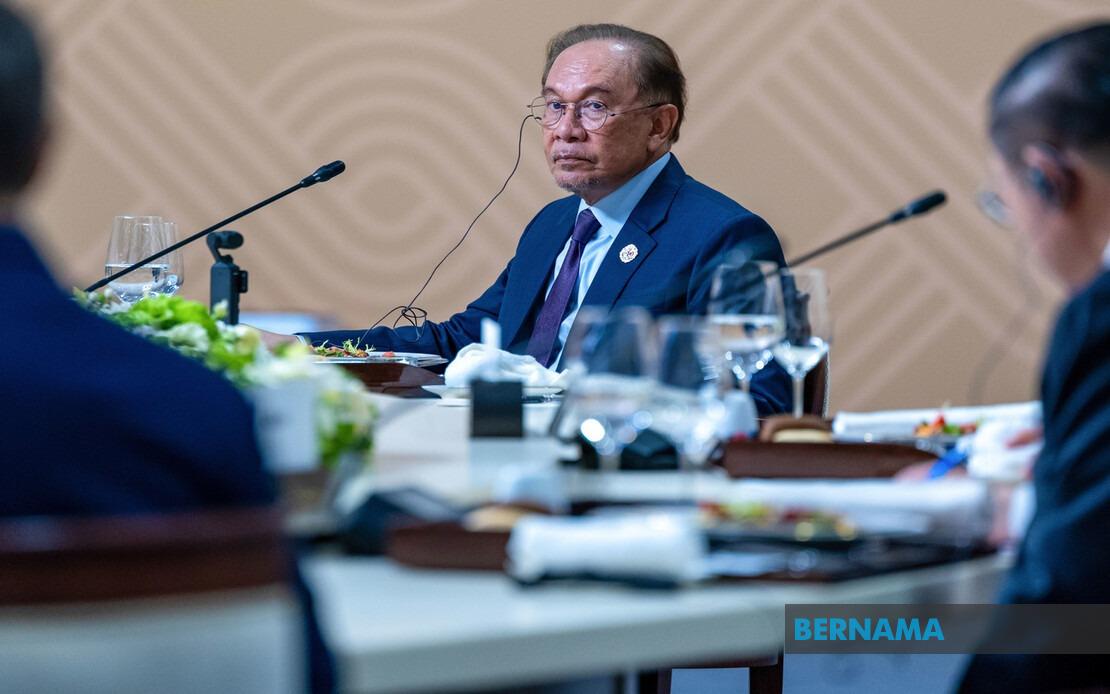
Prime Minister Datuk Seri Anwar Ibrahim has called for the Association of Southeast Asian Nations and the Shanghai Cooperation Organisation to consolidate their institutional resources in the fight against transnational organised crime and to establish a cohesive regional approach to energy security. Speaking during an ASEAN-Russia working lunch in Kazan on June 18, Anwar argued that both regional blocs possess sufficient foundations for deepened cooperation and should now move beyond symbolic agreements into concrete collaborative mechanisms that produce tangible outcomes.
The Malaysian leader referenced the 2005 memorandum of understanding already binding ASEAN and the SCO, which encompasses counter-terrorism initiatives, drug trafficking prevention, money laundering investigations, and economic-financial partnerships alongside energy collaboration frameworks. Rather than negotiating fresh accords, Anwar stressed the need to activate and expand these dormant provisions, directing organisational focus toward a narrower range of priorities where substantive progress could be demonstrated within realistic timeframes. This strategic narrowing represents a pragmatic acknowledgment that without discipline and resource concentration, multilateral initiatives often dissipate into rhetorical exercises.
The challenge posed by digital-age transnational crime featured prominently in Anwar's analysis. Online fraud operations, illicit fund transfers, and human trafficking networks now traverse borders with speeds that outpace traditional law enforcement response mechanisms, he noted. A coordinated intelligence-sharing architecture between ASEAN's member states and SCO participants would generate multiplicative defensive capacity, enabling regional authorities to anticipate and dismantle criminal networks before they complete cross-border operations. This framing resonates particularly for Southeast Asian nations, where online scam syndicates and trafficking rings have inflicted mounting economic and social damage, often operating from jurisdictions outside the region's direct reach.
Energy cooperation emerged as the second pillar of Anwar's proposal, reflecting Malaysia's positioning as both an energy exporter and a regional economy vulnerable to supply disruptions. The SCO membership encompasses major hydrocarbon producers—notably Russia, Kazakhstan, and Uzbekistan—alongside emerging markets with substantial renewable capacity development potential. Anwar, speaking also in his capacity as Finance Minister, identified energy security and the managed transition toward lower-carbon sources as complementary objectives requiring technological transfer and shared expertise. This dual framing acknowledges growing international pressure on ASEAN economies to decarbonise while simultaneously addressing legitimate development and energy independence concerns.
The Prime Minister outlined a comprehensive energy cooperation agenda spanning energy efficiency, grid modernisation, liquefied natural gas procurement strategies, renewable integration protocols, and knowledge exchange on system resilience and operational safety. These constitute practical, immediately implementable projects rather than aspirational climate commitments, suggesting Malaysian readiness to engage in technical cooperation even amid geopolitical complexities. For Southeast Asian policymakers balancing climate obligations with energy poverty reduction and industrial competitiveness, such pragmatic engagement with major energy-producing blocs represents a rational hedging strategy.
Anwar extended his reasoning to encompass the Eurasian Economic Union, another regional grouping with which ASEAN maintains formal cooperative frameworks. He advocated transforming these institutional relationships into genuine commercial catalysts by systematising private-sector engagement. Regular meetings between ASEAN and EAEU business communities, facilitation of participation in major trade and investment forums, and deliberate support for small and medium enterprises seeking market access across both blocs would accomplish what government-to-government declarations often fail to achieve: measurable expansion of commercial activity and capital flows.
Small enterprise competitiveness surfaced as a specific concern within Anwar's EAEU proposal. Malaysian and Southeast Asian firms often lack the technical sophistication, market intelligence, and operational scale to compete internationally or navigate unfamiliar regulatory environments. Structured capacity-building initiatives addressing technology adoption, workforce skills development, and market intelligence would enable smaller regional exporters to capture opportunities within Eurasian markets, thereby distributing the benefits of cooperation beyond large conglomerates and state-owned enterprises.
An additional dimension of the ASEAN-EAEU relationship centres on emerging economic domains where mutual interests are converging. Digital economy development, artificial intelligence governance, cybersecurity resilience, and food security constitute frontier areas where neither bloc possesses overwhelming comparative advantage, potentially enabling more balanced partnership models than traditional resource-extraction relationships. For ASEAN, this represents an opportunity to shape global standards and frameworks at their formation stage rather than adapting to established protocols.
Anwar's remarks reflect Malaysia's broader strategic positioning within overlapping regional architectures. As both an ASEAN member and an SCO dialogue partner, Malaysia navigates multiple institutional relationships, each offering distinct strategic advantages. The emphasis on concrete deliverables and measurable timeframes suggests recognition that bloc-to-bloc cooperation requires discipline to remain consequential. Without specific targets and accountability mechanisms, such frameworks risk accumulating underutilised memoranda while yielding limited practical benefit to constituent populations.
The timing of these statements, delivered during the ASEAN-Russia Commemorative Summit in Kazan, underscores intensifying engagement between Southeast Asia and Russia despite broader geopolitical tensions. Malaysia's willingness to propose deeper institutional cooperation despite global divisions reflects its commitment to diversified partnerships and its belief that functional collaboration on non-political issues can proceed parallel to disagreements elsewhere. This approach carries particular relevance for smaller Southeast Asian economies seeking to maximise strategic autonomy through balanced great-power engagement.
Implementing Anwar's proposals would require substantive bureaucratic reorganisation and sustained political commitment from participating states. Intelligence-sharing on transnational crime demands overcoming sovereignty sensitivities and building trust across diverse legal systems. Energy cooperation requires coordinated investment frameworks and risk-sharing mechanisms. Private-sector engagement necessitates removing regulatory barriers to market access. These operational challenges explain why many regional frameworks remain symbolically robust yet practically dormant. Whether ASEAN and its partners can translate Anwar's vision into functioning mechanisms will determine whether these groupings evolve into consequential institutions or remain primarily diplomatic forums.