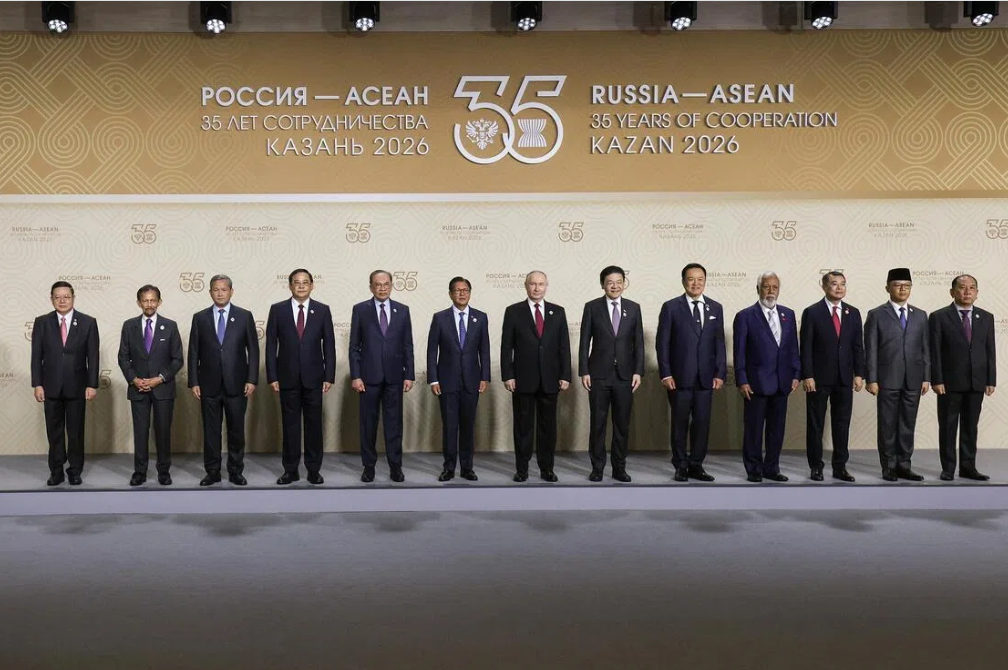
The Association of Southeast Asian Nations and Russia have reaffirmed their commitment to expanding partnership across a broad spectrum of shared interests at a landmark summit held in the Russian city of Kazan on June 17 and 18. The gathering, which brought together senior leaders from the region and Moscow, served as a milestone moment—commemorating 35 years of bilateral relations and three decades since the establishment of formal dialogue mechanisms between the two sides.
Three major agreements emerged from the discussions, with each designed to shape the trajectory of Asean-Russia engagement over different timeframes. The Kazan Declaration, the centrepiece document, offers both a retrospective review of cooperation achievements since 1989 and a forward-looking framework charting priorities for the coming years. The declaration explicitly identifies maritime affairs, trade and investment flows, energy collaboration, infrastructure connectivity, security cooperation, educational exchange, and cultural development as focal areas warranting intensified effort. This expansive agenda reflects the sophisticated understanding on both sides that bilateral ties must evolve to address contemporary regional challenges while capitalising on complementary strengths.
Concurrently, the signatories adopted a Joint Statement on Cultural Cooperation, signalling recognition that sustainable geopolitical partnerships require deep roots in people-to-people relationships. The statement calls for accelerating cultural exchanges and fostering closer ties among citizens, acknowledging that diplomatic frameworks alone prove insufficient without genuine human connection. The Asean-Russia Comprehensive Plan of Action (2026–2030) provides the operational scaffolding for translating these diplomatic intentions into concrete deliverables over the next five years, offering specificity and accountability mechanisms often lacking in symbolic declarations.
Singapore's Prime Minister Lawrence Wong articulated a carefully calibrated diplomatic position during his address, emphasising that Asean and Russia should concentrate on areas where interests genuinely converge rather than attempting forced alignment on contentious matters. His remarks reflected a pragmatic understanding that in an increasingly fractious global environment, selective cooperation on mutually beneficial initiatives—ranging from disaster management to counter-narcotics operations—offers more durable outcomes than attempting comprehensive strategic alignment. Wong specifically highlighted Singapore's appreciation for Russia's recognition of Asean Centrality, the principle that the bloc should remain the driving force for regional architecture and diplomacy in Southeast Asia.
Wong underscored Singapore's expectation that Russia will participate in forthcoming meetings of the ASEAN Regional Forum and East Asia Summit, scheduled for the Philippines later in 2024, while confirming Moscow's continued backing of these mechanisms as Singapore assumes the Asean chair in 2027. This rotation of leadership positions represents a critical opportunity for the lion city to demonstrate that engagement with Russia remains compatible with Asean's broader commitments to regional multilateralism and dialogue, even amid geopolitical tensions elsewhere. The emphasis on Russia's role in Asean-led forums carries particular significance for Malaysian and other regional stakeholders, as it affirms that the bloc maintains space for substantive engagement with major powers across the geopolitical spectrum.
The prime minister's remarks on international law and the rules-based global order signalled Singapore's—and by extension, Asean's—unwillingness to become a theatre for great-power competition. Wong stated that countries must uphold principles of sovereignty and territorial integrity, with particular reference to the bloc's consistent advocacy for peaceful dispute resolution in line with the United Nations Convention on the Law of the Sea. These statements carried implicit reference to the South China Sea territorial disputes, where multiple Asean members maintain claims, underscoring the organisation's determination to prevent its waters from becoming flashpoints for external powers.
Singapore's position on Ukraine and the Middle East, articulated through Wong's remarks, demonstrates the tightrope-walking required of Asean states navigating between Western and Russian interests. Singapore has maintained its condemnation of Russia's invasion of Ukraine as violating international law and has upheld sanctions measures imposed in 2022, yet simultaneously engages Moscow in constructive dialogue on matters of regional consequence. This balancing act reflects broader Asean policy: principled opposition to territorial aggression coexists with pragmatic recognition that Russia remains a major power with legitimate interests in regional stability. Wong's welcoming of the United States-Iran peace agreement and hopes for Strait of Hormuz reopening similarly demonstrate how Asean members frame their diplomatic activities around universal principles rather than bloc alignment.
The bilateral meeting between Wong and Russian President Vladimir Putin, held at Putin's behest, provided opportunity for candid exchange on subjects where Singapore and Russia diverge sharply. Wong's subsequent social media statement—emphasising that dialogue and engagement retain value even amid disagreement—captured the delicate diplomatic dance required when cultivating relationships across ideological and geopolitical divides. For Malaysia and other Asean members, Singapore's approach offers a template for maintaining constructive engagement with Moscow without compromising fundamental positions on international law or regional autonomy.
Wong's separate engagement with Rustam Minnikhanov, the elected leader of Tatarstan, reflects the sophisticated multi-level diplomacy increasingly characteristic of Asean external relations. The discussion of bilateral cooperation with this major Russian federal subject—dating from Lee Kuan Yew's 2007 visit to the region—demonstrates how Asean states develop substantive ties with Russian regions and cities rather than concentrating solely on Moscow-level diplomacy. Such decentralised engagement creates resilience in relationships and generates tangible people-to-people connections that can weather broader geopolitical turbulence.
For Malaysia specifically, the Kazan summit's outcomes carry implications across multiple domains. The maritime cooperation provisions offer potential frameworks for addressing shared concerns regarding navigational safety, port security, and environmental protection in regional waterways. The energy collaboration agenda aligns with Malaysia's strategic interests in diversifying energy partnerships and participating in discussions on hydrocarbon management. The educational and cultural exchange provisions create opportunities for Malaysian institutions and civil society to deepen connections with Russian counterparts, potentially expanding the talent and knowledge networks available to both societies.
The security cooperation provisions merit particular attention from Malaysian policymakers. Shared challenges including transnational crime, maritime piracy, and emerging hybrid threats create legitimate grounds for intelligence-sharing and operational coordination. Russia's participation in Asean-led security forums provides mechanisms through which Malaysia and other members can shape Moscow's understanding of regional security concerns while benefiting from Russian expertise in areas such as counterterrorism and cyber security.
The Kazan Declaration's emphasis on connectivity warrants scrutiny regarding its potential to advance regional infrastructure development. Russia's Belt and Road participation and infrastructure investment capabilities could complement Asean's own connectivity aspirations, though Malaysian stakeholders should examine carefully the terms under which such cooperation occurs to ensure alignment with existing developmental frameworks and debt sustainability principles.
Ultimately, the Asean-Russia summit demonstrates that the bloc retains capacity to engage major powers on pragmatic bases while maintaining principled positions on universal norms. For Malaysia and fellow members, the Kazan outcomes provide operational roadmaps for deepening cooperation with Russia across discrete sectors where mutual benefit clearly exists, while preserving strategic autonomy and commitment to rules-based regional order. This selective, interests-based approach to Russia engagement reflects mature statecraft appropriate to the region's complex geopolitical environment.

