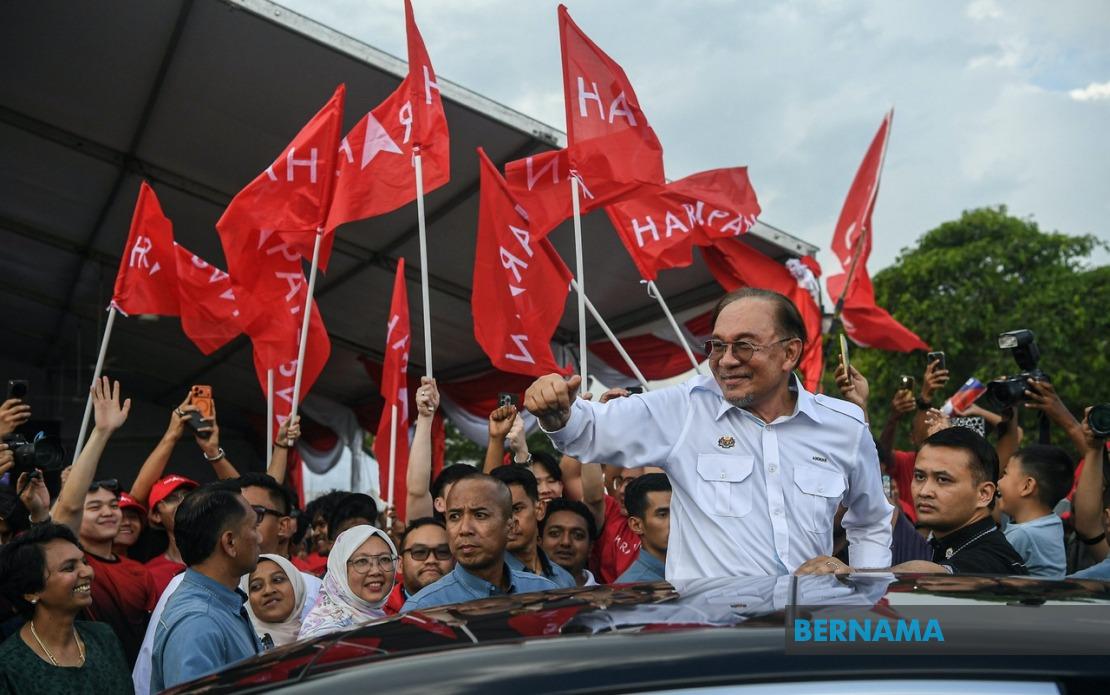
Prime Minister Datuk Seri Anwar Ibrahim's high-visibility campaign presence throughout Johor is delivering measurable momentum for the Pakatan Harapan coalition as it contests the 16th state election with ambitions across all 56 legislative assembly seats. Communications Minister Datuk Fahmi Fadzil, who doubled as the opposition coalition's communications director, attributed the palpable shift in campaign energy to the organic response generated by the Prime Minister's personal engagement with voters at grassroots level across multiple constituencies.
The depth of community engagement, according to Fahmi, transcended typical election choreography and reflected genuine public interest rather than orchestrated enthusiasm. His observations came after accompanying Anwar to campaign events in Senggarang and Semerah within Batu Pahat district, where he noted the spontaneity of voter interactions. In one telling instance, an elderly man transported his wife by trishaw specifically to encounter the Prime Minister—a detail that underscored the drawing power of Anwar's personal presence beyond formal campaign infrastructure.
Fahmi's assessment, delivered during a visit to Bernama's operations centre in Johor Bahru, suggested that such grassroots receptiveness indicated a broader acceptance of the Pakatan narrative being articulated throughout the election period. The minister framed the phenomenon not merely as political theatre but as evidence that voters were actively contemplating the coalition's policy platform and electoral vision, even if immediate conversion to cast ballots remained uncertain. This distinction between curiosity and commitment would prove crucial in determining whether on-ground enthusiasm translated into the actual electoral outcomes Pakatan required.
The campaign strategy centred on Anwar's personal availability had been deliberately intensified in the immediate pre-polling window. Over the weekend of July 4 and 5, the Prime Minister participated in 15 separate campaign engagements statewide, oscillating between constituency meetings, town halls, and candidate support sessions designed to energise local party machinery while maintaining his visible connection to the electoral contest. This demanding schedule demonstrated the coalition's assessment that Anwar's participation could meaningfully influence outcomes in a state where Pakatan faced organised opposition across all available seats.
Packatan's comprehensive approach to the Johor contest reflected the state's strategic importance within Malaysian politics and its historical role as a contestable arena. By fielding candidates in every single one of the 56 seats—rather than concentrating resources on winnable constituencies—the coalition signalled determination to compete for mandate rather than simply defend existing positions. This all-in approach carried both tactical advantage through comprehensive coverage and inherent risk in overextending finite organisational resources across such expansive territory.
The competitive landscape itself remained densely populated, with 172 candidates ultimately contesting the 56 seats, indicating significant multi-cornered contests that would complicate vote consolidation. Such fragmentation worked differently across constituencies depending on local political history, demographics, and incumbent performance, adding layers of complexity to Pakatan's ground strategy. The coalition's reliance on Anwar's star power to cut through electoral noise in such environments appeared to rest on assumptions about his capacity to generate sufficient swing among undecided voters.
Electoral mechanics proceeded according to schedule, with early voting conducted on the same day Fahmi delivered his optimistic assessment of campaign trajectory, and polling day positioned for July 11. The compressed timeline meant that campaign impact had to crystallise rapidly into voting intention, leaving little room for sustained organisational recovery should initial momentum dissipate. Early voting patterns typically offered predictive signals about broader electoral sentiment, though interpretation often proved contested between competing campaigns.
Malaysia's broader political context informed interpretation of Johor's significance. State elections served as intermediate barometers of national sentiment, neither binding nationally nor entirely disconnected from federal political currents. Packatan's 2023 federal election gains had positioned the coalition as a credible alternative to long-dominant structures, yet state-level contests revealed highly variable results reflecting local conditions, incumbent performance, and regional political dynamics distinct from federal-level calculations. Johor presented a critical test of whether federal momentum could translate into state-level competitiveness.
The Prime Minister's active presence in Johor's campaign represented more than standard political engagement. Anwar's personal credibility, accumulated through decades of political struggle and rehabilitation following imprisonment, carried particular resonance among portions of the electorate seeking change or validation of new political directions. His accessibility at campaign events, as evidenced by elderly voters' willingness to travel to encounter him, suggested psychological investment in his person beyond typical electoral support.
For Southeast Asian observers tracking Malaysia's democratic evolution, the Johor election offered insight into how institutional competition operated within a mature but contested democratic system. The coalition's confident deployment of comprehensive candidate slates indicated confidence in electoral contestability, while the importance attributed to prime ministerial campaigning reflected continuing personalisation of politics despite institutional frameworks ostensibly emphasising party-level competition. These dynamics mirrored patterns across Southeast Asia where personal political leadership retained disproportionate influence over institutional or programmatic factors.
The outcomes awaiting voters on July 11 would determine whether Fahmi's optimistic reading of community sentiment accurately predicted ballot-box behaviour, or whether the enthusiasm he witnessed represented interested observation rather than transformative electoral commitment. Such distinctions between campaign atmosphere and actual voting patterns frequently emerged in Malaysian elections, requiring post-election analysis to properly calibrate the relationship between public engagement and democratic choice.

