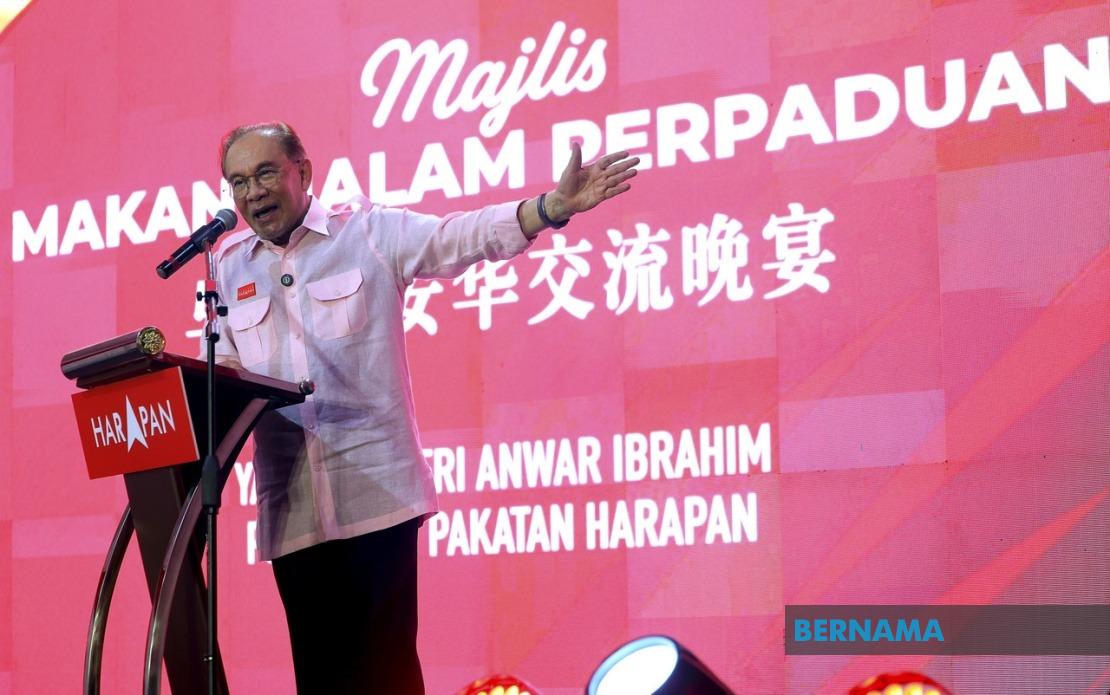
Prime Minister Datuk Seri Anwar Ibrahim has launched a pointed critique at opposition parties contesting the upcoming Negeri Sembilan state election, highlighting what he characterises as their premature scramble for the menteri besar's office even before votes are cast. Speaking at a campaign dinner in Sikamat on the eve of the election campaign's final stretch, Anwar drew a stark contrast between the opposition's internal jostling and Pakatan Harapan's purported focus on substantive governance and public service.
The Pakatan Harapan chairman's remarks represent a calculated attempt to frame the election narrative around competence and unity rather than allowing opposition parties to dictate terms around personality politics and factional positioning. By highlighting what he sees as the opposition's preoccupation with post-election power-sharing arrangements, Anwar seeks to shift voter attention toward the fundamental question of administrative capability and commitment to public welfare—terrain where the incumbent administration can more comfortably make its case.
Anwar's intervention underscores the high stakes surrounding the Negeri Sembilan contest, where Pakatan Harapan's performance will carry symbolic weight across the broader Malaysian political landscape. The state election serves as a significant electoral test for the Unity Government midway through its current term, and the messaging discipline evident in Anwar's remarks suggests the coalition views this contest as an opportunity to consolidate its position before potentially more consequential national contests loom.
The prime minister specifically urged Negeri Sembilan voters to maintain Datuk Seri Aminuddin Harun in the menteri besar role, emphasising his administrative record and commitment to ethical governance. Aminuddin's tenure has been characterised by the absence of major corruption scandals that plagued previous administrations, a point Anwar leveraged to argue for continuity and proven stewardship over the uncertainty associated with a change of government.
Beyond the immediate context of the menteri besar's position, Anwar extended his critique to encompass what he characterises as divisive racial narratives deployed by opposition quarters during the campaign. This observation carries particular significance in Malaysian electoral politics, where communal messaging remains a potent tool, especially in state-level contests. Anwar's framing positions the Unity Government as the more inclusive and pragmatic alternative, one that transcends narrow ethnic appeals in favour of broad-based socio-economic advancement for all communities.
The prime minister highlighted the government's concrete policy offerings across multiple domains—expanded socio-economic allocations, housing initiatives, and salary adjustments for civil servants—positioning these as evidence of genuine commitment to improving living standards regardless of race or background. Such an approach resonates particularly with urban and semi-urban voters concerned with bread-and-butter issues, demographics that have increasingly become crucial swing constituencies in Malaysian elections.
Packatan Harapan's electoral strategy for Negeri Sembilan reflects significant internal coordination among its three coalition partners. The distribution of candidacies—with PKR fielding sixteen candidates out of the thirty-six state seats, DAP eleven, and Amanah nine—demonstrates a careful balancing act designed to respect each component party's organisational capacity and electoral base while avoiding the destructive intra-coalition conflicts that have historically weakened non-BN coalitions in previous campaigns.
The election itself is scheduled for August 1, with early voting commencing on July 28, providing a compressed timeline in which campaign messages must penetrate voter consciousness and convert into actual electoral support. This accelerated schedule means that high-profile interventions like Anwar's campaign appearance carry outsized importance in shaping public discourse and momentum heading into the final days of the contest.
For the broader Malaysian political ecosystem, the Negeri Sembilan outcome will offer important indicators about voter sentiment toward the Unity Government's performance in office, the effectiveness of opposition messaging around economic management and accountability, and the durability of coalition arrangements that have fundamentally reshaped Malaysia's political landscape since 2020. The state's relatively mixed demographic composition—combining urban centres with rural constituencies, and featuring significant representation from Chinese and Indian communities alongside the Malay-Muslim majority—makes it broadly representative of national electoral dynamics.
The opposition's apparent internal competition for the menteri besar position, which Anwar highlighted, potentially reflects genuine uncertainty about the outcome and competing power bases within opposition coalitions. This fragmentation, if it materialises as campaign messaging has suggested, could substantially improve Pakatan Harapan's electoral prospects by allowing the incumbent coalition to appear more unified and focused, a perception Anwar has carefully cultivated through his messaging strategy.

