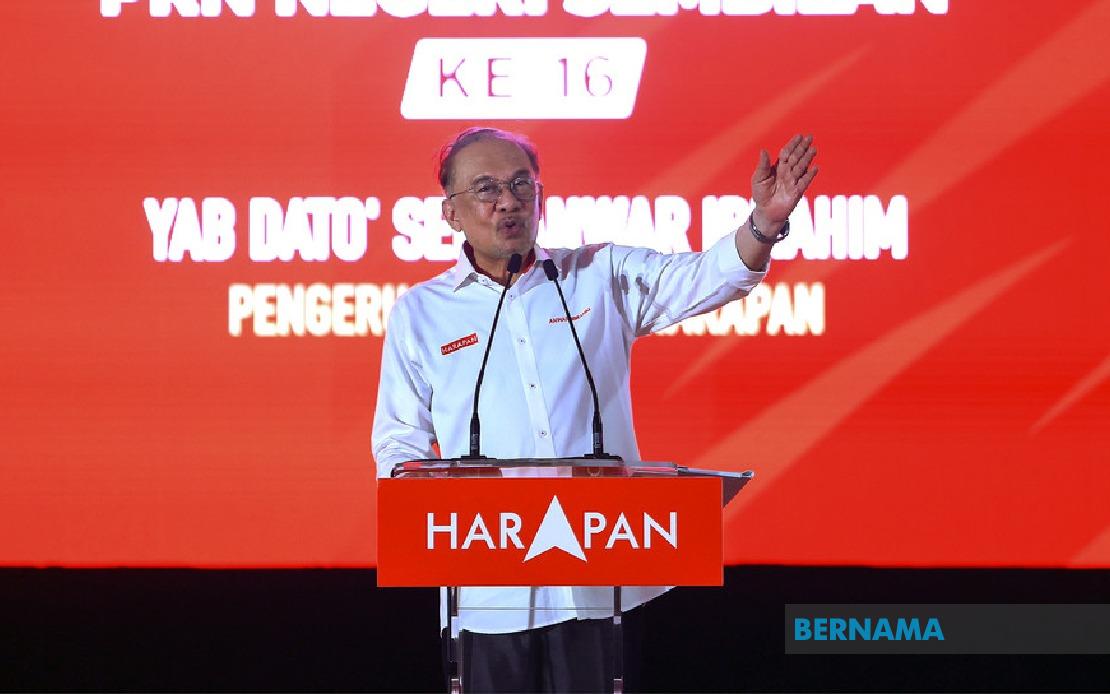
Prime Minister Datuk Seri Anwar Ibrahim has made a direct appeal to voters in Negeri Sembilan to maintain their backing for Pakatan Harapan in the upcoming 16th state election, presenting continued electoral support as essential to preserving the development gains the coalition claims to have achieved. Speaking through a Facebook post, the PH chairman framed the election as a critical juncture for the state, where voter endorsement would determine whether progress halts or accelerates in coming years.
Anwar's campaign message centers on what he describes as the productive synergy between Negeri Sembilan's state government and the Federal administration in Putrajaya. According to his statement, this alignment has facilitated the implementation of multiple development initiatives across the state. The PM suggests that without continued PH governance at the state level, this coordinated approach to infrastructure and services could be compromised, implying that fragmentation between state and federal administrations would slow or derail ongoing projects.
The appeal specifically endorses Menteri Besar Datuk Seri Aminuddin Harun, whom Anwar describes by the informal honorific Tok Min, as a leader whose stewardship since 2018 has been marked by ethical governance and a genuine commitment to public welfare. By invoking these personal qualities alongside administrative achievement, Anwar attempts to establish a reputation-based argument for continuity. The framing suggests that replacing an experienced, trustworthy administrator with an untested alternative would represent an unnecessary risk to state stability.
For Malaysian observers, this messaging reveals how PH seeks to defend its electoral position in a state where it currently holds power. Negeri Sembilan has been a mixed-bag constituency for the coalition—supportive enough to maintain government control, but not overwhelmingly so. The state's relatively small size and population means it often receives less national media attention than larger states like Selangor or Johor, yet its electoral trajectory has implications for PH's overall parliamentary and state assembly mathematics. A loss here would further squeeze the coalition's territorial footprint in the peninsula.
The practical context underpinning Anwar's appeal involves the mechanics of Malaysian federalism and how development funds flow downward. States governed by parties aligned with the federal ruling coalition typically gain preferential access to infrastructure allocations, discretionary grants, and priority consideration in national development plans. Conversely, opposition-governed states often face resource constraints or bureaucratic friction. Anwar's invocation of "cooperation" thus carries real material weight—PH dominance at both levels maximizes resource capture for Negeri Sembilan.
Negeri Sembilan's electoral calendar demonstrates the compressed timeframe for campaigning. Nominations were scheduled for July 16, early voting for July 28, and polling day for August 1, compressing the active campaign period to roughly two weeks. This condensed schedule favors incumbent administrations and established parties with ground machinery already in place, potentially disadvantaging challengers who must rapidly build campaign infrastructure. PH's use of social media for messaging reflects the constraints of such short campaigns, where traditional door-to-door canvassing must be supplemented by rapid digital outreach.
The stability narrative that Anwar emphasizes addresses a persistent concern among Malaysian voters, particularly in smaller states where governance capacity and resources are more limited. Development continuity matters substantially in localities where each major infrastructure project represents a tangible improvement to daily life—whether road upgrades, school facilities, or economic initiatives. Voters in such contexts often worry that political upheaval will leave projects incomplete or abandoned. Anwar's explicit promise that "progress we have built together" will not come "to a halt halfway" directly addresses this anxiety.
For Southeast Asian political observers, Anwar's campaign approach reflects broader patterns of incumbent advantage in regional democracies. Malaysian federal elections and state polls frequently see governing coalitions leveraging administrative resources, developmental achievements, and claims of stability to retain voter confidence. The appeal to continued trust rather than transformation—what Anwar frames as building "a more prosperous and progressive future"—is quintessentially defensive campaigning, aimed at minimizing defections rather than mobilizing new support bases.
The religious language Anwar employs, including "Alhamdulillah" and "Insya-Allah," serves multiple functions. It signals alignment with the values of predominantly Muslim Negeri Sembilan voters, reinforces the culturally rooted legitimacy of PH governance, and frames the election outcome as subject to divine approval rather than mere human preference. This rhetorical choice is particularly relevant in Malaysian politics, where Islamic cultural authority carries substantial political weight even within secular-liberal coalitions like PH.
For Malaysian businesses and investors, the outcome of the Negeri Sembilan election carries implications for policy consistency and administrative continuity. States with stable, development-focused administrations tend to maintain clearer regulatory frameworks and more reliable project timelines. Private sector stakeholders often prefer predictable political environments, even if they might occasionally disagree with specific policies. An electoral change in Negeri Sembilan could introduce policy uncertainty, particularly affecting small and medium enterprises dependent on state-level licensing, land allocations, or infrastructure connections.
The broader context includes PH's need to demonstrate electoral viability beyond the 2022 federal election. While the coalition won that election and formed the current government under Anwar's leadership, it faces skepticism about whether that victory represented durable voter realignment or temporary anti-incumbent sentiment. By successfully defending state governments, PH can argue that it commands genuine voter support rather than merely benefiting from opposition fragmentation. Conversely, state election losses would feed opposition narratives that PH lacks a genuine electoral mandate.
Anwar's appeal ultimately rests on a simple proposition: voters should maintain confidence in a proven administrator and a functioning state-federal partnership rather than risk institutional disruption through political change. Whether this message resonates will depend partly on whether Negeri Sembilan voters perceive development benefits and good governance as genuinely experienced rather than merely claimed. The August 1 polling will provide a concrete measure of whether PH's continuity argument prevails against whatever alternative the opposition presents.

