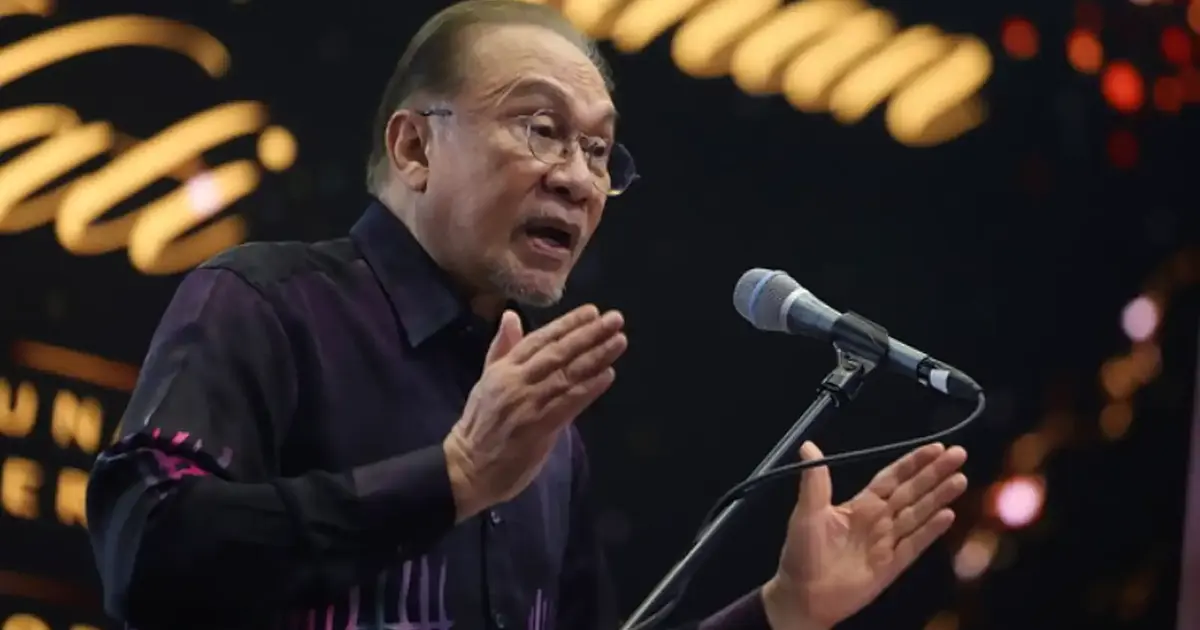
Prime Minister Anwar Ibrahim has issued a pointed appeal to Malaysians to move beyond inflammatory rhetoric and divisive messaging being spread by certain political leaders, positioning the country's multicultural character as fundamental to national progress and stability.
Anwar's remarks underscore growing tensions within Malaysia's political landscape, where competing factions have increasingly employed identity-based appeals and inflammatory language to consolidate support among specific voter blocs. The prime minister's statement represents a deliberate attempt to recalibrate the national conversation around unity and shared values at a moment when sectarian divisions threaten to dominate the political agenda.
The premier emphasised that Malaysia's defining characteristic lies in its mosaic of ethnic communities, religious traditions, and cultural practices coexisting within a single constitutional framework. This diversity, he argued, should be recognised not as a liability or source of perpetual contention, but as an intrinsic advantage that distinguishes Malaysia within the Southeast Asian region and the broader global community. Such framing contests the zero-sum narratives that have periodically emerged in local political discourse, where certain actors present communal advancement as necessarily requiring the diminution of other groups' interests or status.
Anwar's intervention carries particular weight given his positioning as a bridge figure within Malaysian politics. Throughout his career, he has cultivated an image as someone capable of transcending communal loyalties and appealing to a broader coalition of voters across ethnic and religious lines. His call for Malaysians to "rise above" divisive messaging implicitly critiques opponents who have relied on identity politics and fear-based campaigning as their primary electoral strategy.
The timing of these remarks suggests they are directed at specific political actors whose recent statements or campaigns have emphasised communal grievances or threatened particular groups' interests. Without naming individuals or parties explicitly, Anwar's language conveys frustration with a segment of the political establishment that he views as irresponsible custodians of public discourse.
Malaysia's constitutional structure has long enshrined recognition of the country's plural character through various guarantees and protections for different communities. The Federal Constitution itself reflects compromises negotiated between different ethnic and religious constituencies during the independence negotiations in the mid-twentieth century. Anwar's invocation of diversity as a national strength appeals to this foundational consensus, suggesting that departing from it represents a betrayal of Malaysia's basic social contract.
However, the persistence of identity-based political mobilisation in Malaysia reflects deeper anxieties within specific communities about relative status, economic opportunity, and cultural representation. Simply exhorting citizens to transcend divisive rhetoric without addressing underlying grievances risks appearing disconnected from genuine concerns that motivate electoral behaviour. The challenge facing Anwar involves both rhetorical repositioning and substantive policy responses that demonstrate responsiveness to community anxieties across the ethnic and religious spectrum.
For Malaysian readers and observers across Southeast Asia, Anwar's remarks highlight the tension between democratic pluralism and the appeal of communal mobilisation within diverse societies. The region contains numerous nations grappling with comparable pressures—where politicians must navigate between inclusive rhetoric and the electoral incentives created by identity-based voting patterns. Malaysia's experience offers both cautionary lessons and potential models for managing these tensions.
The statement also reflects international attention to Malaysia's political trajectory. Global observers have increasingly focused on whether the country can maintain its multicultural character while managing contemporary pressures toward polarisation. Anwar's positioning as an alternative to identity-focused politics carries implications for Malaysia's regional standing and its capacity to function as a stable, pluralistic democracy within Southeast Asia.
Moving forward, the effectiveness of Anwar's call for unity depends substantially on whether his government translates rhetorical commitment into tangible policies that address disparities in economic opportunity, representation, and recognition across communities. Messaging alone, unaccompanied by substantive action, risks appearing as empty moralising rather than genuine leadership on divisive issues.
The prime minister's intervention also raises questions about how Malaysian civil society, media institutions, and community leaders can collectively contribute to elevating public discourse above inflammatory rhetoric. Creating space for substantive debate about communal interests and group-specific concerns, while simultaneously insisting on mutual respect and recognition of shared citizenship, represents an ongoing challenge for Malaysian democracy. Anwar's remarks constitute one intervention within this larger project, but ultimately success will require coordinated efforts across political, social, and cultural institutions to embed more constructive norms within the public sphere.

