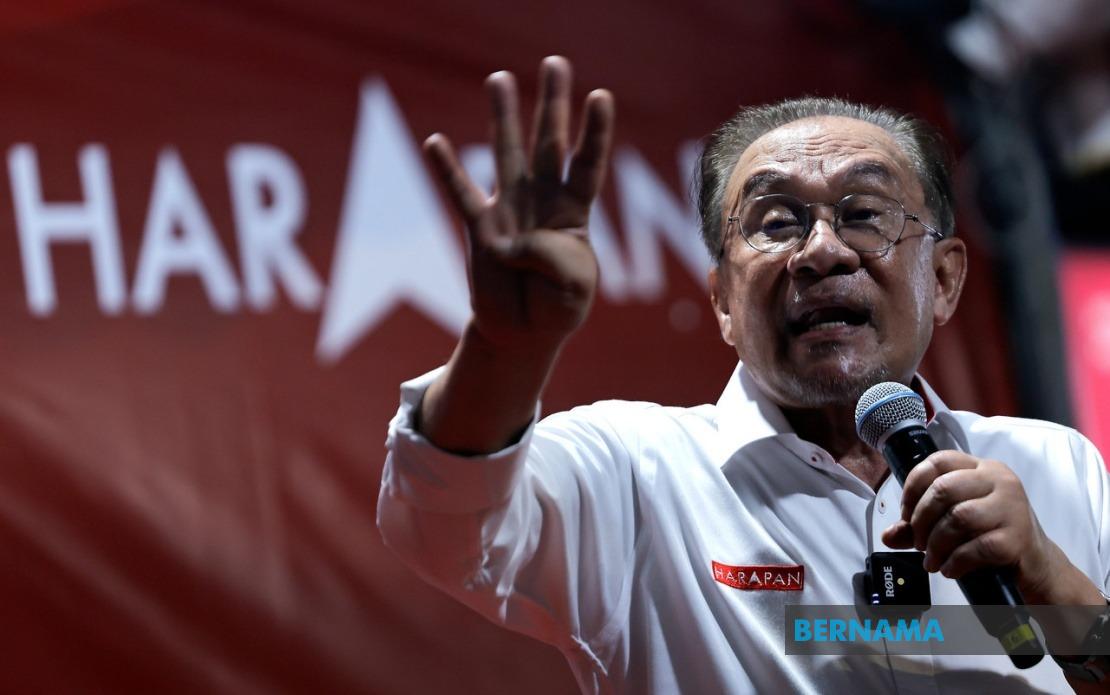
Prime Minister Datuk Seri Anwar Ibrahim has made a direct appeal to voters in Johor ahead of the July 11 state election, urging them to elect leaders distinguished by integrity, wisdom, and genuine commitment to serving ordinary citizens. Speaking at a Pakatan Harapan rally in Muar on June 15, Anwar emphasised that the calibre of leadership chosen in this election will fundamentally shape the trajectory of the state's development and the material wellbeing of its most vulnerable populations.
Anwar's remarks represent a pointed critique of what he characterises as cynical political tactics employed by rival factions. He specifically warned against politicians who capitalise on racial and communal anxieties to secure electoral support, only to abandon their pledges once assuming office. This pattern of exploitation followed by inaction, he suggested, has become a recurring feature of Malaysian politics that voters must learn to recognise and resist. The Prime Minister framed voter education as essential—encouraging citizens to think critically rather than respond emotionally to inflammatory messaging.
The broader context of Anwar's intervention touches on a fundamental governance principle: the alignment of policy direction between state and federal administrations. Johor's current state government, governed by Barisan Nasional, operates independently of the Pakatan Harapan-led federal coalition. Anwar contended that this misalignment creates inefficiencies in translating major federal investments into tangible benefits for ordinary Johoreans. He underscored that coordinated governance between state and federal levels enables more effective distribution of resources, smoother execution of infrastructure projects, and better leverage of economic opportunities.
Central to Anwar's case for Pakatan Harapan victory in Johor is the Johor-Singapore Special Economic Zone (JS-SEZ), a transformative initiative that the federal government has negotiated and advanced. Anwar emphasised that while the state government may have provided support, the federal administration bore primary responsibility for driving the project forward. Similarly, expansion work on the Port of Tanjung Pelepas, another major undertaking, reflects federal initiative and investment. These projects represent substantial economic opportunities, and Anwar argued that a state government aligned with federal priorities can ensure that downstream benefits—employment, business opportunities, skill development—flow effectively to grassroots communities rather than being captured by narrow interests.
Anwar's appeal also carried a distinct message about the proper function of elected representatives. He stressed that leaders entrusted with power must resist the temptation toward arrogance and instead maintain a service orientation focused on addressing citizens' concrete needs. This reflects concern about a leadership culture that sometimes treats electoral victory as validation for detachment from constituent concerns. By contrast, Anwar advocated for state representatives and executive council members who view their role as facilitating welfare and opportunity for those facing economic hardship, rather than as positions of authority divorced from public obligation.
The temporal dimension of Anwar's appeal—urging Johor residents living elsewhere to return home to vote—highlights the practical challenges of ensuring electoral participation across diaspora populations. For a state with significant out-migration, particularly of younger and professional demographics, maximising voter turnout requires acknowledging that many eligible voters maintain emotional and familial ties to Johor despite residing elsewhere. Anwar's framing of this responsibility as serving Johor's future attempts to convert what might otherwise be seen as inconvenient travel into an act of civic investment.
For Malaysian politics broadly, Anwar's emphasis on integrity and humility as leadership criteria addresses a persistent credibility gap. Public perception of politicians as self-serving has accumulated through scandals, unfulfilled promises, and visible wealth accumulation. By elevating these values explicitly and repeatedly, Anwar signals that Pakatan Harapan positions itself as the alternative to what voters may perceive as entrenched patterns of patronage and neglect. This rhetorical positioning matters for a coalition seeking to consolidate gains and reverse the 2022 electoral setback that saw Barisan Nasional recover to form a government alongside Perikatan Nasional.
The Johor election carries significance beyond the state itself. Johor represents Malaysia's second-largest economy and has historically served as a bellwether for broader political sentiment. A Pakatan Harapan victory would strengthen the coalition's position for potential federal negotiations and future national elections. Conversely, retention of Barisan Nasional control would reinforce the belief that traditional power structures retain resilience despite federal governance by Pakatan Harapan. The results will therefore influence calculations about Malaysia's political trajectory across multiple timescales.
Anwar's campaign message also implicitly acknowledges the persistent salience of identity politics in Malaysian electoral dynamics. Rather than simply dismissing appeals to race and religion as illegitimate, he frames them as intellectually insufficient and practically harmful. His suggestion that voters should contemplate consequences for schools, hospitals, and economic opportunity attempts to reframe the election as fundamentally about resource distribution and service delivery—domains where performance can be measured and compared. This represents a deliberate attempt to shift electoral discourse away from zero-sum identity competition toward instrumental evaluation of governance capacity.
The emphasis on federal-state coordination reflects genuine operational realities in Malaysian federalism. Major infrastructure projects, fiscal transfers, and regulatory frameworks are negotiated between levels of government. When these levels operate under different political leadership, transaction costs rise and implementation speeds may slow. Anwar's argument that voters should reward political alignment contains practical force, even if it also serves the obvious partisan interest of advancing Pakatan Harapan electoral prospects. For voters weighing competing claims, the question becomes whether potential efficiency gains from alignment justify switching from incumbents they may view as adequately performing their duties.
As Johor voters prepare for the July 11 election, Anwar's message crystallises key themes in contemporary Malaysian politics: the demand for leadership characterised by principle rather than opportunism, the importance of state-federal coordination for development outcomes, and the continued relevance of identity politics even as material concerns about economic opportunity dominate voter consciousness. Whether these appeals will prove decisive remains to be determined by electoral results, but they establish the intellectual and moral terrain on which this crucial state election will partly be contested.