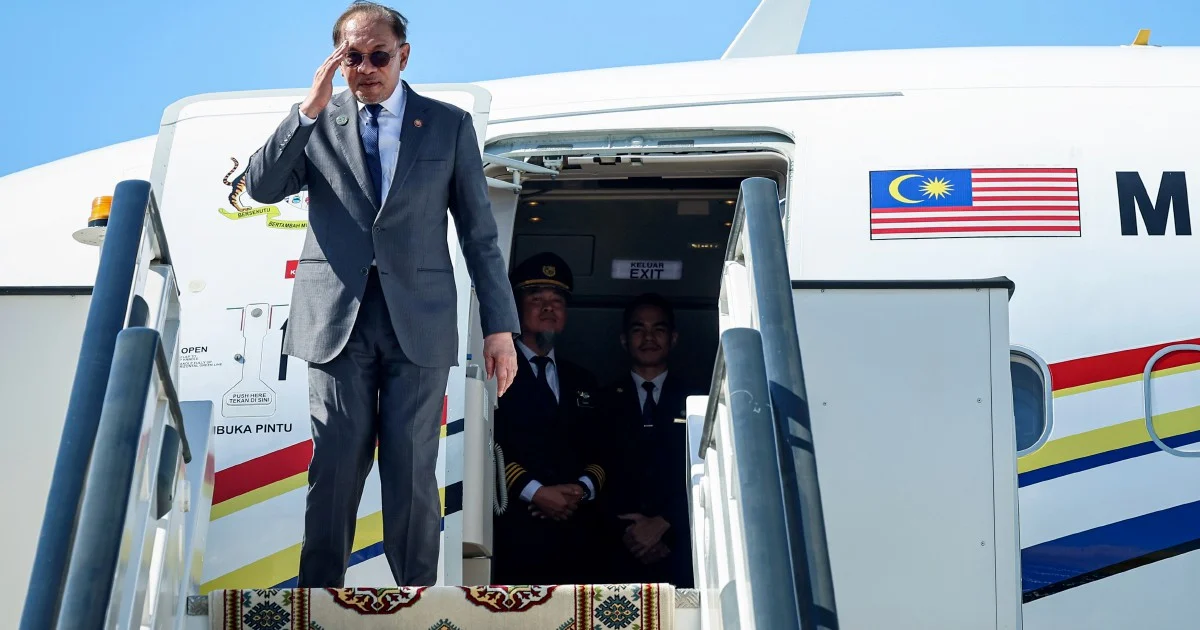
Prime Minister Datuk Seri Anwar Ibrahim touched down in Penang today, marking the conclusion of his official diplomatic mission to Turkmenistan and the commencement of what promises to be a significant stretch of domestic engagements in the northern state. The timing of his arrival, coming directly on the heels of his Central Asian visit, underscores the government's commitment to maintaining momentum on both the international stage and in advancing strategic priorities at home.
The Prime Minister's presence in Penang is anchored by his participation in the National Journalists' Day (Hawana) 2026 grand finale, a marquee event that celebrates the vital role of the media in democratic societies and reflects the administration's engagement with the fourth estate. Hawana, an annual commemoration that honours Malaysia's journalism community, has become an important platform for government officials to reaffirm their dedication to press freedom and the dissemination of accurate information—principles that carry particular weight in the Southeast Asian context, where media landscape dynamics continue to evolve rapidly.
Beyond the ceremonial aspects of Hawana 2026, Anwar's Penang itinerary encompasses several investment-focused events designed to attract capital and foster economic development within the state. These engagements are indicative of a broader strategy to position Penang as a competitive investment destination within Malaysia's ecosystem and across the wider region. Such initiatives reflect the government's recognition that sustained economic growth and foreign direct investment are essential pillars for national development and prosperity.
Penang, as Malaysia's second-largest economic hub and a historically significant state for commerce and trade, serves as an appropriate backdrop for these announcements and discussions. The state has long been regarded as a testing ground for policy initiatives and business partnerships, given its established infrastructure, skilled workforce, and geographic proximity to key Asian markets. The Prime Minister's direct involvement in these engagements signals the seriousness with which the administration views Penang's developmental trajectory.
The Turkmenistan visit that preceded Anwar's arrival in Penang represents another dimension of Malaysia's diplomatic outreach, particularly in furthering relations with nations in Central Asia. Such missions typically encompass discussions on bilateral trade, cultural exchange, energy cooperation, and broader regional stability—areas where Malaysia seeks to expand its sphere of influence and economic partnerships beyond its traditional Southeast Asian circles.
The swift transition from international diplomatic duties to domestic economic and media-focused events demonstrates the multifaceted nature of contemporary prime ministerial responsibilities. Modern governance increasingly demands leaders to balance foreign policy imperatives with domestic economic stewardship and engagement with critical domestic institutions such as the press. This dual focus reflects the interconnected nature of national interest—international standing and credibility are enhanced when underpinned by robust domestic economic performance and stable institutional relationships.
For Malaysian observers and regional analysts, Anwar's activities in Penang carry broader implications for how the government intends to manage economic competition in Southeast Asia. The emphasis on investment events suggests that Malaysian policymakers remain attuned to the region's competitive landscape, where countries such as Vietnam, Thailand, and Indonesia are aggressively pursuing foreign capital. By maintaining visible, high-level engagement with investment promotion, the Prime Minister reinforces the government's commitment to ensuring Malaysia retains its appeal as an investment destination.
The staging of Hawana 2026 in conjunction with investment-related activities also reflects a strategic recognition that media engagement and economic messaging are complementary. A well-informed, engaged media ecosystem can amplify the government's development narrative and investment story to both domestic and international audiences. The Prime Minister's participation in such events positions him as an advocate not only for press freedom but also for the role journalism plays in enabling transparent, informed public discourse around economic policy.
Penang's selection as a venue for these activities is not incidental. The state has historically been home to significant business communities, major port operations, and manufacturing hubs that have attracted multinational corporations. Holding investment-related events in Penang thus carries symbolic weight—it grounds economic policymaking in concrete locations of commercial activity and demonstrates that development initiatives are rooted in Malaysia's existing economic strengths rather than merely aspirational rhetoric.
As Malaysia continues to navigate evolving regional geopolitical dynamics and shifting global investment patterns, the Prime Minister's engagement across multiple fronts—diplomatic, economic, and institutional—reflects the complexity of contemporary governance. The transition from Turkmenistan to Penang exemplifies how modern state leadership requires simultaneous attention to international relations, domestic economic promotion, and the maintenance of essential institutional partnerships that underpin democratic legitimacy and public trust.

