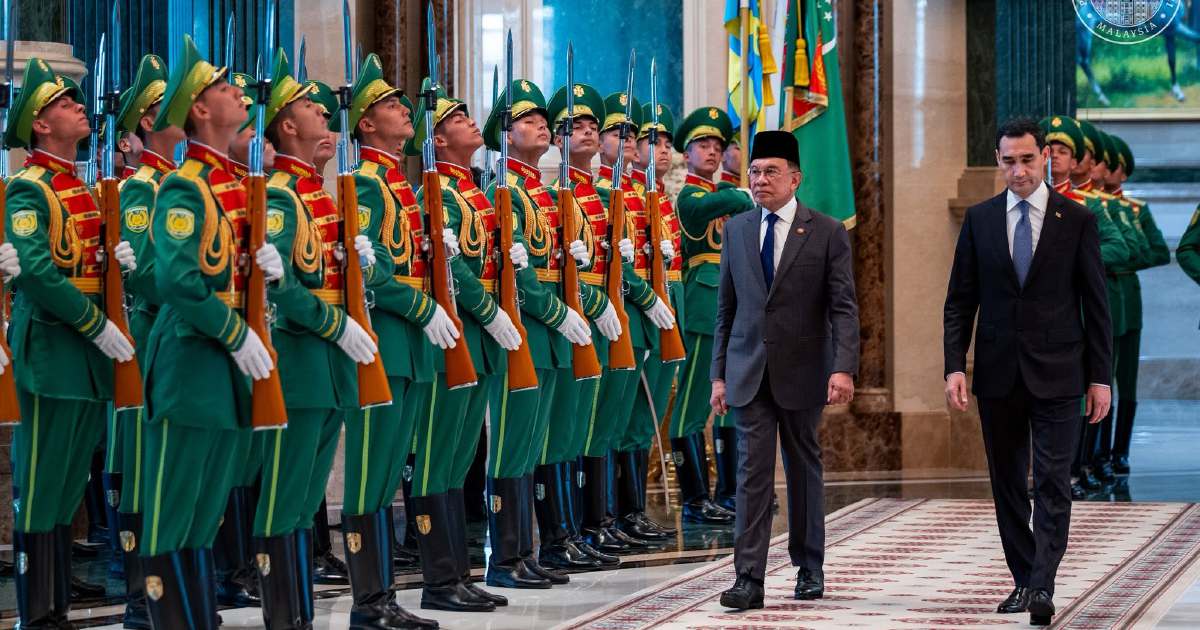
Prime Minister Datuk Seri Anwar Ibrahim was given full ceremonial honours at the Presidential Palace in Ashgabat today, a symbolic gesture underscoring Turkmenistan's diplomatic interest in deepening relations with Malaysia. The occasion represents the first official visit by Anwar to the Central Asian nation since his appointment as premier, signalling an expansion of Malaysia's engagement beyond its traditional regional focus in Southeast Asia and towards untapped strategic markets and partnerships.
The formal reception protocol, complete with ceremonial elements befitting a state visit, reflects Turkmenistan's commitment to treating the Malaysian delegation with appropriate diplomatic standing. Such gestures are not merely procedural formalities; they establish the tone for substantive discussions on bilateral cooperation and signal to domestic and international audiences the priority both nations place on strengthening their relationship. For Malaysia, the visit demonstrates an active foreign policy outreach that extends Malaysia's sphere of engagement into Central Asia, a region with significant energy resources and emerging economic opportunities.
Turkmenistan occupies a strategic position within the broader Central Asian landscape, serving as a crossroads between Europe, the Middle East, and Asia. The nation's substantial natural gas reserves and its location along historic trade corridors make it a potentially valuable partner for Malaysian businesses seeking to diversify their international operations. Malaysia has long recognised the importance of expanding its diplomatic footprint beyond Southeast Asia, and a focused engagement with Turkmenistan aligns with this broader strategic objective of building a multipolar network of partnerships.
For Malaysian policymakers, the timing of this visit carries significance in the context of evolving geopolitical dynamics in the region. As major powers compete for influence in Central Asia, Malaysia's presence through high-level diplomatic engagement signals the country's intention to participate in regional developments and advance Malaysian interests through constructive engagement rather than remaining confined to Southeast Asian affairs. The ceremonial welcome indicates that both nations view this engagement as a stepping stone towards comprehensive cooperation across multiple sectors.
The visit also provides an opportunity to explore potential avenues of collaboration in energy, infrastructure development, and trade. Turkmenistan's hydrocarbon sector represents a domain where Malaysian expertise in resource management and international commerce could prove valuable. Furthermore, discussions may extend to regional connectivity initiatives that could benefit Malaysian businesses seeking to access Central Asian markets or establish supply chain linkages to European and Middle Eastern destinations.
From Turkmenistan's perspective, welcoming the Malaysian Prime Minister reflects the country's interest in diversifying its international partnerships and developing deeper ties with Asian nations. Central Asian states have increasingly recognised the value of engaging with Asian powers as a counterbalance to traditional influences from Russia and China. Malaysia's role as a bridge between Asian and Islamic-majority nations potentially offers Turkmenistan unique networking opportunities and access to broader Southeast Asian markets through Malaysian intermediaries.
The diplomatic protocol and ceremonial arrangements extended to Anwar also underscore the shared commitment to elevating bilateral relations from routine diplomatic contact to a more substantive strategic partnership. Official welcomes of this calibre typically precede discussions on concrete bilateral agreements, whether in the form of trade arrangements, investment frameworks, or cultural exchange programmes. Malaysian delegations can expect detailed conversations on avenues for cooperation that extend beyond symbolic gestures to tangible outcomes benefiting both nations' economies and peoples.
This visit exemplifies Malaysia's contemporary foreign policy approach under Anwar's leadership, which emphasises broadening the country's international engagement and seeking partnerships in regions previously given less diplomatic priority. The emphasis on Central Asia reflects an understanding that Malaysia's long-term prosperity depends on diversifying partnerships and not relying solely on traditional regional relationships. By establishing formal diplomatic momentum through high-level visits, Malaysia positions itself advantageously for future collaboration as regional dynamics continue to evolve.
The presidential palace reception also carries symbolic weight within Turkmenistan's domestic context, as it demonstrates the government's confidence in Malaysia as a reliable diplomatic partner. This mutual recognition of each other's importance lays groundwork for future interactions and suggests that both nations view their relationship as worthy of sustained investment in time and diplomatic resources. Moving forward, observers should monitor whether this visit translates into concrete agreements on trade, investment, or institutional cooperation mechanisms that would demonstrate the visit's substantive value beyond ceremonial significance.

