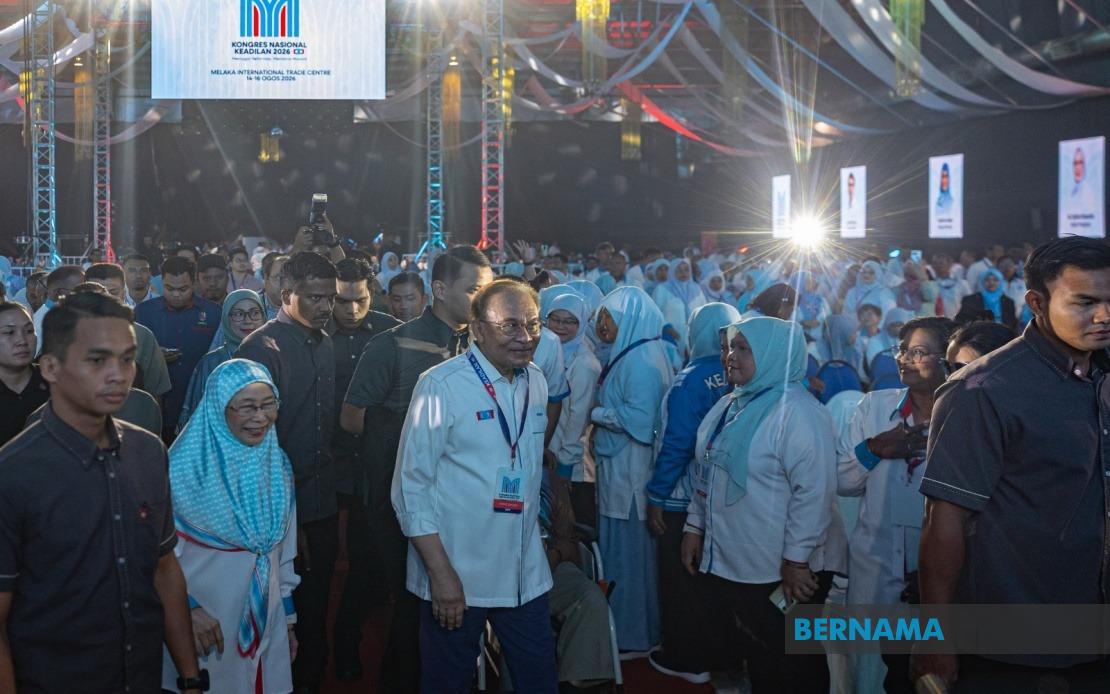
Prime Minister Datuk Seri Anwar Ibrahim has moved to reassure Malaysia's political establishment that the partnership between the Unity Government and UMNO-Barisan Nasional will endure, despite recent tensions that have prompted speculation about the stability of the federal coalition. Speaking at the Parti Keadilan Rakyat (PKR) National Congress 2026 in Melaka on August 16, Anwar emphasised that pragmatism and national interest must guide decision-making, rejecting any notion that personal considerations or factional disputes should dictate government direction.
The Prime Minister's remarks come at a moment of heightened scrutiny over coalition dynamics, with observers questioning whether rifts within the Unity Government might precipitate early changes to Malaysia's political architecture. By publicly recommitting to the UMNO-BN partnership at a party forum, Anwar has sought to quell speculation and project an image of measured leadership focused on continuity rather than confrontation. His statement reflects an understanding that government instability could harm investor confidence, disrupt policy implementation, and undermine efforts to accelerate economic recovery during a period of global uncertainty.
Anwar's framing of the coalition question as fundamentally one of national welfare rather than political calculation carries particular weight in the Malaysian context, where coalitional arrangements have historically been fragile and subject to shifting power calculations. By elevating economic performance and social prosperity as the governing principles, the Prime Minister has implicitly argued that coalition stability serves the broader national interest more effectively than any alternative arrangement. This positioning allows him to present continued cooperation with UMNO-BN not as a concession or survival mechanism, but as a deliberate strategic choice grounded in measurable outcomes.
The timing of these remarks during the PKR National Congress carries significance beyond their immediate substance. As party president, Anwar faced an audience of party faithful who may harbour reservations about cooperation with UMNO, given historical antagonisms between the two organisations. His decision to address coalition matters directly at this forum demonstrates an intent to build internal party consensus around the partnership strategy. By framing stability and prosperity as non-negotiable principles that supersede personal interests or positional competition, Anwar has attempted to establish a shared understanding within PKR that the current arrangement serves the party's long-term interests more effectively than alternatives.
The broader context of recent developments within the Unity Government has been characterised by occasional tensions and competing political narratives, even as the coalition has maintained its parliamentary majority. Questions about resource allocation, ministerial appointments, and the balance of influence between PKR and UMNO-BN have periodically surfaced in Malaysian media. Anwar's emphatic restatement of commitment to the partnership suggests that political leadership recognises the costs of instability and has judged that maintaining the current configuration outweighs the advantages of pursuing alternative arrangements. This calculation reflects mature political thinking, even as it may disappoint those within PKR who view UMNO as a fundamentally problematic partner.
For UMNO and BN, Anwar's public endorsement of continued cooperation validates their decision to participate in the Unity Government despite internal party pressures and the party's historical opposition to PKR-led administrations. The reaffirmation effectively signals that their participation in government is not contingent on periodic tests of coalition durability but instead reflects a shared commitment to delivering outcomes that resonate with Malaysian voters. This stability is particularly important for BN's rehabilitation following the 1Malaysia Development Berhad scandal and subsequent electoral defeats, as sustained participation in a functioning government helps restore the coalition's political credibility.
The emphasis on economic growth as a pillar of the government's legitimacy underscores the administration's understanding that coalition durability ultimately depends on demonstrable improvements in living standards and business conditions. Malaysia's economic performance in the post-pandemic environment has been respectable but not exceptional, with growth rates moderate and inflation a continuing concern for households. Anwar's coupling of political stability with economic advancement suggests that his government intends to marshal coalition resources toward initiatives that can improve growth trajectories and create visible improvements in employment and income. This linkage between political stability and economic results reflects international best practice in coalition governance, where stability provides the platform for sustained policy implementation.
The Prime Minister's explicit rejection of decision-making driven by personal interests or anger addresses a longstanding vulnerability in Malaysian political culture, where personality-driven factionalisms have historically undermined governance. By articulating a governance philosophy centred on collective welfare rather than individual advancement, Anwar has attempted to establish a standard against which both his own performance and that of coalition partners can be evaluated. This approach has potential to elevate the quality of political discourse in Malaysia by focusing public attention on substantive policy outcomes rather than personalised conflicts or power struggles.
Regionally, Anwar's commitment to coalition stability carries implications for Malaysia's standing within Southeast Asia and its engagement with key trading partners and strategic relationships. Government instability or the breakdown of the Unity Government could create periods of policy uncertainty that complicate Malaysia's participation in regional initiatives and economic arrangements. The Prime Minister's reassurance to investors and international observers that the government possesses sufficient durability to implement medium-term strategies should facilitate continued capital flows and support for Malaysian development projects. This stability benefit extends to domestic business confidence, as corporate leaders make investment and hiring decisions based partly on their assessment of political continuity and policy predictability.
Looking forward, the sustainability of Anwar's commitment to the UMNO-BN partnership will depend on the coalition's ability to deliver tangible improvements in areas that resonate most strongly with Malaysian voters, particularly employment creation, housing affordability, and healthcare access. Should economic conditions deteriorate or coalition members perceive that their political interests are being systematically disadvantaged, the unity that Anwar has articulated may face serious testing. However, the Prime Minister's emphatic public recommitment at a party gathering suggests that both PKR and UMNO-BN leadership have judged that the costs of coalition breakdown substantially exceed the benefits of pursuing alternative arrangements. This calculus, if it holds, portends continued cooperation and the consolidation of a more durable political settlement in Malaysian governance.

