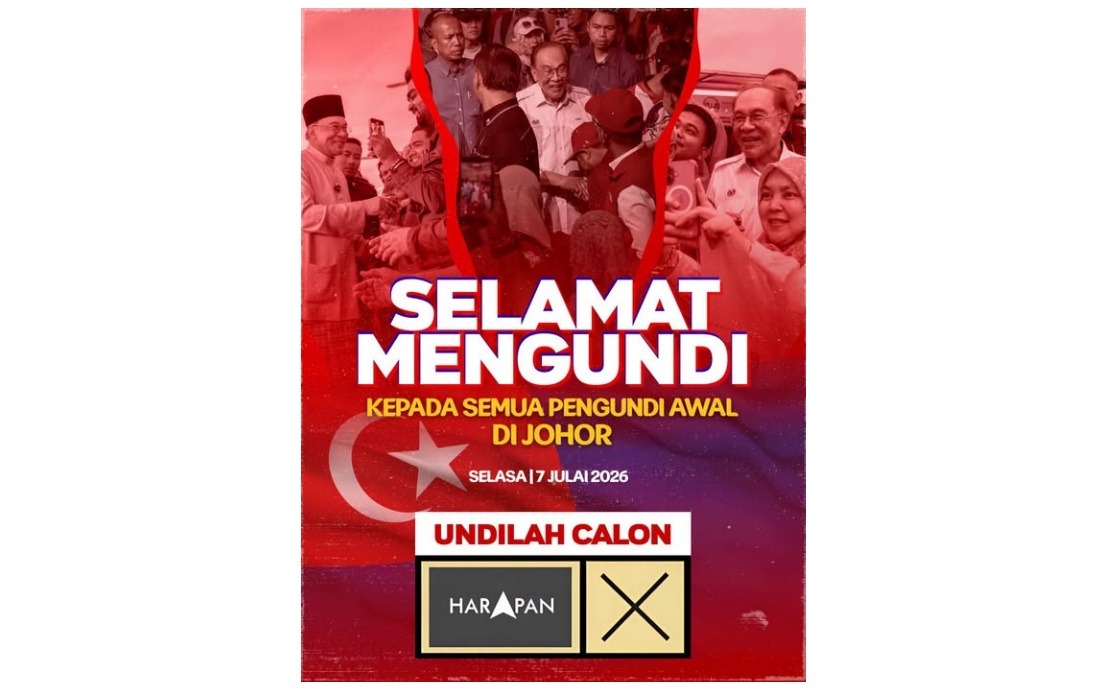
Prime Minister Datuk Seri Anwar Ibrahim has thrown his weight behind Pakatan Harapan's campaign in the 16th Johor state election, issuing a direct appeal to early voters as they head to polling centres across the state. Through a Facebook post released on July 7, Anwar—who leads the PH coalition—encouraged military and police personnel casting ballots to "choose Harapan candidates for a better future for Johor," signalling the coalition's aggressive push in one of Malaysia's largest and most competitive states.
The early voting phase saw 24,751 eligible voters participate at 64 polling centres across Johor on that single day. This group consisted primarily of two disciplined forces: 12,041 Malaysian Armed Forces (MAF) personnel along with their spouses, and 12,710 Royal Malaysia Police (PDRM) and General Operations Force members together with their spouses. For these groups, early voting is a standard procedure designed to accommodate their operational schedules and ensure their participation in the democratic process without disrupting state duties.
Voting infrastructure for this early phase was strategically distributed across the state. A total of 53 polling centres operated for police and General Operations Force voters, while 11 centres served military personnel. All locations opened simultaneously at 8 am, though closing times varied between noon and 6 pm depending on the volume of registered voters at each centre. This staggered approach allowed election officials to manage the flow of voters while maintaining security protocols across multiple sites.
Pakatan Harapan's commitment to the contest is reflected in its comprehensive candidacy across the state. The coalition fielded nominees in all 56 state seats, with representation spanning three parties: PKR contributing 20 candidates, Amanah providing 19, and DAP offering 17. This distribution underscores the coalition's attempt to maintain unity while balancing the interests of its constituent parties—a delicate equilibrium that has proven challenging in previous electoral contests.
The broader context of the election reveals significant competition. In total, 172 candidates threw their names into the ring, competing for voter support across all constituencies. Main polling day was scheduled for Saturday, when approximately 2.7 million registered voters across Johor would participate in what represents a critical barometer of political sentiment in the state that has traditionally been a bellwether for national politics.
Anwar's personal intervention at this early stage reflects PH's recognition of Johor's strategic importance. The state has experienced considerable political volatility in recent years, and its outcome holds implications not just for the coalition's standing in the peninsula's largest state by population, but for the broader narrative surrounding federal politics heading into potential future national elections. Military and police voters, in particular, are considered relatively disciplined constituencies whose voting patterns can provide early indicators of swing trends.
For Pakatan Harapan, the early voting phase represents an opportunity to build momentum before general voting commences. The coalition's explicit campaign messaging—delivered directly by the Prime Minister to military and police early voters—demonstrates the priority placed on securing this particular demographic. These groups are known to maintain relatively consistent voting patterns, and their decisions could influence subsequent turnout and candidate viability in their respective communities.
The Johor election occurs against a backdrop of shifting political dynamics at both state and federal levels. The state has experienced multiple government transitions in recent years, reflecting voter uncertainty and the fragmentation of traditional political support bases. PH's performance in this election would serve as a significant data point regarding the coalition's resilience and appeal beyond its traditional urban and young voter strongholds, particularly in securing support from organised sectors like the military and police.
Anwar's public messaging emphasised the future direction of governance rather than focusing on opposition attacks, a strategic choice that signals PH's confidence in its policy platform. By framing the election around development and progress, the coalition attempted to elevate the discourse beyond personality-driven or adversarial politics, though such appeals often struggle against the ground-level mobilisation efforts of competing parties.
The logistics of conducting early voting across multiple states and constituencies underscore Malaysia's well-established electoral machinery. The simultaneous opening of 64 polling centres and coordinated timing across military and police facilities demonstrate institutional capacity, though such operations also present potential vulnerabilities in terms of security and transparency that remain topics of ongoing debate among electoral observers.
As Johor voters prepared to exercise their franchise, the state remained positioned as a crucial testing ground for political viability in Malaysia's electoral landscape. Early voting turnout and patterns would likely be closely analysed by political observers, media analysts, and rival camps seeking to understand voter sentiment and predict the trajectory of the main polling day results. For Anwar and Pakatan Harapan, the stakes extended well beyond a single state election, touching on broader questions about the coalition's capacity to govern and maintain electoral support in Malaysia's complex, multi-layered democracy.

