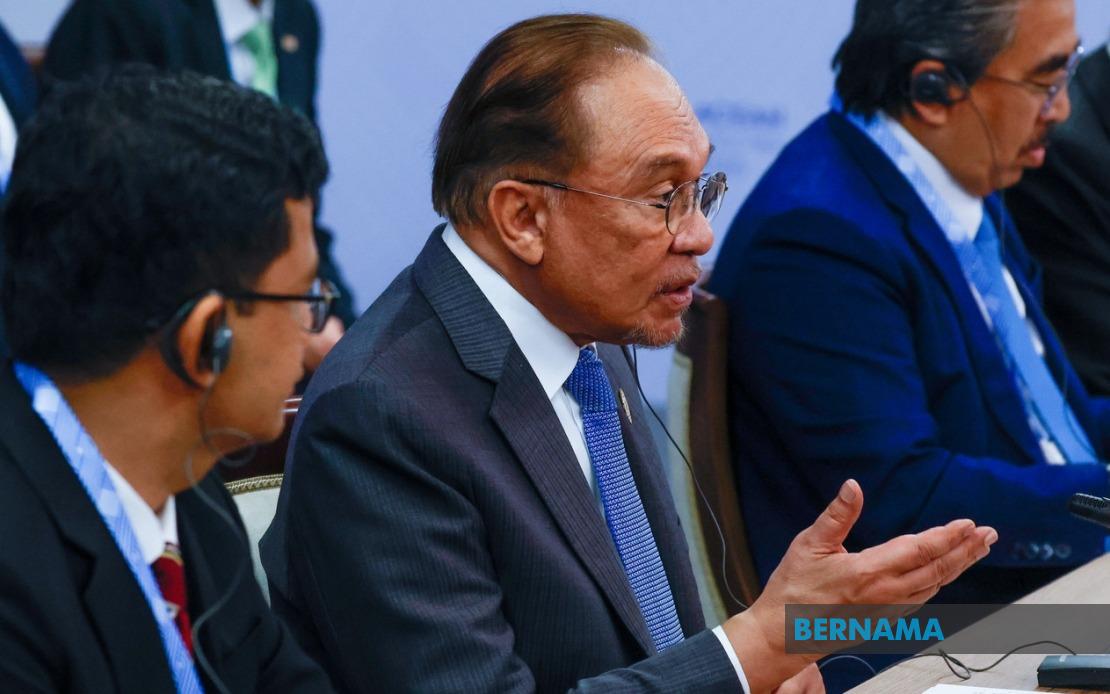
Malaysian Prime Minister Datuk Seri Anwar Ibrahim used a high-level bilateral meeting in Kazan to commend Russian President Vladimir Putin for what he characterised as a steadfast and principled approach to two of the world's most contentious geopolitical flashpoints: the Gaza conflict and the broader situation surrounding Iran. The encounter, held on Wednesday evening, underscored Malaysia's diplomatic interest in Russia's positions at a time when global consensus on Middle Eastern affairs remains fractured and regional tensions continue to shape international relations.
During his opening remarks, Anwar explicitly acknowledged Putin's consistency on these matters, framing Russia's diplomatic approach as one worthy of respect and emulation. He stated that Malaysia, alongside many other nations, admired what he termed the Russian leadership's "tenacity and conviction" in maintaining these positions despite international pressures and competing strategic interests. The language deployed—emphasising consistency and principle—suggests Malaysia views Russia as a stabilising force rather than a provocateur in Middle Eastern disputes, a perception that carries weight in how Malaysia calibrates its own foreign policy.
The Gaza conflict, now spanning months with profound humanitarian consequences, has become a litmus test for how major powers define their geopolitical values. Russia has consistently advocated for ceasefires that would allow humanitarian access to Palestinians, positioning itself rhetorically as a champion of civilian welfare and against what Moscow characterises as disproportionate military responses. This stance resonates differently across the Global South, where perceptions of Western-led interventionism remain contentious and where nations like Malaysia seek to balance relationships with traditional Western allies against emerging powers.
Anwar's public commendation of Russia's Iran policy reflects a more nuanced calculation. Moscow has maintained robust diplomatic and economic ties with Tehran while simultaneously pushing for dialogue-based solutions to regional tensions rather than escalatory military confrontation. For Malaysia, which sits in a region where Iran's influence extends through various channels and where Gulf stability affects energy markets and trade routes, Russia's emphasis on negotiation over confrontation aligns with preferences for de-escalation and predictable international conduct.
The timing of these remarks carries particular significance given the evolving geopolitical landscape in Asia-Pacific and the broader emerging multipolar world order. Malaysia, as a Southeast Asian nation with significant Muslim population and strategic maritime interests, occupies a unique position where it benefits from engagement with multiple power centres. By publicly acknowledging Russia's consistency on Gaza and Iran, Anwar signals that Malaysia values Russia's perspective on global affairs and considers Moscow a credible interlocutor on matters beyond its traditional sphere of influence in Eastern Europe.
Russia's approach to these Middle Eastern issues reflects its broader strategy of positioning itself as an alternative pole of power to Western-led frameworks. Moscow's advocacy for ceasefire mechanisms in Gaza and its sustained diplomatic engagement with Iran are presented domestically and internationally as expressions of principled foreign policy rooted in international law and respect for sovereign nations. This framing appeals to countries like Malaysia that feel marginalised by or subordinate within Western-dominated international institutions and security arrangements.
The bilateral meeting itself represents an important moment in Malaysia-Russia relations, particularly given the broader context of shifting geopolitical alignments. As tensions between Western powers and Russia intensify globally, and as China's role in Asia-Pacific continues expanding, Malaysia seeks to maintain productive relationships across multiple partners. Anwar's explicit praise for Russia's positions demonstrates that this engagement is not merely transactional but involves substantive agreement on fundamental questions about international order and regional stability.
Gaza and Iran are not peripheral issues for Malaysia. The former resonates deeply within the Malaysian Muslim community, affecting domestic political discourse and shaping how citizens perceive their government's international legitimacy. The latter relates to broader questions about regional security architecture, particularly given Iran's connections to various actors throughout Southeast Asia and the Middle East. By aligning rhetorically with Russia's positions on both matters, Anwar indicates that Malaysia sees value in Russia's diplomatic approach and may consider coordinating with Moscow on related international forums and votes.
The geopolitical implications extend beyond bilateral Malaysia-Russia relations. Other Southeast Asian nations, particularly those similarly seeking strategic autonomy and uncomfortable with pressure to choose sides in great power competition, may view Malaysia's public endorsement of Russia's consistency as validation that engagement with Moscow need not compromise their own international standing. This could influence how ASEAN collectively approaches questions involving Russia's role in global affairs and Middle Eastern diplomacy.
Moreover, Anwar's comments reflect Malaysia's broader foreign policy philosophy of non-alignment and strategic flexibility. Rather than viewing Russia as inherently threatening or as a destabilising force, Malaysia appears to regard it as a legitimate power with defensible positions on complex international questions. This perspective differs markedly from framings dominant in some Western and allied circles, suggesting that Malaysia's worldview—and by extension, Southeast Asian perspectives more broadly—cannot be taken for granted in international consensus-building on major issues.
The substantive agreement Anwar identified with Russia on Gaza and Iran suggests potential for deeper cooperation in international forums where these matters are debated. Malaysia may support Russian-backed initiatives or positions in the United Nations, regional organisations, and diplomatic negotiations, provided they align with Malaysian interests and principles. This coordination, while informal, could amplify Russia's voice in global discussions and complicate efforts by Western powers to achieve consensus positions opposed by Moscow.
Looking forward, the Malaysia-Russia relationship appears poised to deepen beyond traditional areas of cooperation. While bilateral economic and military ties remain modest compared to Malaysia's relationships with other major powers, the alignment on geopolitical questions suggests expanding political cooperation. For Malaysia, maintaining these connections while preserving relationships with the United States, European nations, and China represents a delicate balancing act that will require skillful diplomacy.
Ultimately, Anwar's commendation of Putin signals that Malaysia views Russia not as a revisionist pariah but as a legitimate stakeholder in international affairs with coherent, if contested, positions on major global questions. This perception, shared among many emerging and developing nations, challenges Western attempts to isolate Russia and suggests that Moscow retains significant diplomatic capital among non-Western powers. As global geopolitical structures continue evolving, such relationships may prove consequential in shaping international outcomes on issues from Middle Eastern conflicts to the architecture of future global governance.