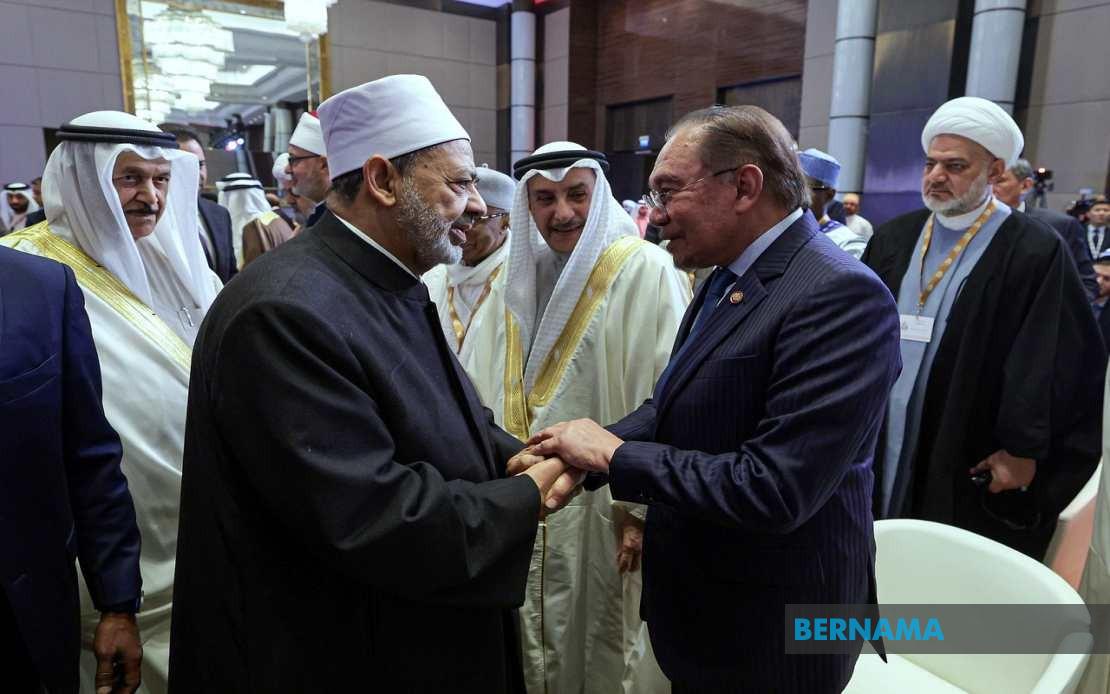
Prime Minister Datuk Seri Anwar Ibrahim has expressed strong admiration for Prof Dr Ahmad Muhammad Ahmad Al-Tayyeb, the Grand Imam of Al-Azhar Al-Sharif, recognising him as one of the most prominent contemporary voices championing the wasatiyyah approach—a principle of Islamic moderation and balance—in navigating today's complex global challenges. In remarks contained within a tribute book launched earlier this year by the Muslim Council of Elders to commemorate Al-Tayyeb's 80th birthday, Anwar emphasised the scholar's unwavering commitment to strengthening cohesion across the Muslim world whilst fostering compassion, mutual respect, and peaceful coexistence between adherents of different faiths.
The Prime Minister's public recognition of Al-Tayyeb carries particular significance for Malaysia, a nation built on constitutional principles of multiculturalism and interfaith cooperation. By elevating the Grand Imam's moderate approach to international prominence, Anwar positions Malaysia as aligned with a leading voice in contemporary Islamic thought—one that explicitly rejects extremism and radical interpretations whilst simultaneously defending core Muslim interests and dignity. This alignment reflects Malaysia's own constitutional framework, which protects religious freedom whilst establishing Islam's constitutionally special position.
Anwar highlighted Al-Tayyeb's remarkable intellectual vigour and relevance despite his advanced age, noting that the octogenarian scholar continues to engage actively with pressing contemporary issues that extend well beyond institutional or sectarian confines. This sustained engagement across diverse domains—from theology to politics to social cohesion—demonstrates how Islamic scholarship can address modern complexities without compromising religious principles. For Malaysian audiences, this underscores the importance of intellectual leadership that bridges tradition and modernity, a balance Malaysia itself strives to achieve.
A cornerstone of Al-Tayyeb's influence, according to Anwar, lies in his embodiment of moderate principles through both scholarship and personal conduct. Rather than merely articulating theoretical positions on moderation, the Grand Imam demonstrates these values through his lived example, lending credibility to his advocacy. Anwar noted that Al-Tayyeb defends the position and principles of the Muslim ummah with intellectual rigour whilst consistently maintaining a measured, wise approach to contemporary dilemmas—a distinction that separates principled advocacy from extremism.
Interfaith dialogue represents another dimension through which Al-Tayyeb has exercised considerable influence. Anwar specifically referenced the Grand Imam's pivotal role in signing the Human Fraternity Document alongside Pope Francis in Abu Dhabi in 2019, a landmark agreement that articulates a shared vision of faith-based coexistence and mutual human dignity. For Malaysia's diverse population, which includes substantial Christian, Buddhist, Hindu, and other faith communities, such high-profile interfaith initiatives carry practical implications—they normalise cooperation and reduce the risk of sectarian polarisation.
The Human Fraternity Document itself represents a significant diplomatic and theological achievement. Rather than papering over genuine theological differences between Islam and Christianity, the document acknowledges distinct faith traditions whilst establishing common ground on universal values: the sanctity of human life, the importance of justice, and the imperative of mutual respect. By championing this framework, Al-Tayyeb has contributed to a global discourse that permits religious distinctiveness alongside civic harmony—precisely the model Malaysia's Constitution attempts to institutionalise.
Anwar's tribute suggests that the wasatiyyah principle, often invoked in Malaysian political discourse, finds authoritative support in one of Islam's most prestigious institutions. Al-Azhar University, with its centuries-old tradition of Islamic learning and its influence across the Muslim-majority world, carries substantial theological authority. When its Grand Imam advocates moderation and interfaith cooperation, this position gains resonance beyond Malaysia's borders and among Muslim communities globally, potentially influencing how Islam is understood and practised internationally.
The political context of Anwar's praise warrants consideration. As Prime Minister of a multicultural nation, Anwar has consistently emphasised the compatibility between strong Islamic commitment and democratic governance, religious pluralism, and women's rights. His public commendation of Al-Tayyeb reinforces this positioning, suggesting that leading Islamic voices worldwide support this vision rather than rejecting it as westernised compromise. This has implications for Malaysia's domestic political discourse, where accusations that moderate positions represent betrayal of Islam persist among more conservative constituencies.
Furthermore, the tribute book project itself—compiled by the Muslim Council of Elders to document Al-Tayyeb's legacy—indicates institutional recognition of his significance. The inclusion of testimonials from religious leaders and international thinkers suggests broad-based acknowledgement of his contributions across diverse constituencies. Anwar's participation in this project positions Malaysia and its Prime Minister within an international network of Islamic and interfaith leaders committed to moderation and dialogue.
The emphasis on Al-Tayyeb's role in promoting values applicable to multicultural societies carries direct implications for regional stability. Southeast Asia, home to diverse Muslim-majority and Muslim-minority nations, faces ongoing tensions between competing visions of Islam's political role and relationship with secular governance. Having a universally respected Islamic scholar advocate for moderation and interfaith harmony strengthens the hand of regional leaders pursuing similar paths and provides intellectual scaffolding for defending these approaches against criticism from more rigid interpretations.
Anwar's recognition of Al-Tayyeb also reflects the Prime Minister's own intellectual orientation. Known for his Islamic credentials—he studied at Al-Azhar himself during his earlier years—Anwar draws on his personal connection to the institution to establish authenticity when discussing moderate Islam. This background allows him to argue for pluralism and democracy not as secular impositions but as compatible with, and even required by, authentic Islamic principles properly understood.
Looking forward, the continued prominence of figures like Al-Tayyeb and the explicit endorsement of their moderate approach by leaders like Anwar suggests that the intellectual battle within Islam between competing visions of the faith's relationship to modernity, pluralism, and governance remains contested but not predetermined. The outcome of this struggle will significantly shape not only Malaysia's political future but also the character of Muslim-majority governance across Southeast Asia and beyond, making the championing of moderate voices at the highest political levels strategically important for regional peace and prosperity.

