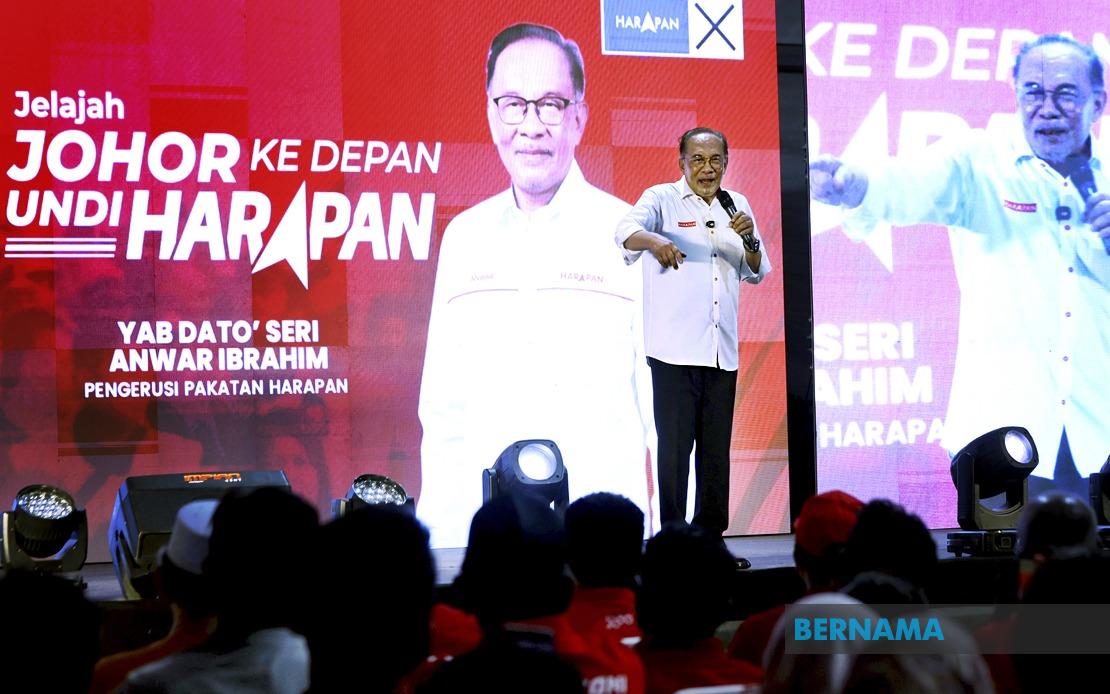
Prime Minister Datuk Seri Anwar Ibrahim has drawn a definitive line under what he describes as Malaysia's "culture of plunder," announcing that his administration will tolerate no exceptions when it comes to official misconduct. Speaking at a political rally in Sungai Mati, Muar during the Johor State Election campaign on July 5, Anwar made clear that the era of using government power to enrich cronies, family members and business associates has ended permanently under the MADANI Government's watch.
The central thrust of Anwar's message placed integrity at the forefront of leadership standards, transcending racial and religious boundaries. He articulated a vision of governance where competence and honesty form the bedrock of public service, rejecting the notion that leadership quality should be assessed through communal or ethnic lenses. This framing is significant for a nation where political discourse has historically become entangled with identity politics. By emphasizing that he seeks "Malays who are good, honest and not corrupt" alongside "Chinese who are good and not corrupt," Anwar sought to reposition the corruption debate away from protection of particular groups and towards universal accountability standards.
The Prime Minister's remarks carried particular weight given Malaysia's long struggle with institutional graft at multiple governance levels. He emphasized that the administrative system remains tainted by "entrenched corrupt practices," a candid acknowledgment that reform requires deep structural change rather than superficial gestures. Anwar framed the government's central mission as recovering every ringgit of the nation's wealth that might otherwise be diverted through illicit channels, positioning anti-corruption efforts not as a moral crusade alone but as essential fiscal discipline to fund national development and restore global confidence in Malaysian institutions.
Specifically, Anwar targeted the practice of weaponizing government contracts for personal enrichment, a pattern that characterized previous administrations. He painted this as fundamentally incompatible with national progress, suggesting that countries plagued by such practices struggle to earn international respect and investment. This framing connects anti-corruption to Malaysia's economic competitiveness, an angle that extends the debate beyond domestic politics into questions of the nation's standing in regional and global markets.
The Prime Minister's assurance that "no one would be protected by the government if found to be involved in corruption" during his tenure represents a clear statement of accountability without exception. This pledge becomes important in a context where previous governments faced accusations of selective prosecution and protecting politically connected individuals. By positioning himself as willing to act against corruption regardless of perpetrators' standing or connections, Anwar sought to demonstrate a fundamental break from patronage-based governance patterns.
Anwar also addressed what he characterized as opposition attempts to weaponize political divisions for narrow advantage. He suggested that current efforts to create political pressure stem from personal agendas to recapture federal power rather than genuine governance concerns. This counterattack frames the corruption narrative within broader electoral competition, where different political coalitions dispute not only policy but the very legitimacy of their rivals' governance records.
The campaign event, which constituted Anwar's eighth engagement on that particular day across Johor, underscored the intensity of the ruling coalition's push ahead of the state election scheduled for July 11, 2024. The timeline suggests a compressed campaign period designed to maximize mobilization among voters who would determine control of 56 state seats contested by 172 candidates. Early voting was set for July 7, compressing the decision window further. This frenetic pace reflects the electoral significance of Johor, a large and strategically important state whose composition has shifted politically in recent years.
Also present at the Sungai Mati rally were Penang Chief Minister Chow Kon Yeow and Ledang Member of Parliament Syed Ibrahim Syed Noh, suggesting coordination among Pakatan Harapan's leadership ranks to project unified messaging. The presence of a state-level administrator alongside federal figures demonstrated the coalition's strategy of combining national narrative frameworks with localized political presence.
For Malaysian voters weighing their electoral choices, Anwar's anti-corruption messaging carries implications that extend beyond rhetoric. The assertion that leaders lack integrity provides a lens through which to evaluate competing claims about competence and suitability. His explicit framing—that voters should judge leaders on integrity and honesty rather than political rhetoric designed to conceal past misconduct—invites critical scrutiny of all political players' historical records, including his own coalition partners.
The broader regional context matters here as well. Southeast Asian nations have grappled collectively with governance challenges and corruption concerns that affect investor confidence, development outcomes, and public trust in institutions. Malaysia's demonstrated commitment to addressing these issues influences how regional peers approach similar challenges and signals whether ASEAN's largest economies are moving toward or away from institutional reform.
Anwar's consistent emphasis on generation-to-future implications—urging Johor voters to protect prospects for the next generation by rejecting leaders lacking integrity—frames electoral choice as a long-term investment rather than short-term political calculation. This argument appeals particularly to younger voters and parents concerned about institutional quality affecting their children's opportunities.
The stakes extend beyond the 56 Johor seats at issue. Control of the state carries symbolic weight within Pakatan Harapan's broader project to consolidate power and demonstrate effective governance. Should the ruling coalition perform strongly, it would validate their anti-corruption messaging and suggest voter confidence in their reform agenda. Conversely, setbacks might suggest that voters doubt the authenticity of reform promises or that opposition parties retain residual support despite being out of federal office.
As Malaysian democracy continues evolving following the 2022 federal election that brought the MADANI Government to power, the interaction between campaign promises and governance delivery remains crucial. Anwar's zero-tolerance positioning on corruption establishes a clear standard against which his administration's performance will be measured—one that ordinary Malaysians, civil society watchdogs, and international observers will be watching closely in the months and years ahead.

