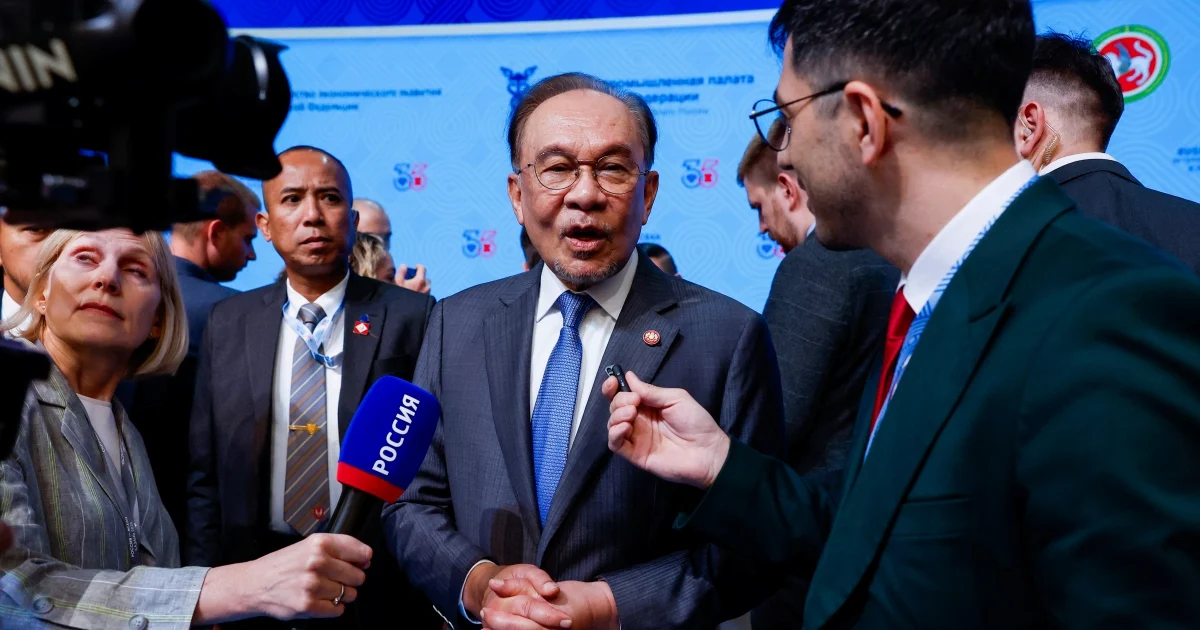
Prime Minister Datuk Seri Anwar Ibrahim has articulated a nuanced vision of international relations that places cultural engagement on equal footing with economic cooperation, arguing that the strengthening of ties between nations requires more than commercial transactions alone. Speaking during his engagement in Kazan, the Prime Minister disclosed his personal appreciation for Russian musical traditions and literary heritage, using his own tastes as a lens through which to examine how societies connect across borders and ideological divides.
The remarks represent a subtle but important diplomatic signal from Malaysia's leadership about the nature of bilateral and multilateral engagement in the contemporary geopolitical landscape. By elevating the discussion of cultural exchange to the level of formal diplomatic dialogue, Anwar is positioning Malaysia as a nation that values intellectual and artistic dimensions of international partnership, not merely transactional relationships grounded in trade statistics and investment flows. This approach aligns with Malaysia's historic positioning as a bridge nation in Southeast Asia, one that has traditionally emphasised the integration of diverse cultural and religious traditions within its own borders and extended that philosophy outward in its foreign relations.
Russia and Malaysia have maintained diplomatic relations extending back decades, though the relationship has been characterised more by pragmatic distance than deep institutional integration. The Malaysian Prime Minister's willingness to speak publicly about his appreciation for Russian cultural products suggests an openness to deepening people-to-people connections that might eventually translate into broader cooperation. Such cultural affinities, when acknowledged by leaders, can help create a foundation of mutual understanding that proves resilient during periods of diplomatic or economic tension.
The importance of cultural diplomacy has become increasingly apparent in Southeast Asian statecraft, where nations share complex colonial histories, diverse religious traditions, and varied political systems. Countries like Malaysia that contain multiple ethnic and religious communities understand intuitively that cultural exchange serves functions that formal agreements cannot. Music, literature, and the arts create spaces for dialogue that transcend the rigid structures of official negotiation, allowing citizens and leaders alike to find common ground rooted in human creativity and expression rather than material interest alone.
Anwar's emphasis on literature as a vehicle for connection is particularly significant given Malaysia's own rich literary heritage in both English and Malay. Russian literature, from the towering figures of Tolstoy and Dostoevsky to contemporary authors, has long grappled with questions of identity, morality, and social transformation that resonate across cultures and historical periods. The Prime Minister's engagement with these traditions suggests a leader who approaches diplomacy with intellectual depth and recognises that the books a nation reads and the music it cherishes can reveal as much about its values as any policy statement.
The Kazan visit itself carries significance as Tatarstan, Russia's largest Muslim-majority region, offers a natural point of connection for Malaysia, a predominantly Muslim nation with substantial experience in managing religious diversity. The presence of a major Islamic civilisation within the Russian Federation creates opportunities for Malaysia to explore cooperation on religious affairs, interfaith dialogue, and cultural preservation—areas where Malaysian expertise and experience could prove valuable. By articulating the importance of cultural exchange during this visit, Anwar may be laying groundwork for expanded cooperation in these domains.
Within the Southeast Asian context, Malaysia's engagement with Russian culture carries implications for how the region positions itself in an increasingly multipolar world. As regional countries seek to maintain strategic autonomy while managing relationships with major powers, cultural diplomacy offers a pathway that neither compromises sovereignty nor alienates important partners. Malaysia's traditional approach of maintaining friendly relations across ideological divides, coupled with its commitment to meaningful cultural engagement, provides a model that other ASEAN members might observe and potentially emulate.
The appreciation for Russian music, meanwhile, speaks to the universal language of artistic expression that transcends political systems and geographic boundaries. Music has historically served as a bridge between peoples, and Anwar's public acknowledgment of this reflects a cosmopolitan worldview increasingly necessary in an era of global interconnection. Russian musical traditions, whether classical compositions or contemporary works, represent centuries of artistic achievement that can appeal to listeners across the Islamic and Western worlds alike.
Looking forward, Anwar's remarks suggest that Malaysia under his leadership intends to pursue a more holistic approach to international engagement that values the full spectrum of human civilisation. Rather than reducing diplomatic relationships to purely economic or security calculations, the government appears committed to building friendships grounded in mutual respect, intellectual appreciation, and cultural curiosity. This philosophy, if consistently applied across Malaysia's foreign relations, could enhance the nation's soft power and cement its reputation as a thoughtful, culturally sophisticated actor on the global stage.