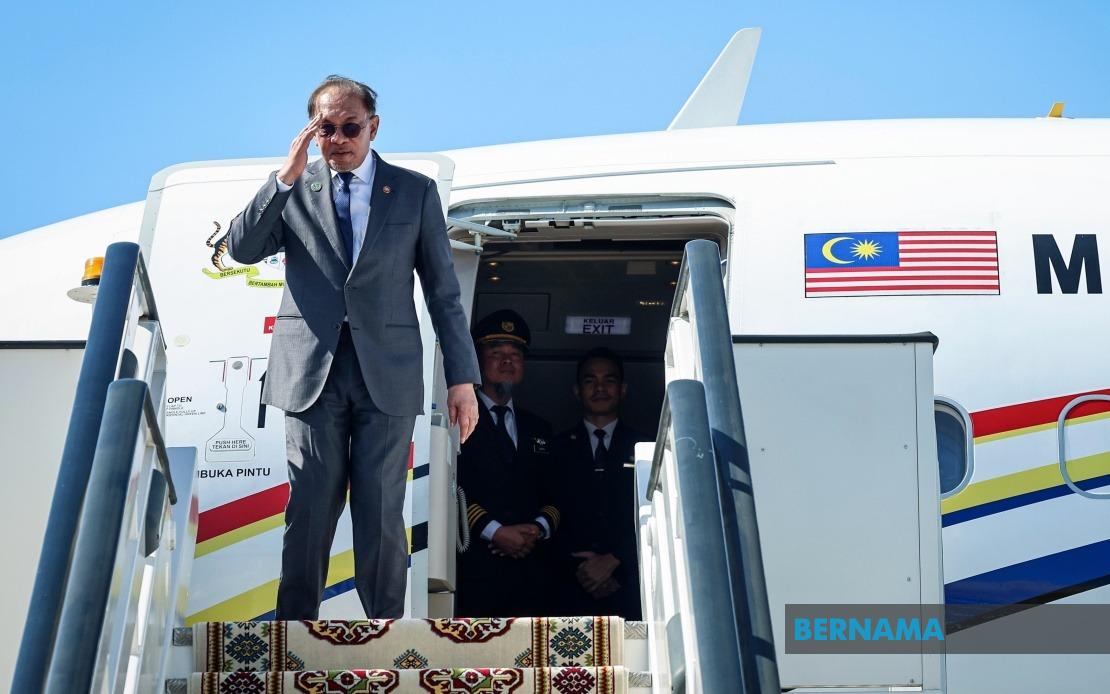
Prime Minister Datuk Seri Anwar Ibrahim transitioned swiftly from diplomatic engagements in Central Asia to domestic commitments, landing in Penang on June 20 to execute a comprehensive schedule that underscored the government's priorities across economic development and media freedom. The transition marked an intensive period of multilateral and bilateral engagement, as Anwar moved directly from concluding his first official visit to Turkmenistan since taking office in November 2022 to address several significant ceremonies and recognition events in Malaysia's northern region.
An aircraft carrying the Prime Minister's delegation departed from Ashgabat International Airport at 4:45 pm local time—equivalent to 7:45 pm Malaysian time—enabling the leader to arrive in Penang in time for engagements beginning the following morning. The Turkmenistan leg represented a historic milestone in bilateral relations, occurring at the invitation of President Serdar Berdimuhamedov and representing Anwar's inaugural state visit to the Central Asian nation. The timing reflected the Prime Minister's balancing act between regional diplomacy and domestic responsibilities, a pattern that has characterised his tenure as Malaysia's 10th Prime Minister.
The Penang visit commenced with an official opening of MKS Instruments Malaysia Sdn Bhd at Bandar Cassia Technology Park in Batu Kawan at 11 am, a facility representing continued foreign direct investment inflows into northern Malaysian manufacturing corridors. The semiconductor and precision instrumentation firm's establishment signalled investor confidence in Penang's industrial ecosystem, particularly within the Batu Kawan free industrial zone, which has emerged as a critical hub for high-technology manufacturing. By inaugurating such facilities personally, the Prime Minister, who also holds the Finance Ministry portfolio, demonstrated direct governmental engagement with attracting and retaining capital-intensive operations essential for long-term economic resilience.
Subsequently, Anwar proceeded to Bandar Setia Fontaines in Kepala Batas to preside over a groundbreaking ceremony for the Setia Fontaines Industrial Park at 1 pm. The project epitomises developer Setia's sustained commitment to catalysing economic activity across Penang and the broader Northern Corridor, a region positioning itself as an alternative investment destination to Selangor's saturated markets. The industrial park represents vertical integration within the Setia Fontaines township development, which combines residential, commercial, and industrial components within a unified masterplan framework. During the ceremony, Setia unveiled two additional strategic collaborations, expanding the township's economic footprint and diversifying revenue streams beyond conventional residential development.
The Northern Corridor Economic Region (NCER) context proves particularly relevant for understanding these industrial announcements. Both Batu Kawan and Kepala Batas fall within NCER's purview, a strategic framework designed to position Penang, Kedah, and Perlis as integrated economic zones capable of competing with established hubs in the Klang Valley. The public visibility of these openings, marked by the Prime Minister's personal attendance, reinforced government messaging regarding commitment to distributing economic opportunities beyond the Selangor-Kuala Lumpur axis—a politically salient distinction given regional sentiments about resource concentration.
The afternoon's centrepiece involved Anwar's attendance at the HAWANA 2026 Grand Finale at PICCA Convention Centre @ Butterworth Arena at 3 pm. The ceremony assembled approximately 1,000 media practitioners from Malaysia and international delegations, making it one of the year's largest convocations of journalism professionals in the region. Organised by the Communications Ministry in collaboration with Bernama (Pertubuhan Berita Nasional Malaysia), HAWANA functions as the pre-eminent recognition platform for honouring journalistic excellence and contributions to informed public discourse within Malaysia's media ecosystem.
During the HAWANA proceedings, Anwar presented the HAWANA Award and Special HAWANA Award to recipients demonstrating exceptional dedication to journalism and advancement of public understanding on critical issues. The Prime Minister also distributed contributions from Tabung Kasih@HAWANA, a welfare fund supporting media practitioners experiencing financial hardship or professional emergencies. This dual emphasis—recognising excellence while providing material support to practitioners—reflected government positioning regarding media as essential infrastructure requiring institutional protection and development. For Malaysian readers, the awards carry significance beyond ceremonial value; they represent official acknowledgment of journalism's role in democratic functioning and public accountability.
Anwar's Turkmenistan journey immediately preceding the Penang visit represented his first state-level engagement with the Central Asian nation since assuming the premiership. The diplomatic initiative signalled Malaysia's broadening engagement patterns beyond traditional Southeast Asian and East Asian partnerships, encompassing Eurasian actors with whom bilateral cooperation encompasses trade, investment, and geopolitical positioning. The timing coincided with Malaysia's ongoing diplomatic activities, including Anwar's recent attendance at the 35th ASEAN-Russia Commemorative Summit in Kazan, where he was accompanied by Investment, Trade and Industry Minister Datuk Seri Johari Abdul Ghani and Economy Minister Akmal Nasrullah Mohd Nasir.
The Kazan summit engagement underscored Malaysia's maintenance of pragmatic relations with Russia despite international polarisation regarding Ukraine, reflecting the ASEAN consensus framework that opposes alignment blocs while preserving dialogue channels. This diplomatic positioning, paired with the Turkmenistan visit, indicated the Prime Minister's strategy of positioning Malaysia as a bridge actor capable of engaging multiple power centres while advancing national economic interests. For regional observers, such multilateral activism demonstrates how Malaysia, despite its medium-power status, leverages diplomatic engagement to influence outcomes affecting trade, investment flows, and strategic positioning in Eurasian affairs.
Following the Penang schedule, Anwar was committed to attending a Himpunan Pertubuhan Lima Generasi (PLG) Malaysia dinner in Negeri Sembilan the same evening, extending his domestic engagements beyond the northern region. The PLG forum represents a strategic constituency of civil society organisations focused on intergenerational dialogue and youth engagement, suggesting the Prime Minister's continued emphasis on cultivating broad-based stakeholder coalitions. This relentless schedule—spanning Central Asian diplomacy, technology manufacturing inaugurations, industrial park groundbreakings, and media recognition ceremonies within consecutive days—illustrated the demanding operational tempo expected of Malaysia's chief executive and the coordination required across multiple governmental and private-sector entities to execute such complex itineraries successfully.

