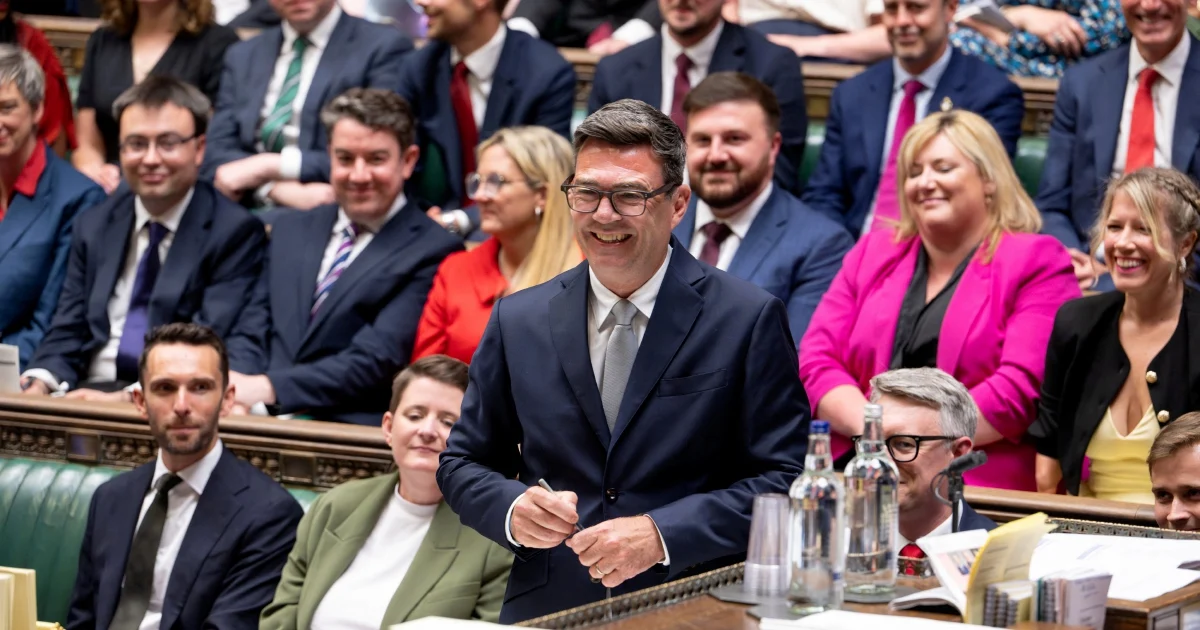
Andy Burnham, the influential mayor of Manchester, appears positioned to become Britain's next Labour leader following Prime Minister Keir Starmer's unexpected resignation announcement on Monday. The development marks a pivotal moment in British politics, with the 57-year-old politician receiving considerable backing within parliament as discussions intensify about the party's future direction and leadership structure.
Burnham has cultivated a formidable political profile over the past two decades, transforming himself from a Westminster insider to the voice of northern England. His journey reflects a deliberate strategy to embed himself as a champion of regional interests, a positioning that has resonated strongly with Labour members and activists who view him as capable of reconnecting the party with working-class communities across the Midlands and the north. This appeal extends beyond traditional Labour heartlands, positioning him as a bridge between metropolitan progressives and struggling industrial regions.
The Manchester mayor's ascent represents a significant shift in Labour's power dynamics. Where Starmer built his leadership on the foundation of managerial competence and institutional respectability, Burnham offers a contrasting vision rooted in populist energy and regional accountability. His tenure leading Greater Manchester has involved high-profile battles with central government over funding disparities, Northern Ireland protections, and devolved authority—battles that have elevated his profile while simultaneously positioning him as a defender of northern interests against what many perceive as London-centric policymaking.
Burnham's record demonstrates consistent political ambition tempered by pragmatic accommodation. He previously contested the Labour leadership in 2015 and 2020, losing both times but accumulating experience and establishing networks within the party apparatus. His previous roles as shadow secretary of state and health minister provide Westminster credentials that distinguish him from regional-only politicians, addressing potential concerns about governance experience among those who might question whether a regional figure can command the machinery of national government.
The broader context of Starmer's departure reveals fractures within Labour's governing coalition. The party's decline in public favour, coupled with internal dissatisfaction about strategic direction and legislative ambitions, created conditions where leadership transition became inevitable. Burnham's emergence as the preferred successor suggests party strategists believe he can arrest Labour's declining trajectory by reconnecting with constituencies alienated during recent years—particularly working-class voters in former strongholds who defected to other parties in successive electoral cycles.
For Malaysia and Southeast Asian observers, Burnham's potential elevation carries implications for Britain's international positioning. A leader rooted in provincial concerns might recalibrate Britain's approach to regional relationships, potentially prioritising economic statecraft over traditional alliance structures. The Asia-Pacific region, increasingly central to global economic competition, would feature prominently in any recalibration of British foreign policy priorities, particularly regarding trade relationships and security architecture.
Burnham's leadership style emphasises negotiation and consensus-building across institutional boundaries. His approach to devolved governance in Greater Manchester involved constructing working relationships with local authorities, businesses, and community organisations—a methodology that could influence how a Burnham-led government navigates the fractious landscape of contemporary British politics. Such collaborative instincts might reshape Westminster dynamics, particularly regarding relationships between central government and regional authorities.
The political timeline remains uncertain, with formal leadership processes likely to unfold over coming weeks. However, Burnham's momentum appears substantial, supported by parliamentary colleagues and regional power brokers within the party structure. His visibility and established policy platforms give him advantages over less-known contenders who might struggle to articulate credible visions for governance.
Burnham's potential premiership would represent an interesting historical moment—the elevation of a politician whose power base exists substantially outside Westminster, whose constituencies are as much about regional identity as party affiliation. This positioning reflects broader trends within contemporary democracy where local and regional governance has become increasingly consequential, and where politicians who demonstrate competence at managing complex regional economies attract national attention.
The coming weeks will determine whether Burnham successfully translates his considerable regional standing into control of the Labour Party apparatus. His previous leadership campaigns provide templates for organisation and messaging, though circumstances have evolved considerably since 2020. The political environment appears more receptive to his messages about regional prioritisation and working-class representation, potentially providing conditions for success his earlier campaigns lacked.

