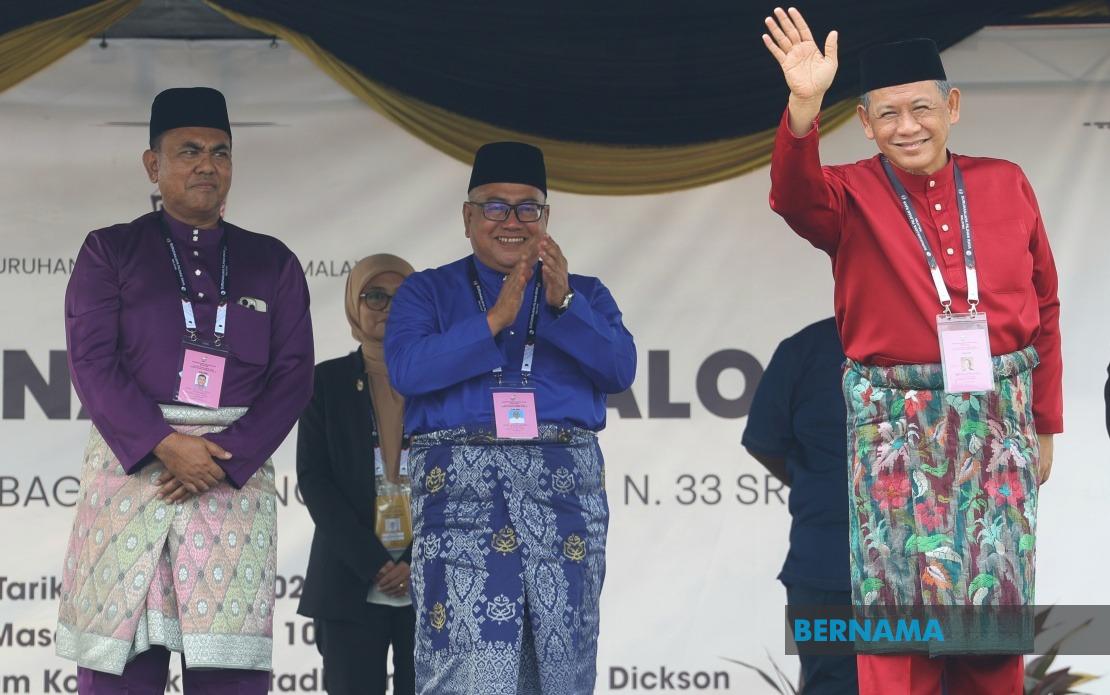
Negeri Sembilan's Menteri Besar Datuk Seri Aminuddin Harun faces a competitive showdown in his bid to retain the Linggi seat, with the 16th state election drawing into sharper focus following the close of nominations on July 18. The Pakatan Harapan leader must contend with not just the sitting Barisan Nasional assemblyman Datuk Mohd Faizal Ramli, but also a challenge from Bersatu's Datuk Zamri Md Said, creating a complex electoral contest that reflects broader political fragmentation across the state.
The nomination process, concluded at the Port Dickson District Administration Complex Auditorium, revealed a state election shaping up as a genuine test of voter sentiment across multiple constituencies. Returning officer Nurhazelin Makli released the full slate of candidates, confirming what had been anticipated: that this election would pit the ruling coalition against a combination of traditional opposition and newer political forces jockeying for influence.
The Linggi contest encapsulates the broader challenge facing Aminuddin and his government heading into polling day on August 1. While he has governed the state as MB during his party's tenure under Pakatan Harapan, defending his own seat requires a ground-level political organisation that extends beyond state-level governance. The presence of Bersatu as a competing force adds particular complexity, given that the party operates within Malaysia's fractious political landscape where regional and ideological divisions frequently override traditional coalition loyalties.
Elsewhere across the state, the electoral contests reveal similarly contested battles. In Sri Tanjung, incumbent Pakatan Harapan assemblyman Dr G. Rajassekaran must fend off challenges from both Barisan Nasional's A. Achutan and Bersatu newcomer Leevineshwaraan Murugan, suggesting that no Pakatan seat can be regarded as secure. The Lukut division presents a different dynamic, where sitting Pakatan representative Choo Ken Hwa faces pressure from Perikatan Nasional candidate Sathes Kumar Nilameham alongside independent aspirant Teo Seng Lee, indicating that opposition forces are not necessarily consolidating around a single banner.
The Bagan Pinang constituency offers perhaps the clearest signal of Pakatan's competitive ambitions, with the coalition mounting a direct challenge to incumbent Pas assemblyman Abd Fatah Zakaria through Nasir Raman, while Bersatu's Sheikh Junaidy Jamaludin complicates the race further. This dynamic—where multiple non-Barisan forces compete against each other—underscores how Malaysian electoral politics has evolved away from straightforward two-coalition contests toward more fluid, multi-party competition.
By contrast, the Chuah seat presents perhaps the state's most straightforward matchup: a direct confrontation between Pakatan incumbent Yew Boon Lye and Barisan Nasional's Pau Jeou Ching, devoid of third-party interference. Such contests remain notable precisely because they have become less common, with voters and political parties increasingly fragmenting across a wider spectrum of choices.
The Election Commission has established August 1 as the date for Negeri Sembilan voters to render their verdict, with early voting provisions scheduled for July 28. This timeline allows campaigns approximately two weeks to mobilise support, a compressed schedule that places premium on existing ground organisation and voter recall of recent governance performance.
The electoral roll reflects a substantial voter base across the state. In total, 889,490 registered voters are eligible to participate, comprising 867,151 ordinary voters alongside 16,884 military personnel and their spouses and 5,455 police personnel and their spouses. This composition matters for political calculation, as security forces voting patterns have historically tilted toward establishment parties, potentially providing baseline support for either Barisan Nasional or incumbent Pakatan candidates depending on local circumstances and institutional relationships.
For Aminuddin and Pakatan Harapan more broadly, the Negeri Sembilan election represents a significant test of their ability to consolidate support in a state where they have held the chief executive position. The fragmentation evident across multiple constituencies—with Bersatu and Perikatan Nasional contesting seats that might otherwise default to straight contests between government and opposition—complicates the narrative. It remains uncertain whether these third-force candidacies will primarily damage Pakatan's position or spread anti-establishment votes sufficiently to advantage the incumbent coalition in tight races.
The Linggi contest featuring Aminuddin carries particular symbolic weight. As Menteri Besar, he represents Pakatan's broader governance claims in the state, and losing his own seat while retaining state government would undermine both his personal political standing and the coalition's narrative of voter endorsement. Conversely, a comfortable personal victory combined with state-level success would provide Pakatan with momentum heading into potential federal-level political manoeuvring, given the significance of state-level power distribution in Malaysian coalition politics. The August 1 polling will clarify which trajectory the state's voters prefer.

