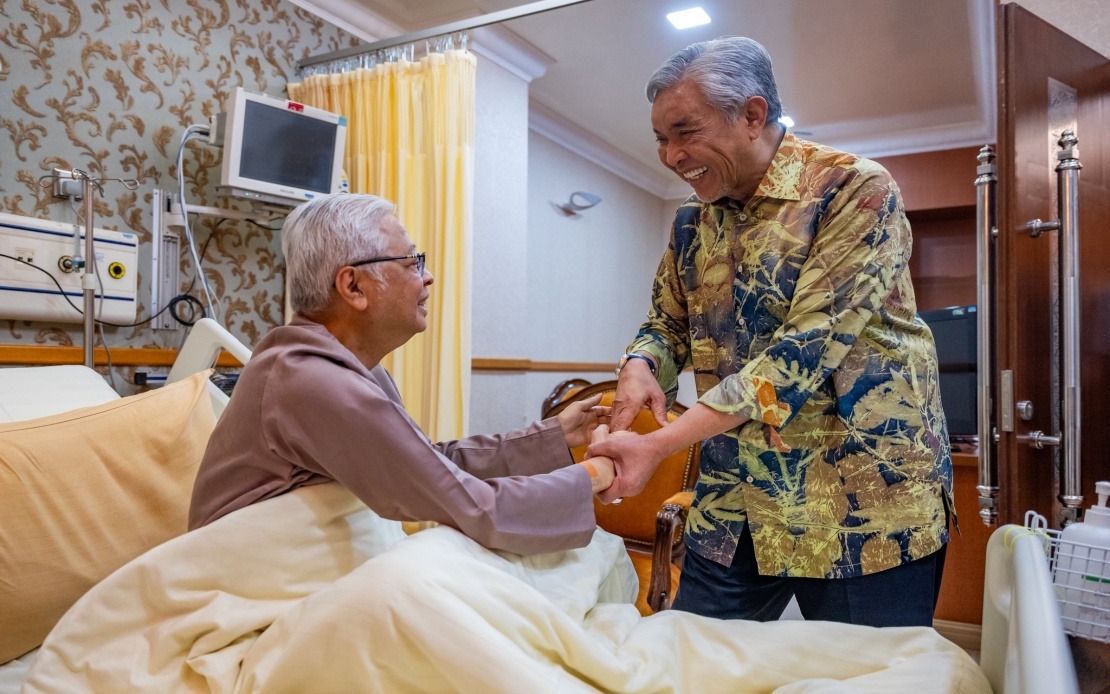
Deputy Prime Minister Datuk Seri Dr Ahmad Zahid Hamidi made a personal visit to the National Heart Institute in Kuala Lumpur on August 10 to check on the wellbeing of former Prime Minister Datuk Seri Ismail Sabri Yaakob, who is currently hospitalised for cardiac treatment. The visit underscores the continued bonds within Malaysia's political leadership circle, even as the nation navigates a complex and often fractious political landscape where personal relationships have historically carried significant weight in national governance.
Through a statement posted on social media platform X, Ahmad Zahid conveyed his warm wishes for his former premier's recovery, emphasising prayers for sustained health and divine assistance in overcoming the current health challenges. The deputy prime minister expressed hope that Ismail Sabri would regain sufficient strength to resume his full range of personal and official responsibilities in the coming weeks. Such public gestures of solidarity between senior political figures serve an important symbolic function in Malaysian politics, demonstrating unity at the highest levels of government and reassuring the public about the stability of the nation's leadership structure.
Ismail Sabri's hospitalisation followed an unexpected health episode on August 6 when he experienced cardiac symptoms while attending the Malaysian Anti-Corruption Commission headquarters in Kuala Lumpur for a scheduled statement recording session. The incident prompted immediate medical intervention, with medical personnel transporting him directly to the National Heart Institute, where cardiologists assessed his condition and determined that surgical intervention would be necessary. The timing of the health issue, occurring during an MACC visit, naturally drew media attention given the high-profile nature of the former prime minister's involvement in various ongoing investigations.
At the institute, specialists performed a procedure to implant a wireless pacemaker device, a minimally invasive technological advancement that addresses abnormal heart rhythms without requiring traditional surgical approaches. This particular type of pacemaker represents a significant step forward in cardiac care, offering patients improved mobility and reduced infection risk compared to conventional pacemaker systems. The successful implantation suggests that Ismail Sabri's condition, while requiring intervention, was identified and treated promptly, which typically results in favourable long-term health outcomes for patients in Malaysia's well-equipped private hospital system.
The National Heart Institute, where Ismail Sabri received care, stands as one of Southeast Asia's leading cardiac treatment centres, equipped with state-of-the-art diagnostic and interventional capabilities. The institution attracts patients from across the region seeking specialised cardiac treatment, reflecting Malaysia's growing reputation as a medical tourism destination. For a former prime minister of Malaysia, treatment at IJN represents access to world-class medical expertise and facilities, though the incident also highlights how even Malaysia's most prominent public figures remain vulnerable to sudden health complications that can disrupt their official schedules and commitments.
The public nature of Ahmad Zahid's visit and subsequent communication about Ismail Sabri's condition reflects customary Malaysian political culture, where senior leaders regularly acknowledge colleagues' personal milestones and challenges through formal visits and public statements. Such rituals help maintain the cohesion essential to Malaysia's coalition-based political system, where former adversaries often must work together across parliamentary sessions and government formations. In this context, Ahmad Zahid's gesture transcends mere courtesy, representing a practical investment in the personal relationships that underpin Malaysia's often delicate political equilibrium.
Ismail Sabri's tenure as Prime Minister, which lasted from August 2021 to August 2022, occurred during a particularly turbulent period in Malaysian politics marked by competing coalitions and shifting parliamentary majorities. His brief administration navigated the tail end of pandemic-related economic disruptions while attempting to consolidate government support in a fractionalised parliament. Since leaving office, he has maintained a lower public profile, though his involvement in various MACC investigations has kept him intermittently in the news cycle, particularly regarding matters predating his premiership.
The cardiac incident serves as a poignant reminder of the physical and psychological demands placed upon Malaysia's senior political leaders, many of whom operate in high-stress environments with irregular schedules and significant public pressure. Healthcare-related absences of prominent political figures can create temporary uncertainty in government functioning, though in Malaysia's parliamentary system, such contingencies are typically managed through established succession protocols and delegation arrangements. Ahmad Zahid's assumption of additional responsibilities during any extended absence by Ismail Sabri from his parliamentary duties would proceed according to established constitutional frameworks.
Looking forward, Ismail Sabri's recovery trajectory will be closely monitored both by his immediate political circle and by broader Malaysian public opinion, which frequently tracks the health status of former heads of government. The successful implantation of the wireless pacemaker and Ahmad Zahid's affirmation of his political colleague's prospects suggest an optimistic near-term outlook. Medical advances in cardiac care have substantially improved outcomes for patients with rhythm abnormalities, and Ismail Sabri's prompt access to specialist treatment places him well within the cohort of patients typically experiencing full functional recovery within weeks of the procedure.

