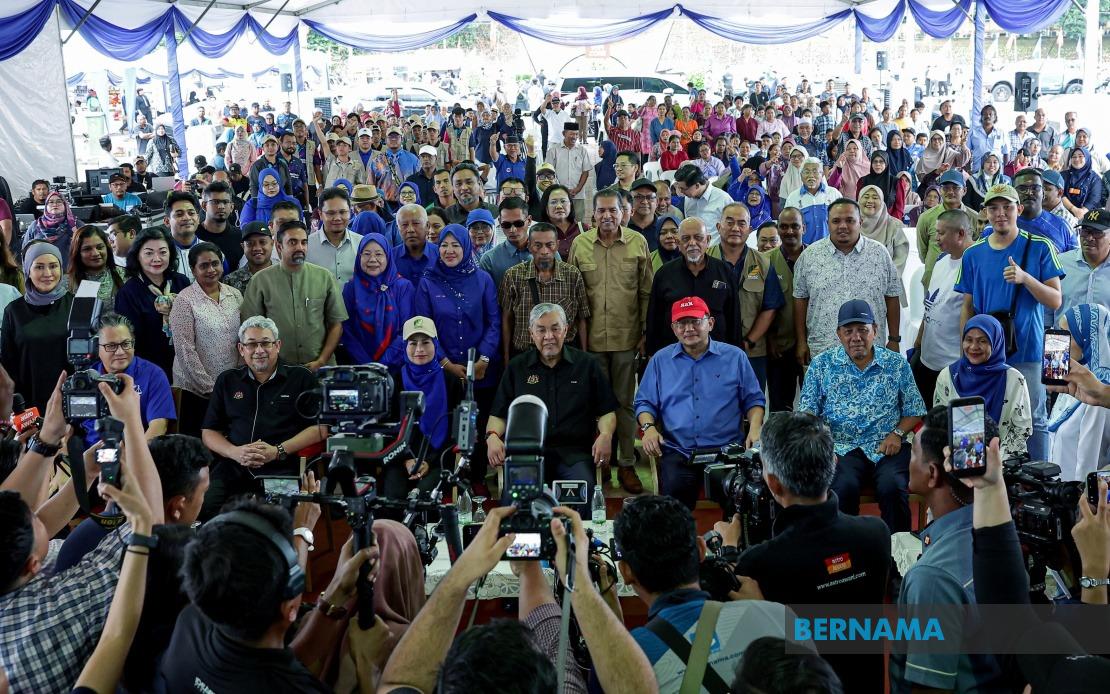
Deputy Prime Minister Datuk Seri Dr Ahmad Zahid Hamidi has made an emphatic appeal to every political party contesting the 16th Negeri Sembilan State Election to steer clear of inflammatory campaigning centred on race, religion, culture and social identity. Speaking after attending the Salam Agrikomoditi MADANI programme at Dataran Melang in Kuala Pilah on July 25, Ahmad Zahid stressed that political contestants must adhere to strict ethical boundaries and maintain decorum throughout the campaign period, which began ahead of early voting on July 28 and general polling on August 1.
The Barisan Nasional chairman articulated a vision where political discourse remains grounded in substantive governance rather than divisive identity politics. He contended that national and state-level leaders bear a collective responsibility to uphold professional standards of conduct, emphasising that the federal government's Unity Government framework should serve as a model for respectful political competition even at the state level. This message carries particular weight given Malaysia's history of sensitive communal dynamics and the need to preserve social cohesion during election campaigns.
Ahmad Zahid's position reflects broader efforts within the BN leadership to establish clearer boundaries around campaign behaviour. He acknowledged that while political differences inevitably emerge and varied viewpoints deserve expression, there exists a civilised methodology for articulating disagreement without resorting to character assassination or inflammatory rhetoric. The deputy prime minister contrasted constructive policy debate—focused on measurable benefits to constituents—with the temptation to attack individuals or invoke contentious historical grievances to mobilise voters.
The call for ethical restraint assumes significance in the context of Malaysia's electoral landscape, where state elections frequently become proxy battles reflecting national political tensions. By positioning the appeal as a matter of leadership integrity rather than a narrow partisan advantage, Ahmad Zahid attempted to create a shared standard applicable equally to all competing parties. This framing allows BN to claim the high ground while simultaneously signalling to other coalitions that any departure from these standards would represent a violation of collectively endorsed norms.
In a parallel statement from Johor, UMNO vice-president Datuk Seri Mohamed Khaled Nordin provided clarification regarding the strategic understanding between Barisan Nasional and Perikatan Nasional in selected Negeri Sembilan constituencies. Mohamed Khaled explicitly denied that this arrangement constituted any merger or fundamental shift in party alignment, characterising it instead as a tactical coordination mechanism designed to prevent wasteful multi-cornered contests. This distinction matters significantly for party members and voters seeking clarity on whether such cooperation signals deeper ideological convergence.
The BN-PN arrangement in Negeri Sembilan represents a pragmatic calculation by both coalitions to optimise electoral efficiency in a state where the outcome remains genuinely competitive. By avoiding three-way splits between BN, PN, and Pakatan Harapan-linked candidates, both larger coalitions increase their chances of capturing additional seats from the opposition. For Malaysian politics more broadly, such seat-sharing agreements have become increasingly common as coalitions attempt to consolidate anti-incumbent support or consolidate pro-government votes depending on local circumstances.
Ahmad Zahid simultaneously reaffirmed Barisan Nasional's unwavering commitment to supporting Prime Minister Datuk Seri Anwar Ibrahim's federal administration throughout the current parliamentary term. He explicitly dismissed suggestions that BN harboured intentions to topple the MADANI Government through covert political manoeuvres or backdoor arrangements. This reassurance addresses persistent speculation in political circles about the stability of the federal coalition and whether state election results might presage shifts in national political alignments.
The deputy prime minister's emphasis on the federal government's stability and the inviolability of the Unity Government arrangement signals confidence that BN's electoral performance in Negeri Sembilan will not fundamentally alter national political configurations. Whether BN gains additional seats or cedes ground to opposition parties, Ahmad Zahid's messaging suggests that such outcomes will not trigger coalition realignments at the federal level. This stability provision offers investors, policymakers, and international observers some reassurance regarding the predictability of Malaysia's political trajectory.
For Negeri Sembilan voters, the campaign environment Ahmad Zahid described reflects deliberate attempts by major political actors to maintain minimal standards of public discourse civility. The state election, scheduled to conclude on August 1, will test whether parties genuinely adhere to these commitments or whether the intensity of electoral competition overrides proclaimed ethical standards. The presence of Plantation and Commodities Minister Datuk Seri Dr Noraini Ahmad at the Kuala Pilah event underscored BN's organisational mobilisation across multiple governmental portfolios.
The election represents a significant electoral moment for Negeri Sembilan, determining the composition of the state assembly and the direction of state administration. For Malaysian observers tracking broader political trends, the contest provides valuable indicators regarding voter sentiment toward the Unity Government arrangement and whether recent economic challenges have eroded public support for the BN-anchored federal coalition. Early voting on July 28 and the August 1 general poll will offer concrete evidence of these dynamics.
Ahmad Zahid's intervention in the campaign discourse establishes a clear benchmark against which subsequent campaign conduct can be measured and evaluated. Should political parties subsequently resort to the identity-based appeals and character attacks he cautioned against, observers can point to the deputy prime minister's explicit prohibition as evidence of broken commitments. The appeal thus creates both a normative framework and a mechanism for accountability, even if enforcement mechanisms remain limited.
Ultimately, Ahmad Zahid's message reflects an institutional judgment that Negeri Sembilan's election will proceed most constructively when anchored in substantive policy disagreements rather than communal polarisation. Whether competing parties genuinely respect this framing will become apparent as the campaign intensifies toward the August 1 polling date. The outcome will likely influence whether similar appeals for campaign civility gain traction in future Malaysian electoral contests at state and national levels.

