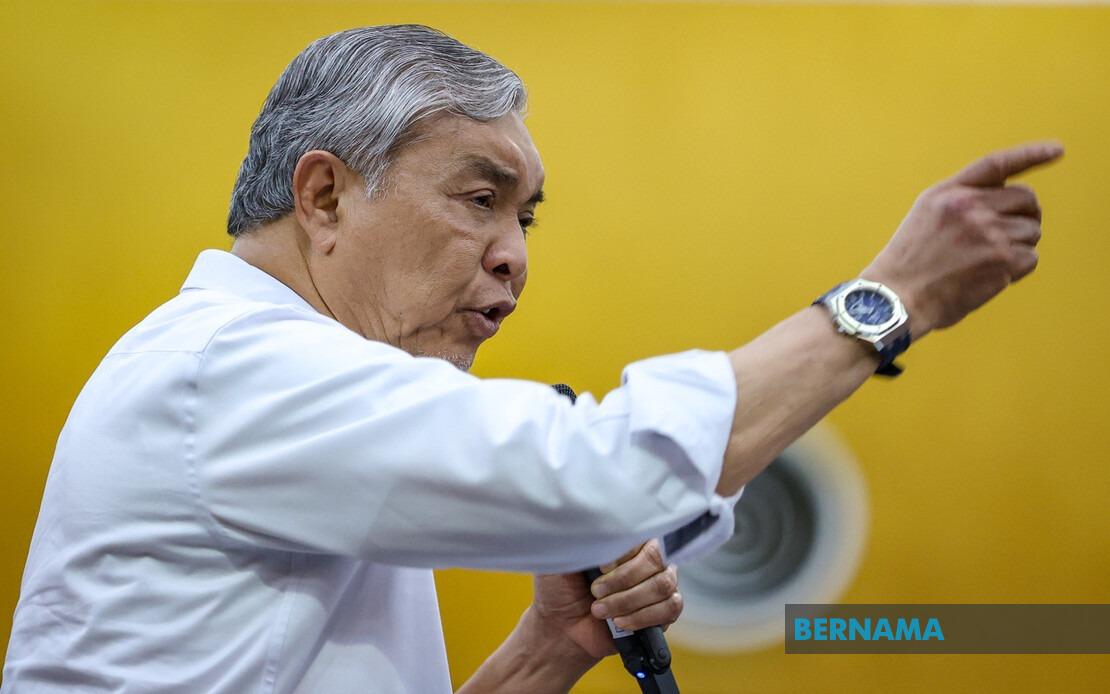
Deputy Prime Minister Datuk Seri Dr Ahmad Zahid Hamidi has proposed a structured approach to developing political awareness among Malaysia's student leadership, suggesting that Student Representative Councils at higher education institutions should participate in targeted programmes combining leadership training with exposure to the nation's political frameworks. Speaking in Johor Bahru on July 9, Ahmad Zahid outlined his vision for a more politically informed generation of young leaders who could grapple meaningfully with the country's evolving challenges and policy debates.
The initiative reflects broader concerns among the political establishment about youth engagement with democratic processes. Rather than expecting students to absorb political knowledge passively, Ahmad Zahid's proposal seeks to create deliberate educational pathways through which campus leaders could develop deeper comprehension of how governance systems function, the mechanisms through which political parties operate, and the substantive policy questions that dominate national conversation. By targeting Student Representative Councils specifically, the proposal aims to reach individuals already positioned as influential voices within their institutional communities.
Ahmad Zahid, who simultaneously holds the chairmanship of Barisan Nasional, emphasised that the federal government stands ready to defray programme costs for participating councils across the country, contingent upon approval from Higher Education Minister Datuk Seri Dr Zambry Abd Kadir. This financial commitment signals official willingness to invest resources in what is framed as essential preparation for young people navigating their earliest experiences as voters and potential political actors. The conditional nature of the offer—requiring ministerial sign-off—reflects bureaucratic protocols while keeping decision-making authority within the education portfolio.
Crucially, Ahmad Zahid articulated a measured position regarding youth political participation, distinguishing between knowledge and activism. He stressed that becoming eighteen and acquiring voting rights does not obligate young citizens to pursue active involvement in party politics. Instead, he advocated for universal political literacy—ensuring that regardless of whether individuals choose partisan engagement, they possess sufficient understanding to make informed electoral choices. This framing attempts to sidestep criticism that such programmes might constitute partisan political recruitment by redefining the objective as foundational civic education rather than mobilisation for any particular party's benefit.
Reflecting on his own trajectory, Ahmad Zahid recalled his early political awakening during his university years at Universiti Malaya, presenting his student activism as an exemplar of how campus leadership positions can serve as launching pads for longer political careers. His personal narrative invokes a traditional model of political progression—from student organisation through to national office—though he notably framed this as one possible path rather than the prescribed outcome of the proposed courses. The implicit suggestion is that exposure to political knowledge during formative years creates conditions enabling ambition if and when it emerges.
The deputy prime minister placed particular emphasis on voting behaviour and the weight that electoral participation carries for political systems and party trajectories. He characterised the decision to cast a ballot as consequential, warning against apathy or treating voting rights as trivial. Each vote, he stressed, contributes to determining which leaders assume office and which ideological or policy directions a political organisation pursues. This messaging appeals to the younger electorate's sense of agency and collective influence, suggesting that their electoral choices matter concretely rather than symbolically.
The timing of these remarks proved significant, with Ahmad Zahid's comments emerging as Johor prepared for state polling scheduled for Saturday, featuring fifty-six state assembly seats in contention. The proximity of the election to his proposal regarding voter education raises questions about whether the initiative should be understood primarily as long-term institution-building or as part of immediate pre-election discourse aimed at encouraging higher youth turnout. Malaysian elections frequently turn on margin considerations in tightly contested seats, and mobilising younger demographics—particularly in an age cohort that has sometimes demonstrated lower propensity to vote—could meaningfully influence outcomes.
For Malaysia's higher education sector, Ahmad Zahid's proposal introduces questions about institutional autonomy and the appropriate scope of political education on campus. Universities have historically navigated tension between their roles as spaces for political learning and development versus concerns about becoming venues for partisan activity or government influence. A nationally mandated curriculum addressing politics and leadership, even if framed in non-partisan language, necessarily involves choices about which topics receive emphasis, whose perspectives are represented, and which interpretations of Malaysian political history and structures become institutionalised in educational practice.
The regional context adds further dimension to considering youth political engagement across Southeast Asia. Many countries in the region face similar challenges regarding younger voters' electoral participation rates and depth of political knowledge. Malaysia's approach—whether it eventually materialises as formal programmes—offers a model, for better or worse, of how governments might intervene in campus life to shape political consciousness. Nations like Thailand, Indonesia, and the Philippines, each grappling with questions about democratic stability and informed participation, may regard Malaysia's experiments with either interest or caution depending on ideological perspectives regarding state involvement in education.
Implementation of any such programme would require navigating significant practical considerations. Designing curriculum that genuinely educates about political processes without veering toward partisan advocacy demands careful attention from educators and programme administrators. Questions would inevitably arise regarding funding transparency, determination of course content, selection of instructors, and mechanisms for ensuring academic integrity. The proposal's success would likely hinge on whether participating institutions view the initiative as enhancing their educational missions or as externally imposed political intervention.
Looking forward, Ahmad Zahid's proposal represents an explicit recognition that Malaysian policymakers identify political disengagement or low political literacy among youth as a concern warranting governmental attention and resource allocation. Whether this concern stems primarily from civic commitment to strengthening democracy or from calculations about electoral advantage—or more likely, a combination of both—the proposal reflects a judgement that Malaysia's current approaches to preparing young citizens for political participation require supplementation. The coming months will indicate whether this proposal advances toward institutionalisation or remains a proposal without follow-through.

