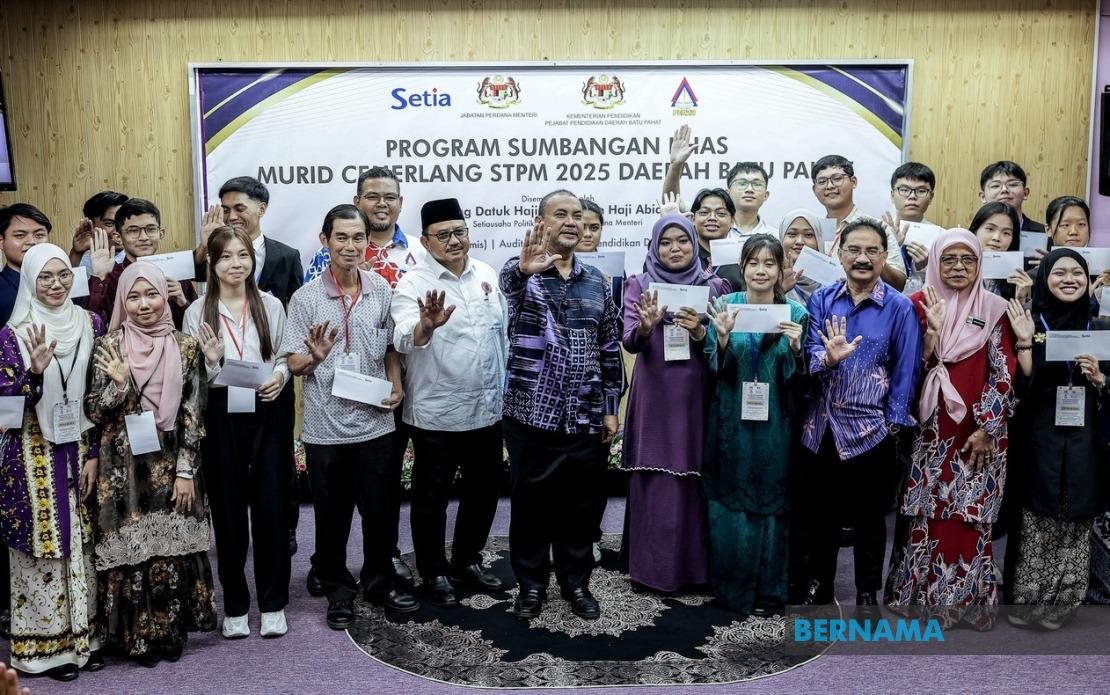
A total of 214 high-performing STPM students across Batu Pahat district received special monetary contributions from the Prime Minister's Office today, marking a government effort to honour outstanding academic achievement and foster pursuit of tertiary education. The recognition ceremony, held at the Batu Pahat District Education Office auditorium, saw Datuk Azman Abidin, Political Secretary to the Prime Minister, present the awards to deserving students drawn from 16 secondary schools throughout the district.
The initiative reflects a deliberate government strategy to invest in human capital development by incentivising excellence at the secondary level and creating tangible motivation for students contemplating their post-secondary options. Rather than treating top performers as merely academic statistics, the programme sends a symbolic message that the state recognises and values intellectual merit. This approach carries particular relevance in Malaysia's competitive education landscape, where STPM results fundamentally shape university admission prospects and career trajectories.
Datuk Azman articulated the underlying philosophy of the awards scheme during his remarks to the assembled students and families. He emphasised that the contributions aim to motivate recipients to sustain their academic performance and transition seamlessly into higher education pathways. Beyond the immediate monetary benefit, he positioned the awards as an opportunity for recipients to model excellence to their peers, creating aspirational value that extends beyond individual recipients to influence school and community culture around educational achievement.
The programme's scope appears deliberately designed for expansion. Datuk Azman indicated that the initiative depends on available funding and that the government intends to scale it to additional districts and localities. This phased approach suggests careful budgeting but also reflects genuine commitment to institutionalising recognition of student achievement across Malaysia's secondary school system. The expansion plan indicates this is not a one-off gesture but rather a component of sustained education policy.
For recipients, the contribution carries multiple layers of significance. Twenty-year-old Afida Auni Airulnizam, a former student of Sekolah Menengah Kebangsaan Tun Sardon in Rengit, articulated how the award functioned both as recognition and motivation. Drawing inspiration from her older brother's university journey, Afida aspires to pursue sports science at tertiary level. The financial support arrives at a critical juncture when students and families face mounting costs associated with university preparation, entrance examinations, and initial enrolment expenses.
The financial dimension of the awards proves particularly meaningful for families managing educational costs across multiple siblings. Muhd Ammar Firdaus Mohd Fadzil, another twenty-year-old recipient from SMK Tun Ismail, directly credited the contribution with alleviating financial pressure associated with preparing for higher education. For middle and lower-income households, such support can remove barriers that might otherwise prevent capable students from accessing university, effectively broadening the socioeconomic diversity of Malaysia's tertiary-educated population.
The focus on STPM achievers specifically targets a critical cohort within Malaysia's education pipeline. STPM students represent the cream of the secondary system, having demonstrated sustained academic excellence across two years of demanding coursework. Yet paradoxically, many high-performing STPM graduates face barriers accessing university slots due to limited domestic places and competition for international scholarships. Government recognition and financial support at this juncture can decisively influence whether top students proceed to tertiary study or pursue alternative pathways.
The involvement of 16 secondary schools across Batu Pahat signals an inclusive approach that distributes recognition beyond single high-performing institutions. This geographical spread prevents concentration of awards among elite schools and acknowledges that academic excellence emerges across diverse school settings. Such distribution carries important symbolic value in affirming that government investment in education development reaches beyond established metropolitan centres.
From a policy perspective, the initiative represents government action on education promotion without requiring major structural reform. By channelling resources directly to motivated high-achievers rather than overhauling systems, the government demonstrates responsiveness to education stakeholder concerns while managing fiscal constraints. The awards scheme complements existing scholarship and loan schemes but operates at an earlier intervention point, influencing decisions about tertiary education participation during the critical window when students finalise their post-secondary plans.
The broader context involves Malaysia's ongoing competition for talent and the recognition that education remains foundational to economic development. As regional competitors intensify investment in student support and educational incentives, Malaysia's willingness to recognise and reward achievement helps retain top talent domestically. International evidence demonstrates that targeted support for high-achieving students at transition points significantly influences university enrolment rates and subsequent professional outcomes.
Looking forward, the expansion of this programme across additional districts will test the government's commitment to sustained education investment and its ability to coordinate awards distribution at scale. Success requires transparent selection criteria, equitable distribution mechanisms, and clear communication about programme objectives. If executed effectively, the scheme could establish a valuable precedent for recognising student achievement while simultaneously addressing financial barriers to higher education access.

