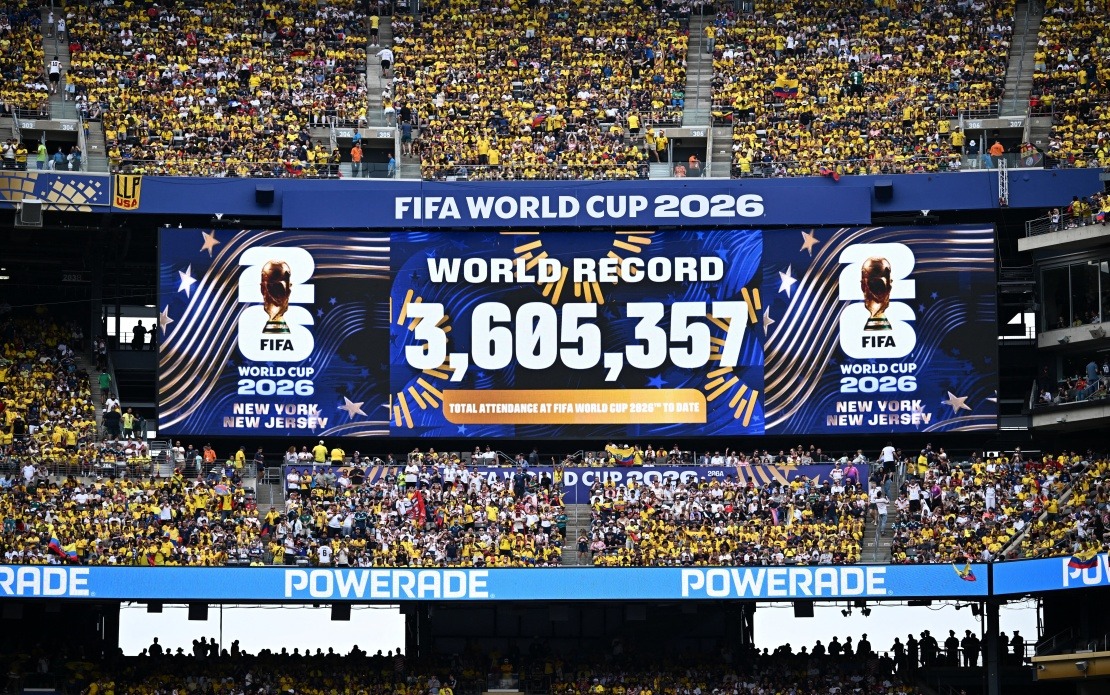
The 2026 FIFA World Cup has achieved a historic milestone by becoming the most-attended tournament in the competition's 96-year history, drawing 3,605,357 spectators and eclipsing the previous benchmark set three decades earlier. The announcement of this record-breaking figure came during the second half of Germany's match against Ecuador in East Rutherford, New Jersey, where the achievement was celebrated with a grand display across the stadium's screens and enthusiastic applause from the gathered crowd.
What makes this accomplishment particularly striking is the timing within the tournament schedule. With 48 matches still remaining to be played across the 16 host cities, the total attendance figures are poised to reach unprecedented heights. Should the current trajectory continue at its present pace, the final aggregate could approach double the 1994 record, fundamentally reshaping expectations around global sporting events and fan engagement. The 1994 tournament, which held the previous record, consisted of just 52 matches in total, meaning the 2026 edition benefits from both an expanded format and extraordinary popular enthusiasm.
The consistency of strong attendance throughout the tournament has been equally remarkable. Venues across the sprawling geographic expanse of the tournament—spread across 16 cities in the United States, Canada, and Mexico—have maintained capacity levels exceeding 99 percent on average. This uniformity across multiple nations and regions underscores the competition's universal appeal and the scale of coordination required to manage such widespread infrastructure and logistics. For Malaysian and Southeast Asian observers, this demonstrates the global appetite for football at its highest level, regardless of geographic or cultural proximity to the competing teams.
FIFA President Gianni Infantino has framed the attendance surge as evidence of football's enduring power to transcend boundaries and foster genuine human connection. In his assessment, the record reflects far more than mere statistics—it encapsulates the sport's capacity to generate moments of authentic celebration and shared joy across diverse populations. The scenes witnessed in stadiums stretching from the Pacific Northwest to Mexico City have illustrated how football functions as a universal language, capable of uniting strangers in collective passion and emotional investment.
The expanded 48-team format, which debuted at this tournament, has fundamentally altered the mathematics of World Cup attendance. By increasing the total number of matches from the traditional 64 to 80, the format creates more opportunities for fans to engage with the competition while also extending the tournament's duration and geographic reach. This structural change, combined with the North American venue's substantial stadium capacities and the region's proven capacity for attracting large sporting audiences, has created ideal conditions for record-breaking attendance figures.
For Southeast Asia, where football commands enormous grassroots enthusiasm despite the region's teams rarely reaching the World Cup stage, the 2026 tournament represents both inspiration and aspiration. The tournament's demonstrated commercial viability and fan engagement validate football's position as the world's preeminent sport. Malaysian fans, accustomed to following the World Cup through media coverage, will note that the tournament's record-breaking success reflects broader trends toward mega-events becoming increasingly spectacular and accessible entertainment experiences.
The geographic distribution of matches across three nations has raised interesting questions about how international sporting events can be structured to maximize both accessibility and economic impact. By spreading venues across the United States, Canada, and Mexico, organizers created numerous regional hubs where fans could access matches without requiring transcontinental travel. This model contrasts with previous tournaments hosted in single nations and offers a template for future mega-events seeking to balance competitive requirements with practical fan logistics.
The sustained high attendance throughout the tournament—rather than the typical pattern where early-round matches attract smaller crowds—suggests that the expanded format has genuinely created compelling matchups at every stage. Earlier World Cup editions often experienced attendance fluctuations based on the prestige of competing teams, with knockout rounds drawing significantly larger crowds than preliminary fixtures. The consistency in 2026 indicates that the broader competitive structure has maintained genuine drama and unpredictability across all phases.
Looking toward the tournament's conclusion, the trajectory established thus far positions the 2026 World Cup to become a watershed moment in sporting history. Officials and observers will scrutinize final attendance figures as indicators of whether this milestone represents a permanent shift in global football consumption or a peak driven by the specific circumstances of North American hosting. The implications extend beyond mere attendance numbers—they speak to the sport's continuing cultural centrality and its capacity to mobilize populations at scales that rival few other human endeavors.
For Malaysian stakeholders in the football ecosystem, from administrators to broadcasters to passionate fans, the 2026 tournament's success serves as both validation of football's universal appeal and a reminder of the sport's capacity to generate economic and social impact at continental scales. As the tournament progresses toward its conclusion, the final attendance tally will likely cement 2026 as a watershed moment in World Cup history, reshaping benchmarks and expectations for generations of international sporting competition.

